
Table of Contents
- Displacement vs Semi-Displacement Yacht Hulls: The Core Differences
- Speed, Performance and Planing Speed Profiles
- Yacht Fuel Consumption Factors: What Hull Type Really Costs You
- Yacht Stability at Sea: Ride Comfort and Rough Water Handling
- Long-Range Cruising Yacht Characteristics and Engine Load
- Environmental Impact, Retrofitting and Resale Value
- How to Choose: A Decision Framework for Buyers
- Frequently Asked Questions
Last Updated: October 2, 2026
Displacement vs Semi-Displacement Yacht Hulls: The Core Differences
Comparing displacement and semi-displacement yacht hulls comes down to one trade-off: a displacement hull pushes through the water at lower speeds with remarkable efficiency, while a semi-displacement hull blends that stability with the ability to accelerate when you need it.
A displacement hull is a vessel design that moves through the water by displacing it, capped by its own waterline length and never rising onto a plane. A semi-displacement hull is a hybrid design that generates partial dynamic lift at speed, letting the vessel exceed displacement speed without fully planing.
How Displacement Hulls Work
These hulls carry their full weight through buoyancy alone. Waterline length sets a hard ceiling on speed, so a longer hull cruises faster without extra horsepower. The payoff is low resistance at cruising pace, which is why long-range cruisers favour this form.
How Semi-Displacement Hulls Work
Semi-displacement hulls use flatter aft sections and a moderate dead rise to create lift as speed builds. That reduces wetted surface and drag, pushing the vessel past displacement speed. The cost is higher engine load and thirstier running at the top end, a trade many owners accept for flexibility.
Speed, Performance and Planing Speed Profiles
The speed difference between these hulls is not a matter of opinion, it is a matter of hydrodynamics. The governing figure is the Froude number, which relates speed to the square root of waterline length. Naval architects divide hull behaviour into three regimes: displacement mode below roughly Fn 0.4, semi-displacement or semi-planing mode between about Fn 0.4 and Fn 1.0, and full planing above Fn 1.0.
A displacement hull sits firmly in the first regime. Its speed is capped by hull speed, the point at which the wavelength of the bow wave equals the waterline length and the vessel effectively sails uphill against its own wave. Adding horsepower past that point mostly creates a bigger wave and a bigger fuel bill, not more speed. This is why a longer waterline, not a larger engine, is the displacement owner’s route to a faster cruise.
A semi-displacement hull is designed to climb out of that trough. Flatter aft sections, a moderate dead rise and often a finer entry generate dynamic lift as speed builds, reducing wetted surface and letting the vessel push past displacement speed. The transition is not linear. Most semi-displacement designs pass through a hump around Fn 0.5 to Fn 0.6 where resistance peaks sharply before lift takes over. That hump is where the vessel feels bow-high, the engines labour and fuel burn spikes. Once past it, the ride settles and efficiency partially recovers.
In practical terms, a displacement motor yacht of a given length typically cruises at a steady, economical pace set by its waterline. A semi-displacement equivalent of similar length can run meaningfully faster at cruise and considerably faster at wide-open throttle, but it will never match a true planing hull, which sacrifices low-speed efficiency and sea-keeping to skim the surface.
- Displacement: steady, efficient, capped by hull speed, no hump to cross
- Semi-displacement: faster cruise, a resistance hump to manage, higher fuel burn at the top end
- Planing: fastest, least efficient at low speed, best for short high-speed bursts
For an owner weighing a relaxed Mediterranean island-hopping itinerary against a long ocean passage, the speed ceiling and the hump behaviour together decide the plan.
Yacht Fuel Consumption Factors: What Hull Type Really Costs You
Yacht fuel consumption factors favour the displacement hull at any steady cruising speed. Lower resistance and reduced engine load mean fewer litres per nautical mile, which extends cruising range on the same tank.
Semi-displacement hulls burn more once they climb past displacement speed. The lift that delivers speed also demands more horsepower, so fuel efficiency drops sharply at the top of the throttle range. Owners who mostly cruise slowly rarely see the penalty; those who run fast pay for it every passage. As a general rule, a displacement hull delivers the best fuel efficiency at low speed, while a semi-displacement hull rewards you only when speed matters more than range.
Yacht Stability at Sea: Ride Comfort and Rough Water Handling
Yacht stability at sea depends on hull form, weight distribution and sea-keeping geometry. Displacement hulls, with their deep forefoot and generous buoyancy, tend to track predictably in a seaway. Semi-displacement designs trade some of that calm for a sharper bow and flatter aft, which can feel livelier in confused chop. Regardless of the hull type chosen, maintaining a balanced load remains essential for performance, a principle that extends to the items detailed in the yacht charter packing guide.
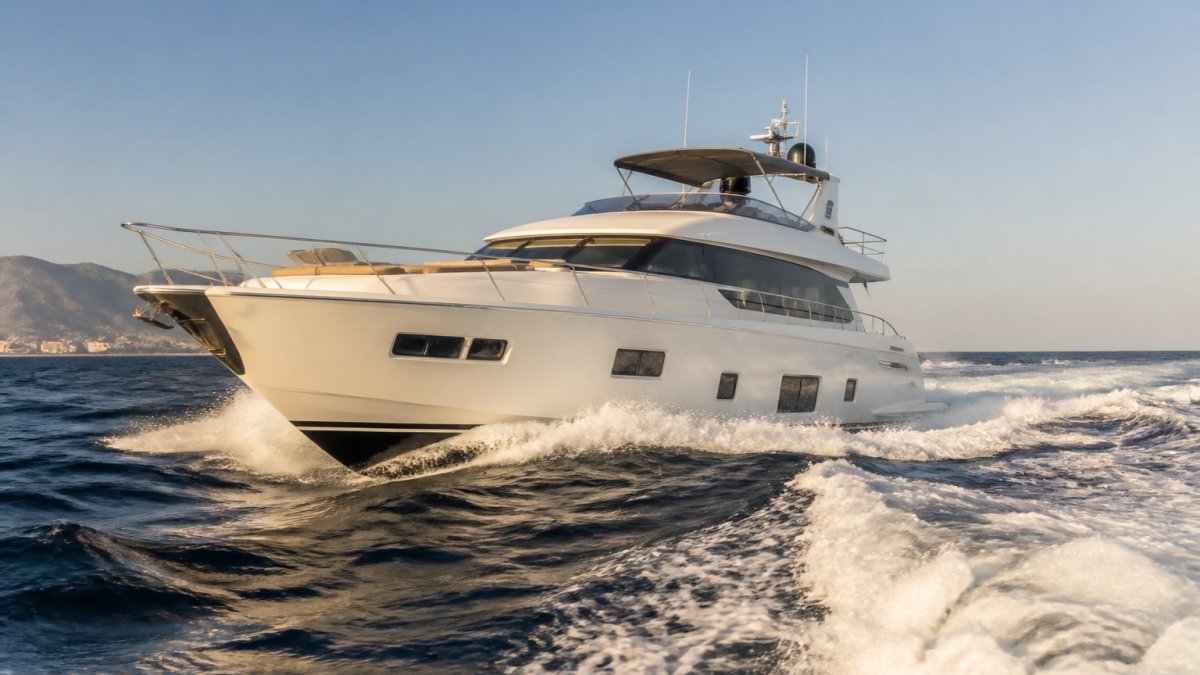
Ride comfort is subjective, but the physics are not. Wetted surface, trim and bow shape all influence how a vessel handles rough water. A well-designed semi-displacement yacht can be exceptionally stable at speed; a poorly balanced displacement hull can feel tender. Hull form matters more than category alone.
Get in touch with us to discuss your yachting needs. →
Long-Range Cruising Yacht Characteristics and Engine Load
Long-range cruising yacht characteristics point firmly toward displacement hulls. Their lower resistance and gentler engine load let them carry modest power plants across vast distances, which is why ocean-crossing trawlers favour the form. Semi-displacement yachts can cruise long distances too, but they typically need more horsepower and burn more fuel to do it.
Environmental Impact, Retrofitting and Resale Value
Carbon Footprint and Emissions
Fuel burn and carbon emissions are directly linked: every litre of marine diesel combusted releases roughly 2.6 to 2.7 kilograms of carbon dioxide, a figure that follows from the carbon content of the fuel itself rather than any particular engine. That means the hull’s efficiency advantage compounds at the environmental level. A displacement hull’s lower resistance and gentler engine load translate into fewer litres per nautical mile, and therefore a smaller carbon footprint per mile travelled. A semi-displacement hull can approach that efficiency when run gently, but its emissions rise sharply once it climbs past the resistance hump and the engines work harder to sustain speed.
For owners tracking environmental impact, the practical lever is not the hull label alone but the speed at which the yacht is habitually run. The same semi-displacement vessel can be a modest emitter at displacement speed and a heavy one at full throttle.
Hull Modifications: What Is Actually Feasible
Retrofitting a hull is where many owners’ assumptions meet reality. The honest answer is that most structural modifications are uneconomical, and the reasons are specific rather than vague.
Resale Value and Market Liquidity
Resale value tends to hold better on unmodified, well-documented hulls. Buyers in the luxury market pay for originality and provenance, and a hull with a clear history and no structural alterations is easier to place.
How to Choose: A Decision Framework for Buyers
Match the hull to how you will actually use the yacht, not how you imagine you might.
Priority | Best Hull Type | Why |
|---|---|---|
Maximum range, low fuel burn | Displacement | Lowest resistance and engine load |
Faster cruising, flexibility | Semi-displacement | Partial lift past displacement speed |
Calm rough-water tracking | Displacement | Deep forefoot, predictable sea-keeping |
Mixed coastal and fast passages | Semi-displacement | Balance of speed and stability |
Lowest carbon footprint | Displacement | Fewer litres per nautical mile |
Frequently Asked Questions
What is the primary difference between displacement and semi-displacement hulls?
A displacement hull sits deep in the water and moves by pushing water aside, which limits speed to its theoretical hull speed. A semi-displacement hull generates partial lift as speed increases, allowing it to rise slightly and reach higher speeds. The trade-off is greater engine load and higher fuel consumption at speed.
Which hull type offers better stability in rough sea conditions?
Full displacement hulls generally provide more predictable yacht stability at sea because their deep, rounded underwater shape maintains buoyancy and resists rolling. Semi-displacement hulls with wider aft sections and flatter dead rise can feel steadier at anchor but may pound in head seas at speed. The best choice depends on whether you prioritise comfort in open ocean passages or flexibility in coastal cruising.
How does hull shape influence fuel efficiency during long-range cruising?
Displacement hulls have lower wetted surface and wave-making resistance at slow speeds, making them significantly more fuel efficient for extended passages. Semi-displacement hulls burn more fuel when pushed toward planing speed because engine load increases sharply.
What are the speed limitations of a full displacement yacht?
A full displacement yacht is limited by its waterline length. The theoretical hull speed in knots equals roughly 1.34 times the square root of the waterline length in feet. A 60-foot waterline displacement yacht tops out around 10.4 knots regardless of engine horsepower. Exceeding this speed wastes fuel and creates excessive wake without meaningful gains.
How does a semi-displacement hull transition to a planing state?
As a semi-displacement hull accelerates past displacement speed, hydrodynamic lift builds under the aft sections and the bow rises. This transition demands more horsepower and throttle response, but it unlocks cruising speeds that full displacement hulls cannot reach.
Choosing the wrong hull type is a mistake you live with for the life of the vessel, and it shows up in fuel bills, range and resale alike. Palm Lifestyle removes that risk by pairing technical hull analysis with end-to-end brokerage, from valuation and financing through to charter placement. Get in touch with us to discuss your yachting needs and find the hull that fits how you actually sail.