
Table of Contents
- Beyond the Asking Price: What Pre-Owned Yacht Costs Really Include
- The Used Yacht Inspection Checklist: Survey, Sea Trial, and Closing Costs
- Pre-Owned Yacht Maintenance Costs in the First Year
- Yacht Refit Costs: When Deferred Maintenance Comes Due
- Yacht Operating Expenses: Mooring, Insurance, and Seasonal Maintenance
- Depreciation, Resale Value, and Total Cost of Ownership
- Building Your Pre-Owned Yacht Budget: A Practical Framework
- Frequently Asked Questions
Last Updated: October 11, 2026
Beyond the Asking Price: What Pre-Owned Yacht Costs Really Include
The hidden costs of buying a pre-owned yacht are the expenses that appear after the deal closes: survey fees, sea trial charges, registration and documentation, first-year maintenance, refit work, mooring, insurance, and depreciation.
A pre-owned yacht has had at least one previous owner, so its true condition rests on record, maintenance history, and inspection rather than brochure specification.
Most buyers focus on the headline figure and treat everything else as noise. That is backwards.
Below, we break down each layer of cost a pre-owned buyer should plan for, from survey to contingency reserve.
The Used Yacht Inspection Checklist: Survey, Sea Trial, and Closing Costs
A used yacht inspection checklist starts with a pre-purchase marine survey, followed by a sea trial, and ends with closing costs including registration and documentation.

What a Marine Survey Actually Covers
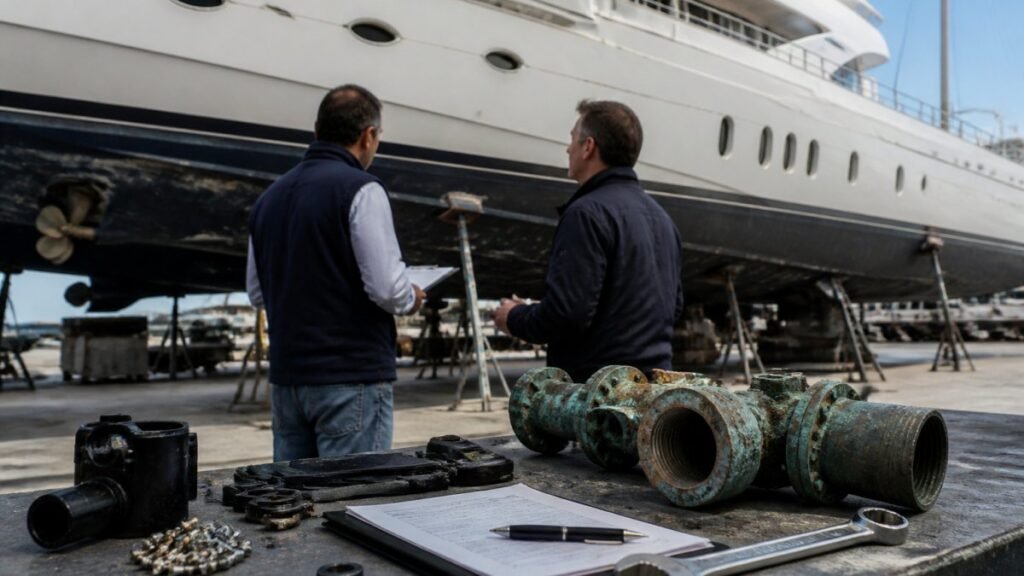
A marine survey is a detailed condition assessment of a vessel’s hull, structure, systems, and machinery, carried out by a qualified surveyor before purchase.
A survey is not a guarantee but a snapshot: a surveyor reports what is visible and testable on the day, and hidden corrosion or an intermittent fault can still surface months later.
A full pre-purchase survey is usually split into distinct parts, and understanding the split helps you read the report:
- Below-waterline inspection, often done with the vessel hauled out, covering the hull, keel, rudder, through-hull fittings, anodes, and running gear.
- Above-waterline inspection, covering the deck, superstructure, windows and hatches, rails, and the condition of sealants and fastenings.
- Systems and machinery inspection, covering engines, generator, electrical distribution, navigation electronics, air conditioning, plumbing, and tankage.
Buyers often commission the survey after a sea trial confirms the vessel performs acceptably, or treat the two as one combined exercise.
A cheap survey is not a bargain. Buyers who commission the least expensive surveyor often receive a thin report that misses structural issues, and those issues surface during the first season of ownership when repair bills are highest.
Sea Trial and Closing Fees Buyers Forget
A sea trial is a supervised run on the water to confirm engines, steering, and systems perform under load.
A useful sea trial is not a gentle cruise. It should include a cold start, a run to cruising and near-maximum rpm, steering checks at low and high speed, generator load testing, and observation of exhaust colour, vibration, and temperature.
Closing costs are where budgets quietly break. The International Maritime Organization on vessel registration and flag state requirements sets the framework many flag states follow.
Three closing-cost mechanics are worth understanding before you sign anything:
- Flag and registration route. Where a vessel is registered determines which documentation fees and survey requirements apply, and re-flagging later is its own cost.
- Titling and ownership structure. Whether the vessel is held personally or through a company affects the legal and administrative work at completion, and therefore the fees.
- Escrow and payment mechanics. Using an escrow arrangement protects both sides, but it is a service with its own charge, and cross-border transfers can add currency and banking costs.
Budget the survey, sea trial, and closing as one transaction block, and confirm each fee with the relevant maritime authority and a qualified advisor before you commit. These are the costs that decide whether a purchase stays on budget.
Pre-Owned Yacht Maintenance Costs in the First Year
Pre-owned yacht maintenance costs in the first year typically run higher than in any subsequent year, because a new owner inherits every deferred task the previous owner postponed. Budgeting the first twelve months separately is the most useful habit a buyer can build.
Routine Upkeep and Cleaning
Routine upkeep covers the predictable work: hull cleaning, teak and gelcoat care, interior deep cleaning, filter and fluid changes, and system checks. Frequency depends on use and location; a vessel sitting in a warm, humid marina needs more attention than one used regularly and stored well.
- Hull and waterline cleaning schedule set
- Teak and exterior surfaces on a care cycle
- Engine and generator service intervals logged
- Air conditioning and watermaker filters replaced
Mechanical Wear and Unexpected Breakdowns
Mechanical wear is the cost line buyers underestimate most. Engines, generators, stabilisers, thrusters, and watermakers all have service lives, and a pre-owned vessel is somewhere along those lives when you buy it.
Ask for the engine and generator hour meters before the survey, not after. Hours tell you far more about remaining service life than the model year does, and they give your surveyor a clear focus for the mechanical inspection.
Yacht Refit Costs: When Deferred Maintenance Comes Due
Yacht refit costs are the expenses of correcting and upgrading work the previous owner deferred. A refit is not cosmetic but the correction of accumulated wear, and it is the most common reason a pre-owned purchase exceeds its budget.
Deferred maintenance is invisible at viewing: fresh upholstery and a polished hull can sit on top of tired systems, corroded fittings, and outdated electronics. Assume some refit is needed, then let the survey tell you how much.
Reading Age and Hours as Refit Triggers
Rather than treating refit as one lump, experienced buyers map likely work to the age and running hours of specific systems. The pattern below is a planning aid, not a rule, since service life depends on use and maintenance.
Get in touch with us to discuss your yachting needs. →
| System | Typical trigger to inspect closely | Why it matters |
|---|---|---|
| Standing rigging (sailing vessels) | Around a decade of service | Replacement is a significant, safety-critical job |
| Teak decks | Thinning caulk lines, lifting planks | Re-caulking or replacement is labour-intensive |
| Air conditioning and chillers | Ageing compressors, refrigerant loss | Often the first system to fail in hot, humid climates |
| Watermakers | Membrane age, low output | Membranes are a recurring replacement cost |
| Electronics and navigation | Obsolete chartplotters, unsupported software | Upgrades cascade through the whole network |
| Generators and main engines | High or unusually low hours | Both heavy use and long idleness cause problems |
| Batteries and charging | Age, capacity loss | A full bank replacement is a sizeable single line |
| Hull coatings and anodes | Time since last haul-out | Deferred antifouling raises fuel burn and wear |
Prioritising the Work: Safety, Then Reliability, Then Comfort
Once the survey is in hand, fix work in this order:
- Safety-critical items. Hull structure, through-hulls, seacocks, fire suppression, liferafts, and anything the survey flags as a risk to the vessel or those aboard. These come first regardless of cost.
- Reliability items. Engines, generator, steering, electrical distribution, and bilge systems. A yacht that cannot be relied on is a yacht that cannot be used.
- Comfort and cosmetic items. Upholstery, finishes, entertainment systems, and interior refresh. These can be staged across seasons without affecting seaworthiness.
This ordering lets a buyer spread spend across the first two or three years instead of absorbing everything at once, and it gives you a negotiating position: safety and reliability findings are legitimate grounds to revisit the price, while cosmetic preferences are not.
Estimating Immediate Post-Purchase Work
To size the first-year refit, sort survey findings into three buckets: must-do before launch (your immediate reserve), should-do within twelve months (your year-one contingency), and nice-to-do later (discretionary).
Where a refit is substantial, buyers sometimes choose to combine it with a broader upgrade. Our yacht builders guidance covers how new-build and refit decisions differ in cost structure and timeline.
Get the survey findings in writing with photographs before you agree a final price. A documented defect is a negotiating tool; a verbal comment at the dock is not.
Yacht Operating Expenses: Mooring, Insurance, and Seasonal Maintenance
Yacht operating expenses are the recurring costs of keeping a vessel ready to use: mooring or dockage, insurance, seasonal maintenance, fuel, crew if applicable, and provisioning. They continue whether or not you take the yacht out, which is why frequency of use matters so much to the true cost of ownership.
Mooring and Dockage Fees
Mooring and dockage fees are charged for the berth itself and scale with vessel length rather than use. A larger yacht in a premium marina costs more per metre, and availability in desirable locations is limited. Confirm berth availability and terms before committing, because a yacht without a berth is a yacht with a problem.
Insurance and Environmental Exposure
Insurance premiums reflect vessel value, age, usage, cruising range, and the environmental exposure of the region where the yacht is kept. A vessel moored in a hot, humid, salt-heavy environment degrades faster than one in a temperate climate, and insurers price that risk accordingly.
The two operating costs buyers most often underestimate are berth availability and insurance for the cruising range they actually want, not the range they mentioned at the viewing.
Depreciation, Resale Value, and Total Cost of Ownership
Depreciation is the decline in a yacht’s value over time, and it is the largest single cost of ownership for most buyers.
Pre-owned vessels generally depreciate more slowly than new builds, since the steepest decline happens in a new yacht’s first years.
Resale value depends on brand reputation, condition, maintenance records, and how the yacht was used. A well-documented vessel with a complete service history holds value better than an identical one with gaps in its records.
Building Your Pre-Owned Yacht Budget: A Practical Framework
A pre-owned yacht budget should separate one-time acquisition costs from recurring annual costs, then add a contingency reserve. Buyers who blend these into a single number lose visibility on where the money goes.
| Cost Category | When It Applies | Planning Approach |
|---|---|---|
| Survey and sea trial | Before purchase | One-time, commission before committing |
| Closing, registration, documentation | At completion | One-time, confirm with maritime authority |
| First-year maintenance | Year one | Higher than steady state, budget separately |
| Refit and deferred work | Year one to three | Reserve based on survey findings |
| Mooring and dockage | Ongoing | Recurring, scales with vessel length |
| Insurance | Ongoing | Recurring, reflects value and cruising range |
| Depreciation | Over ownership | Largest single cost, plan resale early |
Our recommendation is a three-part structure: a transaction budget covering survey, sea trial, and closing; an annual operating budget covering mooring, insurance, maintenance, and crew; and a contingency reserve sized to the survey findings, not to optimism.
For buyers who want the acquisition itself handled end to end, our yacht purchase service covers valuation, negotiation, survey coordination, and closing.
Buyers acquiring their first pre-owned vessel who want the transaction, survey, and closing process coordinated rather than assembled piece by piece.
Frequently Asked Questions
What costs should I expect when buying a pre-owned yacht?
Beyond the purchase price, budget for a marine survey, sea trial, and closing fees. First-year costs include insurance, mooring or dockage, routine maintenance, cleaning, and a contingency reserve for mechanical surprises. Many buyers underestimate these pre-owned yacht costs by focusing only on the sticker price. A realistic budget should also account for potential refit work if the vessel has deferred maintenance.
How much should I budget for pre-owned yacht maintenance costs annually?
Pre-owned yacht maintenance costs vary by size, age, and usage. Older vessels typically need more frequent repairs and part replacements. Budget for routine upkeep like hull cleaning, engine servicing, and seasonal maintenance. Set aside a contingency fund for unexpected breakdowns. The frequency of use and environmental exposure also affect how much you spend each year.
What should I check before buying a used yacht?
Use a used yacht inspection checklist that covers the hull, engine hours, electrical systems, navigation equipment, and safety gear. A professional marine survey and sea trial are essential. Review maintenance records and ask about any recent refit work. Understanding yacht refit costs before you buy helps you negotiate or walk away if the vessel needs major work.
Are older yachts more expensive to maintain?
Generally, yes. Older yachts face more mechanical wear, corrosion, and system failures. Yacht operating expenses like insurance and mooring may be similar, but maintenance and refit costs tend to rise with age. However, a well-maintained older yacht can be cost-effective if the previous owner kept detailed records and addressed major components recently.
The challenge with pre-owned yacht ownership is not the purchase price. It is the costs that arrive quietly afterward, and the buyers who plan for them are the ones who enjoy the vessel instead of resenting it. Palm Lifestyle handles valuation, survey coordination, negotiation, and closing as a single process, backed by our global network and end-to-end service. Get in touch with us to discuss your yachting needs.