

Last Updated: November 1, 2026
Quick Summary
A motor yacht runs on diesel engines and moves regardless of wind, while a sailing yacht uses wind through its sails and relies on an engine mainly for manoeuvring in port. For first-timers, the motor yacht vs sailing yacht choice comes down to pace, workload, comfort and total trip cost.
- Motor yachts give predictable speed and a fixed schedule, so they suit guests who want to visit several destinations.
- Sailing yachts suit guests who value a slower pace and accept schedules that bend with the weather.
- A motor yacht with a professional crew is usually the lower-effort start for a beginner with no boating background.
- Compare all-in itinerary costs in AED, since fuel is the line where motor and sailing charters diverge most.
- Book a skippered sailing charter for a short trip to test whether the motion and workload suit you.
Table of Contents
- Motor Yacht vs Sailing Yacht: The Core Differences
- Speed, Travel Time and Range
- Motor Yacht or Sailboat for Beginners: Ease of Operation
- Motor Yacht vs Sailboat Comfort: Stability, Motion and Space
- Total Trip Costs: Fuel, Crew and Charter Fees in AED
- First Time Yacht Charter Tips: Choosing the Right Type for Your Trip
- Booking Your First Charter With Palm Lifestyle
- Frequently Asked Questions
Motor Yacht vs Sailing Yacht: The Core Differences
Choosing between a motor yacht and a sailing yacht is the first real decision for anyone new to the water, and the motor yacht vs sailing yacht question shapes everything that follows. This question is often the first one raised by people new to chartering, and the answer shapes everything from budget to crew needs. A motor yacht runs on diesel engines and moves regardless of wind.
How each type is powered and what that means for you
The power source changes how a trip feels from the first hour. Our guide to choosing a yacht charter broker explains how to match a first-timer with the right boat. When you weigh a motor yacht vs sailing yacht, motor yachts give you predictable speed and a fixed schedule.
For a first-timer, this difference matters more than the hull shape or interior finish. Browse our luxury maritime lifestyle experiences to see the range on offer before you commit.
Speed, Travel Time and Range
Motor yachts cover ground quickly. Most charter itineraries built around them move from one anchorage to the next in a few hours, which leaves more time ashore.
Range also differs. A motor yacht’s range depends on fuel capacity and cruising speed, and it can reach far-off anchorages without waiting for conditions.
For a Mediterranean charter, a motor yacht lets you combine several stops in one week. A sailing yacht lets you spend more hours in each bay.
Motor Yacht or Sailboat for Beginners: Ease of Operation
This is where first-timers most often misjudge the choice. The gap is not between engines and sails. It is between the number of decisions you personally have to make in the first hour, and how many of those decisions have a safe default.
What actually makes a motor yacht easier for a beginner
On a motor yacht, the crew’s workload is dominated by the engines, thrusters and docking lines. A twin-screw motor yacht with a bow thruster can be walked sideways into a berth, and the person at the helm has one control input to manage.
The beginner’s real job on a motor yacht is narrower: understand the safety briefing, know where the life jackets and fire equipment are, stay clear of the swim platform while engines are running, and follow the captain’s instructions during docking.
What a sailing yacht actually demands
A sailing yacht adds a second control system on top of the engine. Sail trim, tacking, gybing and reefing all change the loads on deck, and the boat heels while you do it. Even with a professional skipper aboard, a first-timer who wants to be useful has to learn three things before the first passage:
- Where not to stand. The boom swings across the cockpit during a tack, and the foredeck is a working area under load.
- What the commands mean. “Ready about” and “helms a-lee” are not decorative; they tell you when to duck and when to move.
- How to hold a course. A sailing yacht wanders more than a motor yacht under autopilot, so the person on the helm has to watch the telltales and the compass rather than just the horizon.
Sailing instruction time varies widely by person, so plan for structured training before taking on crew duties on a passage.
Licences, briefings and crew: what to expect
Requirements vary by flag state, by country of operation and by vessel size, so treat the following as the questions to ask rather than a fixed rulebook:
- Do you need a licence to be aboard? As a guest on a professionally crewed charter, usually no. As the person chartering a bareboat, most operators require a recognised sailing or powerboat certificate, and some require a sailing resume showing recent experience on comparable vessels.
- What safety briefing is mandatory? A professional crew should run a safety briefing before departure covering life jacket location and fitting, fire extinguishers, the location of the first-aid kit, man-overboard procedure, and how to call for help. Ask for it in writing if your group includes children or non-swimmers.
- Who is actually in charge? On a crewed charter, the captain has final authority on weather, route and safety. That is a feature, not a limitation, for a first-timer.
If your goal is to learn rather than just to travel, book a sailing charter with an experienced skipper and tell them in advance that you want hands-on time at the helm and on the winches. A skipper who knows this before the trip will build teaching into the itinerary; one who does not will simply sail the boat for you.
A practical rule for first-timers
If you have no sailing experience and your priority is a relaxed trip with several stops, a motor yacht with a professional crew is the lower-effort start. If you want to learn sailing, a sailing charter with an experienced skipper gives you hands-on time without full responsibility.
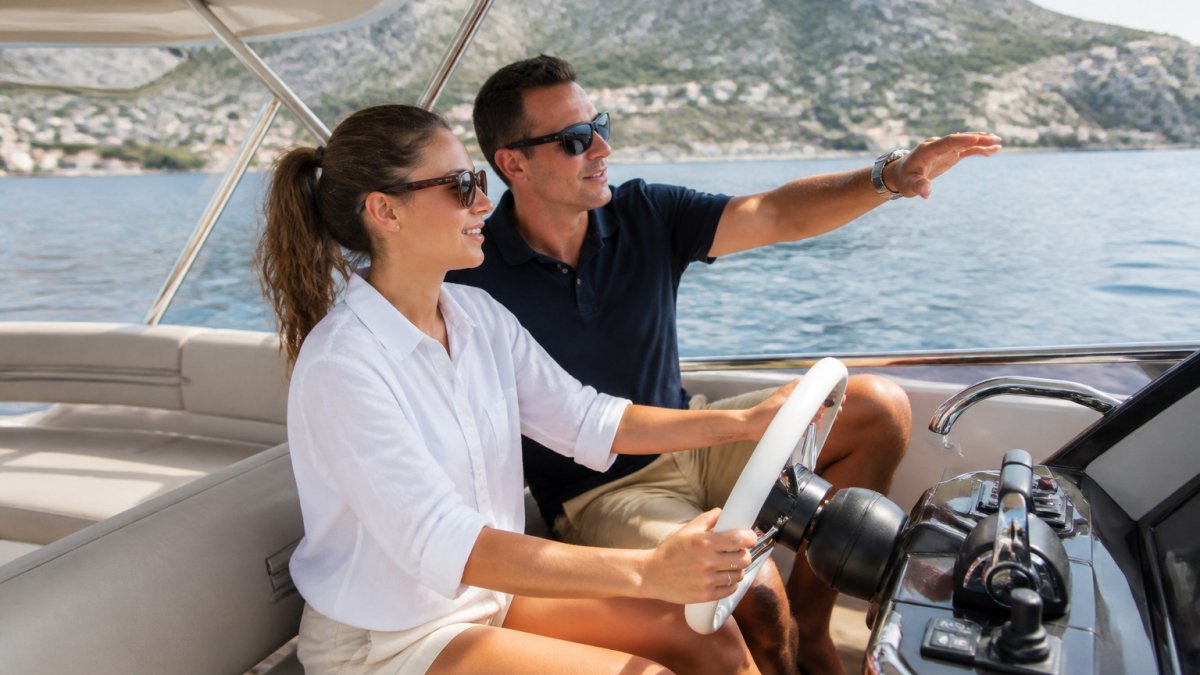
Motor Yacht vs Sailboat Comfort: Stability, Motion and Space
Comfort is where many first-timers form their final opinion on motor yacht vs sailing yacht.
Get in touch with us to discuss your yachting needs. →
Sailing yachts heel under sail, and that motion can unsettle guests who are prone to seasickness. The upside is a quieter, more engaging ride once the boat settles on a steady course.
If comfort is your priority, a motor yacht is usually the more forgiving choice.
Total Trip Costs: Fuel, Crew and Charter Fees in AED
Many yacht comparisons stop at the observation that motor yachts burn more fuel. That is true but useless for planning. A first-timer needs to know which line items move the total, and by how much, before they can compare a motor yacht and a sailing yacht on equal terms. The cost structure below shows which line items to expect, and a written quote replaces any general estimate.
The six line items that make up a charter total
Every quote should separate these, because they behave very differently between the two yacht types:
- Charter fee (base rate). The vessel and crew for the agreed dates. This is the largest single line and is usually quoted per week. Base rates differ by vessel type and length, so compare quotes for the same specification.
- Fuel. The line that diverges most. A motor yacht running at cruising speed burns fuel continuously, and a week of island-hopping can add a meaningful fuel bill on top of the base rate. See how a week’s route is structured in our Sardinia and Corsica charter itinerary from Olbia. A sailing yacht under sail burns almost nothing; its engine use is limited to manoeuvring, light-wind motoring and battery charging.
- Crew. A captain, deckhand and chef are typically included in a crewed charter fee, but gratuity is usually separate, so confirm how it is handled in your quote. On a sailing yacht, the same crew may be smaller.
- Provisioning. Food and drink for the group. This scales with guest count and menu ambition, not with yacht type, so it is the one line that is roughly comparable between a motor and a sailing charter of the same length.
- Marina and anchorage fees. Overnight berthing in a marina is typically charged per night, and rates depend on the vessel and marina. Motor yachts that cover more distance per day may spend more nights in marinas. Sailing yachts more often anchor, which is usually free or a small fee.
- Local taxes and cruising permits. Varies by country and route. Ask for it as a separate line.
How the two types compare on a one-week trip
Charter pricing depends on vessel size, season, crew level and itinerary, so request a quote from Palm Lifestyle for current pricing.
These are planning ranges, not quotes. Vessel age, crew level, season and route can move the total substantially in either direction. Always ask for a written breakdown in AED that lists each of the six line items separately, so you can compare a motor and a sailing option on the same basis.
The cost trap first-timers fall into
The mistake is comparing base charter fees only. A motor yacht with a lower base fee but a fast, fuel-heavy itinerary can end up costing more than a sailing yacht with a higher base fee and a slow route.
The practical fix is to ask for an all-in estimate for your specific itinerary, not a per-week rate.
Compare all-in itinerary costs in AED, not base charter fees. The fuel line is where motor and sailing diverge most, and it is the line most often left out of first quotes.
First Time Yacht Charter Tips: Choosing the Right Type for Your Trip
Start with your group and your goals. Consider these points before choosing between a motor yacht vs sailing yacht:
- Guests prone to seasickness: lean toward a motor yacht with stabilisers and a higher beam.
- Guests who want to learn sailing: choose a sailing yacht with an experienced skipper aboard.
- Itineraries with many stops: a motor yacht covers distance faster.
Watch out: wind forecasts change, so build a flexible schedule into any sailing charter. Do not promise guests a fixed arrival time without a contingency plan.
Best for: groups who want maximum destinations and minimal sailing effort.
Skip if: your group wants a slow, sail-powered experience with time to learn.
Booking Your First Charter With Palm Lifestyle
Once you know which type suits your trip, the next step is matching the right vessel to your dates and destination. Our crewed yacht charter in Turkey page shows availability and weekly rates for Bodrum, Göcek and the Turquoise Coast. Explore our yacht charter options to compare what is available, or get in touch with us to discuss your yachting needs.
Frequently Asked Questions
Is a motor yacht or sailing yacht better for beginners?
For most first-timers a motor yacht is the easier starting point. It needs no wind, the controls are more direct, and the vessel holds a steadier course in calm conditions. A sailing yacht rewards guests who enjoy learning handling and want the experience of moving under wind power, but it asks more of the crew and of the passengers during manoeuvres. If your priority is a relaxed trip with predictable timing, a motor yacht suits you better. If you want the sailing experience itself, a sailing yacht with an experienced professional crew is a strong choice.
Do you need sailing experience to charter a sailing yacht?
Not always. Many sailing yacht charters include a professional skipper and crew, so guests do not need sailing experience to enjoy the trip. Bareboat charters, where you sail the vessel yourself, typically require demonstrated skills and qualifications set by the operator. Confirm the charter format before booking so you know whether you will be a passenger or a participant in handling the boat.
Do sailboats flip easily?
Modern sailing yachts are designed with keels and ballast to resist capsizing in normal conditions. Larger sailing yachts are generally more stable than small dinghies. Stability still depends on sea state, sail management and crew experience, which is why an experienced skipper is recommended for first-time guests.
Which type of yacht is more comfortable for a first trip?
Comfort depends on the sea conditions and your sensitivity to motion. A motor yacht typically offers a steadier ride in choppy water and more consistent onboard space, which suits guests prone to seasickness. A sailing yacht can heel and move more under sail, though many guests find the motion pleasant in moderate wind. For a first trip, a motor yacht is usually the more comfortable option, and you can add sailing days to the itinerary if you want to try it.
