

Table of Contents
- Why Yacht Size Decides Your Mediterranean Cruising Ground
- Yacht Size Categories and Their Ideal Mediterranean Uses
- 24m Motor Yacht Layout Benefits for Guests and Crew
- Luxury Motor Yacht Specifications That Change the Experience
- Yacht Charter vs Ownership Costs in the Mediterranean
- The Yacht Acquisition Process: From Search to Sea Trial
- What Competitors Miss: Sustainability, Technology and Resale
- Conclusion
- Frequently Asked Questions
Last Updated: September 24, 2026
Why Yacht Size Decides Your Mediterranean Cruising Ground
The best size yacht for Mediterranean travel is a motor yacht of 24 metres or more, because that length unlocks guest comfort, crew separation and access to the anchorages and harbours that define a proper Med season. Buyers who fixate on a single number miss the three specifications that decide where a yacht can go.
Length overall (LOA) governs berth availability and crew requirements. Beam determines interior volume and deck space. Draft decides which bays and harbour approaches you can enter at all. A 30-metre yacht drawing 1.8 metres has far more freedom than a 26-metre yacht drawing 2.6 metres.
Bigger is not automatically more restricted, nor smaller more flexible. What matters is how the naval architect balanced volume against draft.
Length, Beam and Draft: The Numbers That Limit Port Access
Draft catches owners out. Many desirable anchorages and smaller harbours sit in shallow water, and a deep-draft hull cannot enter them regardless of length.
Practical thresholds to work with:
- Under 2 metres of draft: access to most coastal anchorages and smaller harbour approaches
- 2 to 2.5 metres: comfortable for mainstream marinas and most bays, tighter in shallow anchorages
- Over 2.5 metres: restricted to deeper berths and approaches; itinerary planning matters more
Beam matters for a different reason.
Yacht Size Categories and Their Ideal Mediterranean Uses
Yacht size categories in the Mediterranean split into four practical groups: compact cruisers under 24 metres, the 24m-30m sweet spot, 30m-40m mid-range superyachts, and 40m+ full superyachts. Each trades flexibility against space, and the trade is sharper here because the cruising ground mixes shallow anchorages, historic harbours and deep-water marinas.
Size Band | Typical Guests | Crew | Draft Range | Best For |
|---|---|---|---|---|
Under 24m | 6-8 | Owner-operated or 1-2 | 1.2-1.8m | Couples, short coastal trips |
24m-30m | 8-10 | 3-4 | 1.8-2.2m | Families, mixed guest groups |
30m-40m | 10-12 | 5-7 | 2.0-2.5m | Long trips, corporate hosting |
40m+ | 12+ | 8-12 | 2.5m+ | Extended cruising, full service |
Compact Cruisers Under 24 Metres
Below 24 metres, a yacht like the Prestige 420 Fly or the Absolute 47 Fly gives you maneuverability in tight harbours and lower running costs. The trade-off: limited storage, fewer staterooms, and no separate crew quarters, so guests and crew share living space.
The 24m-30m Sweet Spot
The 24m-30m band is where most Mediterranean charter and ownership decisions should land. Above 24 metres you gain dedicated crew accommodation, a proper beach club and enough deck space to separate guest areas from service areas, while staying short enough to keep berthing options open in harbours that cannot take a 45-metre vessel.
30m-40m and 40m+ Superyachts
Above 30 metres, the Princess Y95 class delivers full-beam master suites, large beach clubs and stabilization systems that make rough-water cruising comfortable. Above 40 metres you enter full superyacht territory: multiple decks, tender garages, water toy storage and a crew of eight or more.
24m Motor Yacht Layout Benefits for Guests and Crew
A 24m motor yacht layout works because it separates three functions smaller vessels must combine: guest living, crew operations and service logistics. That separation is the biggest quality-of-life jump in the size range.
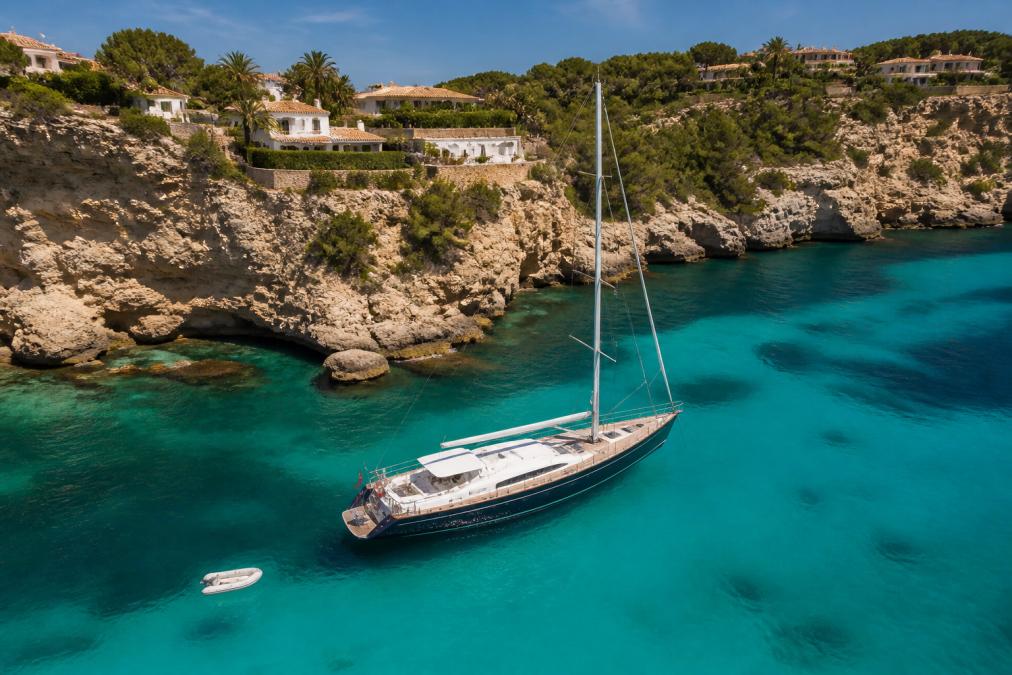
Guests relaxing on the aft deck of a 24m motor yacht, the best size yacht for Mediterranean travel, at golden hour.
Luxury Motor Yacht Specifications That Change the Experience
Luxury motor yacht specifications that genuinely change the experience come down to four systems: stabilization, propulsion, tender storage and climate control. Everything else is finish.
Get in touch with us to discuss your yachting needs. →
Yacht Charter vs Ownership Costs in the Mediterranean
Yacht charter versus ownership costs in the Mediterranean is not a simple price comparison, because the two models buy different things. Charter buys access without responsibility. Ownership buys control, customization and asset value, along with every ongoing cost of a hull in the water. Maintaining this level of control requires careful attention to the long-term durability of yacht flooring materials, which significantly impacts both the vessel’s aesthetic appeal and its eventual resale value.
What Drives Charter Cost
Charter costs are typically quoted as a weekly rate plus expenses, with a crew gratuity on top. The rate scales with length, crew count and vessel age, but expenses are where the Mediterranean matters most: fuel, berthing in popular harbours, provisioning and shore support all rise sharply in peak weeks, and faster on larger yachts.
What Drives Ownership Cost
Ownership costs run continuously: berthing, insurance, crew salaries, maintenance, fuel, and periodic refit. For a 24m+ vessel, crew is usually the largest single line item, because a yacht of that size generally requires professional crew to operate legally and safely. Crew cost does not pause when the yacht is idle, which is the structural difference between the two models.
Where the Two Models Meet
Ownership and charter are not mutually exclusive. Many owners place their vessel into the charter market to offset running costs, which is where a brokerage handling both sides of the transaction saves real time and money. The offset rarely covers the full annual cost of a 24m+ yacht, but it can meaningfully reduce the gap between what the vessel earns and what it consumes.
The Yacht Acquisition Process: From Search to Sea Trial
The yacht acquisition process runs through six stages, and skipping any of them is how buyers end up with expensive surprises.
- Brief and budget definition. Establish intended use, guest numbers, cruising region and whether the vessel will be chartered. This shapes the size band before you look at a single listing.
- Market search and shortlisting. A broker with genuine inventory access filters by LOA, beam, draft, age and layout, not by photographs.
- Pre-viewing documentation. Request build history, refit records, engine hours and classification status before travelling to see anything.
- Sea trial. This is where handling, noise, vibration and stabilization performance get tested in real conditions. Never buy without one.
- Survey and valuation. An independent survey plus a realistic market valuation protects you on both condition and price.
- Contract, financing and registration. Legal transfer, financing arrangements and flag registration run in parallel.
What Competitors Miss: Sustainability, Technology and Resale
Sustainability, technology and resale value are the three factors most buying guides skip, and they increasingly decide whether a purchase holds up over a decade.
Insurance and Resale Value by Yacht Size
Insurance and resale value both scale with size, but not in a straight line. Insurers assess 24m+ vessels on crew qualifications, cruising area, survey condition and claims history, so a well-crewed, well-documented yacht often insures more favourably than a cheaper, poorly maintained one.
Conclusion
Choosing the right size shapes everything downstream: where you can cruise, how many guests you can host, what crew you need and what the vessel will be worth when you sell. Get the length, beam and draft balance right for your actual use, and the rest of the ownership or charter decision becomes far simpler.
Frequently Asked Questions
Why is 24 metres considered the threshold for superyachts in the Mediterranean?
At 24 metres length overall, a motor yacht crosses into a different regulatory and service category. Crew certification requirements, safety equipment and insurance terms all step up, which is why this figure appears in so many specifications. It also marks the point where a yacht gains a beach club, separate crew quarters and genuine long-range capability. For Mediterranean cruising, a 24m motor yacht layout benefits from full-beam owner suites and space for a tender, without the draft that keeps larger vessels out of shallow anchorages.
What are the primary differences between chartering and owning a 24m+ motor yacht?
Chartering gives you access to a crewed 24m+ yacht for a defined period with no capital outlay, no berthing commitment and no refit liability. Ownership delivers full control over itinerary, interior specification and onboard inventory, but you carry mooring, crew, insurance and maintenance costs year-round, whether or not you use the yacht. For owners who cruise only a few weeks a year, listing the vessel for charter can offset part of that standing cost. Palm Lifestyle supports both routes, so the decision rests on how you actually plan to use the yacht.
How does yacht size impact access to exclusive Mediterranean anchorages?
Draft and beam decide where you can go. A 24m-30m motor yacht typically draws little enough to enter shallow bays and small harbours that a 40m+ superyacht must pass by. Port access also depends on berth availability, since many historic Mediterranean marinas were built for much smaller vessels. If your itinerary leans on quiet coves and village quays, staying in the 24m-30m band widens your options considerably. Larger yachts trade that flexibility for volume, stabilisation and onboard amenities.
Is a 24m+ yacht suitable for long-range Mediterranean cruising?
Yes, provided the specification matches the route. Fuel capacity, range at cruising speed, stabilisation and storage for provisions matter more than length alone. A well-specified 24m motor yacht can move comfortably between the western and eastern Mediterranean across a season, while a 30m-40m vessel handles longer passages with less weather sensitivity. Review range figures, tankage and tender capacity against your intended itinerary before you commit, rather than assuming a larger yacht automatically suits longer trips.