
Table of Contents
- Understanding Sailing Yachts for Sale
- Sailing Yacht Types and Hull Designs
- Top Sailing Yacht Brands
- New vs. Used Sailing Yachts for Sale
- Sailboat Financing and Purchase Options
- Total Cost of Ownership: Beyond the Purchase Price
- Choosing the Right Yacht Broker and Brokerage
- Conclusion: Your Next Sailing Adventure Awaits
Sailing Yachts for Sale: A 2026 Buyer’s Guide
Last Updated: July 21, 2026
When evaluating sailing yachts for sale, most buyers focus on the hull and engine without understanding the total investment required. At Palm Lifestyle, we’ve guided hundreds of yacht purchasers through this complex decision, and we’ve learned that the acquisition price represents only a fraction of true ownership costs. Below, we’ll walk you through everything from hull designs to financing structures, helping you make an informed decision that matches both your budget and your sailing ambitions.
Understanding Sailing Yachts for Sale
A sailing yacht is a vessel propelled primarily by wind through sails, designed for leisure cruising, racing, or extended offshore passages. Unlike motorized yachts that rely on fuel consumption, sailing yachts offer operational efficiency and a connection to traditional maritime culture. Modern sailing yachts now integrate advanced materials like carbon fiber, sophisticated electronic navigation systems, and hybrid propulsion options that combine sail with electric engines.
What Makes a Sailing Yacht Different
Sailing yachts differ fundamentally from motorized vessels in operational philosophy. A sailing yacht relies on wind energy, reducing fuel dependency and operating costs over extended passages. The crew must possess or develop sailing skills, reading wind patterns, managing rigging, and understanding weather systems. This requirement filters the buyer pool; those who embrace it find the experience deeply rewarding.
The design of a sailing yacht prioritizes sail efficiency and stability. Hull shapes are optimized for aerodynamic performance rather than pure speed through engine power. The keel or centerboard provides lateral resistance, allowing the yacht to sail upwind. Sailing yachts also command favorable insurance rates due to their lower accident rates compared to high-speed motorized yachts.
Key Specifications You Need to Know
Understanding yacht specifications separates informed buyers from those making costly mistakes. Hull length defines the vessel’s size category and dramatically impacts performance, cost, and handling. A 35-foot sailing yacht offers manageable crew requirements and reasonable marina fees, while a 60-foot sailing yacht demands professional crew and substantial infrastructure investment.
Displacement, the weight of water the hull displaces, indicates how heavily the yacht is built and how it handles rough seas. A heavier displacement yacht absorbs wave energy and provides a smoother ride in offshore conditions, but sacrifices speed. Lighter displacement designs accelerate quickly but can feel twitchy in choppy water.
Draft measures how deep the hull sits below the waterline. Shallow draft (under 5 feet) allows exploration of coastal areas and inland waterways, but reduces stability. Deep draft (8+ feet) improves offshore capability and weather resistance, but restricts access to shallow anchorages. Your intended cruising grounds should drive this decision.
Beam, the yacht’s width at its widest point, affects interior space and stability. A wider beam provides more living space and stability but increases docking fees and can complicate marina access in tight spaces.
Sailing Yacht Types and Hull Designs
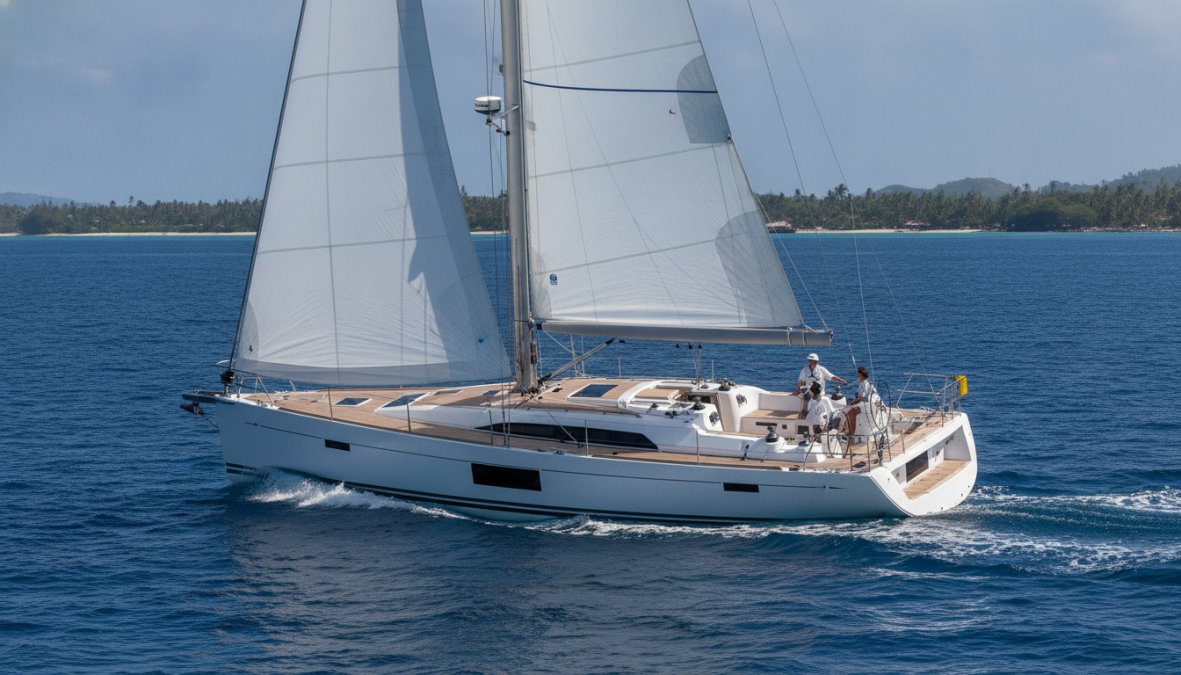
The sailing yacht market offers distinct categories, each suited to different sailing philosophies and cruising patterns.
Monohulls: Sloops and Schooners
A sloop is the most common sailing yacht configuration, featuring a single mast and two sails: a mainsail and a jib. The simplicity of this design makes sloops easy to sail, maintain, and finance. Most sailing yachts for sale under 50 feet are sloops. They excel in moderate conditions and offer the best balance of performance, cost, and crew requirements.
Schooners feature two or more masts, with the forward mast shorter than the aft mast. This design distributes sail area across multiple smaller sails, reducing the physical strength required to manage them. Schooners perform exceptionally well in heavy weather because individual sails can be reduced without losing all propulsion. However, schooners require more crew expertise and command premium prices. A couple can comfortably manage a 40-foot sloop, while that same couple would struggle with a 40-foot schooner.
Multihulls: Catamarans and Beyond
Catamarans feature two parallel hulls connected by a bridge deck, offering exceptional stability and interior volume. The wide beam provides spacious cabins and saloons without the motion sickness that affects some sailors on monohulls. Catamarans excel in light winds and offer reduced draft.
The trade-off: catamarans are slower to windward (sailing upwind) and cost significantly more than comparable monohull sailing yachts for sale. A 45-foot catamaran typically costs 30-40% more than a 45-foot monohull. They also require wider marina berths, increasing docking fees. Catamarans appeal to cruisers prioritizing comfort and stability over speed and cost efficiency.
Trimarans, three-hulled vessels, offer a middle ground: better windward performance than catamarans with more stability than monohulls. However, trimarans remain niche vessels with limited resale markets.
Top Sailing Yacht Brands
The sailing yacht market includes established builders with decades of heritage and newer manufacturers competing on innovation and value.
Nautor Swan represents the pinnacle of sailing yacht craftsmanship, combining Finnish engineering precision with Italian design sensibility. A Swan holds its value exceptionally well, and the brand commands a premium in the used market. However, new Swan sailing yachts for sale start at substantial price points.
Oyster Yachts specializes in blue-water cruising vessels designed for long-distance offshore sailing. An Oyster yacht is built to withstand extreme conditions and maintain performance across thousands of nautical miles. The brand appeals to serious cruisers planning extended passages.
Hallberg-Rassy, a Swedish builder, focuses on sturdy cruising yachts with excellent sea-keeping qualities. These vessels prioritize comfort and safety over speed.
Beneteau and Jeanneau, both French manufacturers, dominate the volume market. Their sailing yachts for sale offer competitive pricing and broad model ranges. Beneteau excels at production efficiency without sacrificing quality, making their vessels accessible to first-time buyers.
New vs. Used Sailing Yachts for Sale
The decision between new and pre-owned vessels hinges on budget, timeline, and tolerance for uncertainty.
Advantages of Pre-Owned Vessels
Used sailing yachts for sale typically cost 40-60% less than new comparable models. This price advantage allows buyers to access larger vessels or better-equipped yachts within the same budget. A buyer with a $300,000 budget might purchase a new 35-footer or a well-maintained used 45-footer, dramatically expanding cruising capability.
Pre-owned vessels have documented histories. You can review maintenance records, understand how the yacht has been used, and identify any recurring issues. A new yacht is an unknown quantity; a used yacht with transparent records reduces surprises.
The depreciation cliff affects new yachts more severely. A new sailing yacht loses 15-25% of its value in the first two years. Purchasing a three-year-old yacht means someone else absorbed that depreciation, and you enter the market at a more stable price point.
Used yachts also allow for sea trials that reveal real-world performance. However, pre-owned vessels require scrutiny. Hidden structural damage, corroded through-hulls, and delaminated hulls can cost tens of thousands to repair. The survey process becomes critical.
What to Look for in a Yacht Survey
A professional yacht survey is non-negotiable for any pre-owned purchase. This inspection examines the hull, rigging, engine, electrical systems, plumbing, and structural integrity. The surveyor produces a detailed report identifying defects, maintenance needs, and safety concerns.
A comprehensive survey costs between $3,000 and $8,000 depending on the yacht’s size and complexity. This investment pays dividends by preventing catastrophic purchases. A surveyor might identify $50,000 in deferred maintenance that wasn’t visible during casual inspection, allowing you to renegotiate price or walk away.
The survey should include a haul-out, removing the yacht from water to inspect the hull bottom. This reveals osmotic blistering (water infiltration in the fiberglass), barnacle damage, and keel condition.
Request the surveyor’s qualifications. Look for certifications from the Society of Accredited Marine Surveyors (SAMS) or equivalent international bodies. Insist on a sea trial before finalizing the survey. The yacht must be sailed in various wind conditions to demonstrate that sails, rigging, and steering systems function properly.
Sailboat Financing and Purchase Options
Most sailing yacht purchases involve financing. Understanding the available structures prevents overpaying and clarifies total commitment.
Financing Structure and Terms
Yacht financing typically extends 10-20 years, with longer terms for larger vessels. Interest rates depend on the loan amount, yacht age, and your credit profile. Lenders typically require 20-30% down payment.
The monthly payment represents only part of your financial obligation. Insurance, marina fees, maintenance, and surveys add substantially to the annual cost. A $500,000 yacht might carry a $3,000 monthly payment, but total annual ownership costs could exceed $60,000 when all expenses are included.
Loan-to-value ratios matter. Lenders will finance up to 70-80% of the yacht’s appraised value. If you’re purchasing a $400,000 vessel, expect to finance no more than $280,000-$320,000, requiring $80,000-$120,000 down payment.
Some buyers use home equity loans or lines of credit to finance yacht purchases. These often carry lower interest rates than marine-specific loans, but they put your primary residence at risk. Evaluate this strategy carefully with a financial advisor.
At Palm Lifestyle, we assist clients in navigating financing options and connecting with marine lenders who understand the unique aspects of yacht purchases.
Total Cost of Ownership: Beyond the Purchase Price
The purchase price is deceptive. True ownership costs extend far beyond the monthly payment.
Marina, Insurance, and Maintenance Factors
Marina fees vary dramatically by location and season. Mediterranean marinas during peak summer charge $50-$150 per foot annually. A 40-foot yacht in a premium location might cost $2,000-$6,000 per month for a berth.
Insurance typically runs 1-2% of the yacht’s value annually. A $500,000 yacht costs $5,000-$10,000 per year to insure. Rates increase if the yacht is older, if you lack sailing experience, or if you plan to cruise in high-risk regions.
Maintenance consumes 5-10% of the yacht’s value annually for well-maintained vessels. A $500,000 yacht might require $25,000-$50,000 yearly in maintenance, repairs, and system upgrades. The rigging system, sails, lines, and hardware require regular replacement. Engines need overhauls. Through-hulls corrode.
Hauling the yacht out of water annually for bottom cleaning and inspection costs $2,000-$8,000 depending on the vessel’s size.
Cost Category | Percentage of Yacht Value | Annual Cost (500K Yacht) |
|---|---|---|
Marina/Mooring | 1-3% | $5,000-$15,000 |
Insurance | 1-2% | $5,000-$10,000 |
Maintenance/Repairs | 5-10% | $25,000-$50,000 |
Hauling & Bottom Work | 0.5-1% | $2,500-$5,000 |
Crew (if applicable) | 10-20% | $50,000-$100,000 |
Fuel/Utilities | 0.5-2% | $2,500-$10,000 |
Choosing the Right Yacht Broker and Brokerage
A qualified broker transforms the yacht-buying process from stressful to seamless. The wrong broker wastes time and money.
What to Expect from Full-Service Support
A full-service brokerage handles every aspect of the transaction. They source vessels matching your criteria, arrange sea trials, coordinate surveys, negotiate prices, manage financing connections, and handle legal documentation. Quality brokers save buyers money by identifying vessels before they’re widely marketed and by understanding market pricing deeply.
Interview potential brokers about their specific experience with your target yacht type and size. Request references from recent clients. Ask specifically about transparency regarding costs, honesty about vessel condition, and willingness to walk away from deals that don’t serve the buyer’s interests.
Understand the fee structure. Some brokers charge flat fees; others work on commission. Commissions typically run 10% of the sale price, split between buyer’s and seller’s brokers. Clarify whether you’re responsible for any portion of this cost before engaging.
Palm Lifestyle operates as a full-service brokerage with deep expertise in sailing yacht acquisitions. We maintain relationships with builders, surveyors, and marine lenders, enabling simplified transactions. Our team prioritizes transparency, disclosing all costs upfront and never pressuring clients toward unsuitable vessels. Whether you’re purchasing your first sailing yacht or upgrading to a larger vessel, our brokerage handles the complexity while you focus on the sailing adventure ahead.
Choosing the right sailing yacht requires balancing performance, cost, and lifestyle fit. The market offers exceptional vessels across every budget and sailing philosophy. However, the purchase represents only the beginning of your sailing journey. The true measure of success is whether the yacht you select enables the cruising experiences you envision, within a financial structure you can sustain long-term. Get in touch with us to discuss your yachting needs, and let our team guide you toward a vessel that transforms your maritime aspirations into reality.
Frequently Asked Questions
What should I look for when buying a used sailing yacht?
When evaluating used sailing yachts for sale, request a comprehensive yacht survey from a qualified marine surveyor to assess hull condition, rigging integrity, and engine performance. Examine maintenance records, sea trial results, and the vessel's cruising history. Check for signs of osmotic blistering, corrosion, and structural damage. Verify all safety equipment, navigation systems, and certifications are current. A thorough pre-purchase inspection protects your investment and reveals potential repair costs before you commit.
How do I finance a sailing yacht purchase?
Sailboat financing typically involves marine mortgage loans, which function similarly to home mortgages but are structured for vessel purchases. Lenders evaluate the yacht's age, condition, and value, along with your creditworthiness. Down payments generally range based on the vessel type and your financial profile. Working with an experienced yacht broker ensures you understand all financing terms, including insurance requirements and sea trial contingencies. Transparent brokerages disclose all costs upfront, so you avoid unexpected fees after commitment.
What are the main types of sailing yachts available?
Sailing yacht types include monohulls and multihulls. Monohulls encompass sloops (single mast), cutters, and schooners (multiple masts), offering traditional performance and seaworthiness. Catamarans, a popular multihull design, provide stability, spacious interiors, and shallow draft—ideal for cruising. Each sailing yacht type serves different purposes: offshore capability favors monohulls, while comfortable cruising and chartering often prefer catamarans. Your choice depends on intended use, crew experience, and cruising grounds.
What brands are known for quality sailing yachts?
Leading sailing yacht brands include Nautor Swan, renowned for performance and craftsmanship; Oyster Yachts, celebrated for blue water cruising capability; Hallberg-Rassy, known for robust offshore vessels; Beneteau and Jeanneau, offering diverse ranges from entry-level to luxury models. These manufacturers combine traditional nautical expertise with modern engineering. When evaluating brands, consider build quality, resale value, and availability of parts and service support in your intended cruising regions, particularly if you're based in the Mediterranean or GCC.
