

Table of Contents
How Yacht Financing Works: What Every Buyer Should Know First
Quick Comparison: 7 Best Yacht Financing Options for Individuals
1. Trident Funding, Best Specialized Marine Lender for Streamlined Closings
2. LightStream, Best Unsecured Personal Loan for Excellent-Credit Borrowers
3. Newcoast Financial Services, Best for Concierge-Style Marine Financing
4. Sterling Acceptance Corporation, Best Traditional Marine Lender with Decades of Experience
5. U.S. Bank Marine Lending, Best Bank Financing for Dealer Purchases
6. J.P. Morgan Private Bank, Best Superyacht Financing for Ultra-High-Net-Worth Individuals
Last Updated: June 9, 2026
Acquiring a yacht is one of the most significant financial decisions a person can make, and understanding the 7 best yacht financing options for individuals is the difference between a smooth purchase and a costly mistake. This guide from Palm Lifestyle covers every major lending route available in 2026, from specialized marine lenders to private banking arrangements for superyachts.
Most guides treat yacht financing like car financing. The underwriting criteria, loan-to-value ratios, and documentation requirements are fundamentally different. A lender who handles recreational boat loans may not have the appetite or expertise for a vessel valued above a certain threshold.
Quick Picks:
Best Specialized Marine Lender: Trident Funding – tech-enabled closing with deep industry expertise
Best Unsecured Option: LightStream – no collateral, fast funding for excellent-credit borrowers
Best Concierge Service: Newcoast Financial Services – personalized strategy plus integrated insurance
Best Traditional Marine Lender: Sterling Acceptance Corporation – nearly four decades of proven closings
Best Bank Financing: U.S. Bank Marine Lending – dealer integration and same-day decisions
Best for Superyachts: J.P. Morgan Private Bank – bespoke financing for ultra-high-net-worth buyers
How Yacht Financing Works: What Every Buyer Should Know First
Yacht financing is the process of borrowing capital against a vessel or through personal credit to fund a purchase, repaid over a defined term at a fixed or variable rate. Unlike auto loans, yacht loans involve complex collateral assessment, stricter credit thresholds, and often require a formal marine survey before funds are approved.
Most lenders treat yachts as secured loans, placing a lien against the hull via USCG vessel documentation. Loan-to-value ratios typically range from 80% to 90% for well-qualified borrowers on newer vessels, with amortization schedules spanning 10 to 20 years. Always request a full APR comparison rather than comparing headline rates alone.
Yacht-Specific vs. Recreational Boat Loans: Key Differences
Recreational boat loans are frequently processed through credit unions with simplified applications. Yacht financing above certain values introduces jumbo boat loan territory: lenders require a certified marine survey, hull identification number verification, proof of marine insurance, and a full financial profile including two to three years of tax returns. Working with a specialized marine lender rather than a general consumer bank will almost always produce better terms and fewer surprises at closing.
Secured Loans vs. Unsecured Personal Loans for Yacht Purchases
A secured loan uses the yacht as collateral and offers lower interest rates because the lender’s risk is mitigated by the asset. An unsecured personal loan carries no lien but a higher APR. For buyers who want clean title, an unsecured option like LightStream is viable with excellent credit. For larger purchases, secured marine financing almost always produces lower monthly payments and better long-term cost.
Quick Comparison: 7 Best Yacht Financing Options for Individuals
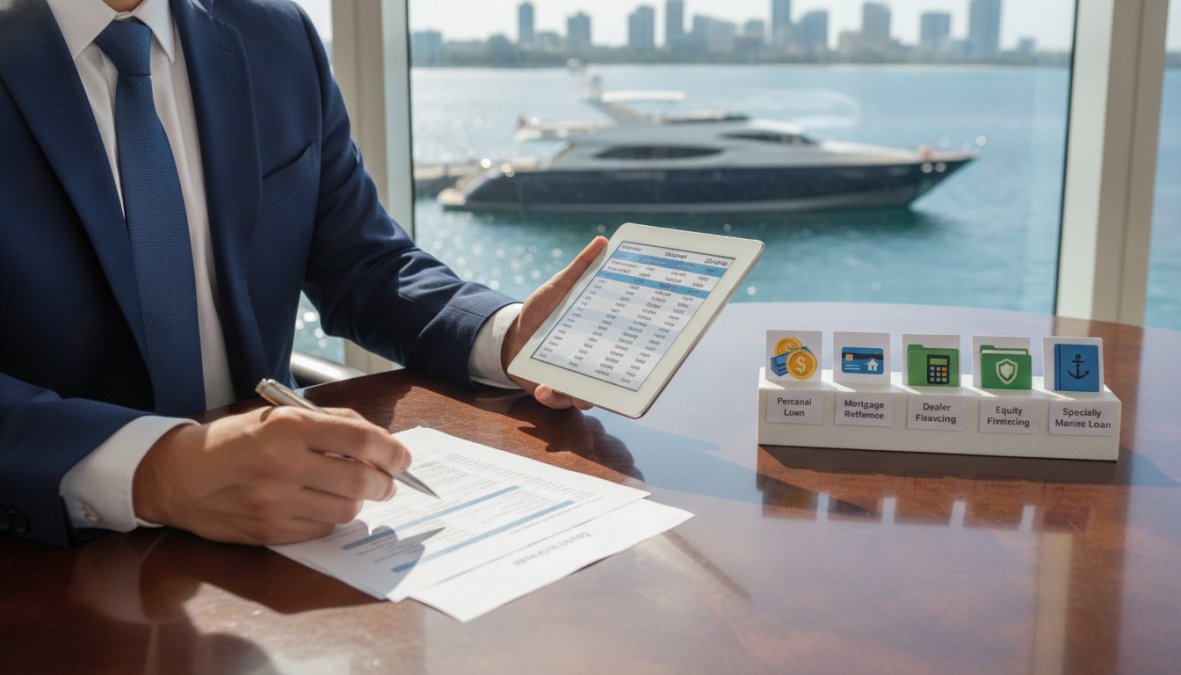
Before examining each lender in detail, this table summarizes the key differentiators across the 7 best yacht financing options for individuals covered in this guide.
Lender | Loan Type | Best For | Key Feature | Collateral Required |
|---|---|---|---|---|
Trident Funding | Secured marine loan | simplified closings | YachtCloser digital platform | Yes |
LightStream | Unsecured personal loan | Excellent-credit borrowers | No lien, same-day funding | No |
Newcoast Financial Services | Secured marine loan | Concierge buyers | Integrated insurance services | Yes |
Sterling Acceptance Corp. | Secured marine loan | Traditional buyers | 4 decades of marine expertise | Yes |
U.S. Bank Marine Lending | Secured bank loan | Dealer purchases | Online pre-approval letters | Yes |
J.P. Morgan Private Bank | Bespoke private financing | Superyacht buyers | Holistic wealth integration | Yes |
Home Equity / HELOC | Secured property loan | Homeowners with equity | Lower rates, flexible draw | Yes (home) |
1. Trident Funding, Best Specialized Marine Lender for simplified Closings
Trident Funding is the right call for buyers who want marine lending expertise without the friction of a traditional bank process. Their proprietary YachtCloser digital platform handles document processing end-to-end, enabling closings that would take weeks at a conventional institution to move significantly faster.
Their curated pool of marine-focused lending partners means applications are reviewed by underwriters who understand hull valuations, vessel depreciation, and liveaboard documentation, critical when your purchase involves a foreign-flagged vessel or a pre-owned yacht requiring a detailed survey.
What works: The combination of specialist knowledge and digital efficiency is rare. Most experienced marine lenders still rely on fax-era workflows. Trident’s platform is a genuine differentiator.
What to watch: No published rate sheet exists, you must enter the application process to understand your actual APR.
Pros:
Deep institutional knowledge of marine underwriting
Efficient digital closing experience via YachtCloser
Access to multiple marine-focused lending partners
Cons:
Rate transparency requires direct application
Terms vary significantly by credit and vessel type
2. LightStream, Best Unsecured Personal Loan for Excellent-Credit Borrowers
LightStream, a division of Truist, offers unsecured fixed-rate personal loans for yacht purchases with no collateral requirement, the vessel title remains clean from day one.
Loan terms range from 24 to 240 months with same-day funding potential for qualified applicants. There are no origination fees, no prepayment penalties, and no lender fees. The critical qualification: competitive rates are reserved for borrowers with excellent credit. If your credit shows significant derogatory marks, the rate differential versus a secured marine loan widens considerably.
What works: No marine lien is genuinely valuable for buyers who plan to charter the vessel or prefer clean title. Application speed is unmatched among options in this guide.
What doesn’t: LightStream has no marine expertise. Buyers needing guidance through vessel valuation or survey requirements should use a specialist lender.
Pros:
No lien placed on the vessel
Same-day funding potential
No fees of any kind
Cons:
Requires excellent credit for competitive rates
No marine expertise or specialist guidance
According to Truist’s LightStream lending overview, the platform’s “best loan experience” guarantee includes a rate-beat program for qualifying borrowers who find a lower rate elsewhere.
3. Newcoast Financial Services, Best for Concierge-Style Marine Financing
Newcoast Financial Services takes a consultative approach closer to a financial advisor than a loan processor. Their one-on-one model suits buyers with complexity: unusual vessel configurations, multiple lender options to evaluate, or a need to coordinate financing and insurance simultaneously.
The integrated marine insurance services are a meaningful differentiator, financed yachts require proof of insurance before closing, and Newcoast handles both, compressing the pre-closing timeline. Their multi-lender network shops your application to multiple institutions, producing better rate outcomes than going directly to a single lender. Service availability varies by region and vessel type; buyers outside the core U.S. market should confirm scope early.
Pros:
Personalized strategy rather than a transactional process
Integrated insurance services reduce coordination overhead
Multi-lender access produces competitive rate outcomes
Cons:
Regional availability limitations
Less suited to straightforward, low-complexity transactions
4. Sterling Acceptance Corporation, Best Traditional Marine Lender with Decades of Experience
Nearly four decades in marine and RV lending gives Sterling Acceptance Corporation credibility that newer entrants cannot replicate. Their underwriters understand how vessel values behave across economic cycles, and their expertise in USCG vessel documentation, state registration, and lien placement means closings proceed with fewer surprises.
The honest trade-off: Sterling’s model is less digitally oriented than Trident Funding. If you value institutional depth over a self-service application experience, Sterling earns its place on this list.
Pros:
Institutional knowledge built over nearly 40 years
Proven track record in efficient closings
Deep expertise in vessel documentation and registration
Cons:
Less emphasis on digital-first application workflows
No published rate transparency
As documented in National Marine Lenders Association lending standards, experienced marine lenders with long track records maintain tighter compliance with vessel documentation requirements, reducing post-closing title issues.
5. U.S. Bank Marine Lending, Best Bank Financing for Dealer Purchases
U.S. Bank Marine Lending suits buyers purchasing through a dealership who want a major national bank behind their financing. Their online pre-approval letter system integrates directly with participating dealers, letting you negotiate from a position of confirmed financing, with same-day decisions for qualified applicants.
The limitation: major national banks apply stricter underwriting criteria than specialized marine brokers. Buyers with variable income or complex vessel documentation histories may find the process more rigid than with Trident or Sterling.
Pros:
Stability of a major financial institution
Dealer integration and pre-approval letter system
Same-day decision potential for strong applicants
Cons:
Stricter underwriting criteria than marine specialists
Less flexibility for complex or non-standard transactions
6. J.P. Morgan Private Bank, Best Superyacht Financing for Ultra-High-Net-Worth Individuals
Superyacht financing operates on entirely different terms, and J.P. Morgan Private Bank is the benchmark. Their consultative approach considers a client’s total financial condition, assets, cash flow, and long-term wealth strategy, rather than simply underwriting a single loan.
What makes J.P. Morgan genuinely distinct is the integration of legal, insurance, and shipyard specialists into the financing process. Superyacht acquisitions involve VAT implications, flag state registration, crew employment structures, and construction contracts requiring coordinated expertise. Their network provides this coordination, and the ability to unlock liquidity from existing yacht assets is also available, structured financing simply not offered by standard marine lenders.
Pros:
Unmatched expertise in superyacht construction, registry, and VAT structures
Holistic integration with legal, insurance, and shipyard specialists
Ability to unlock liquidity from existing vessel assets
Cons:
Exclusively for ultra-high-net-worth clients
Not suitable for standard yacht loan requirements
According to J.P. Morgan Private Bank superyacht financing overview, their superyacht financing team coordinates directly with shipyards, flag registries, and legal counsel to structure transactions that account for the full lifecycle cost of vessel ownership.
Tax Implications and Insurance Requirements for Financed Yachts
Tax and insurance considerations are where many first-time buyers discover the real cost of ownership, often after closing.
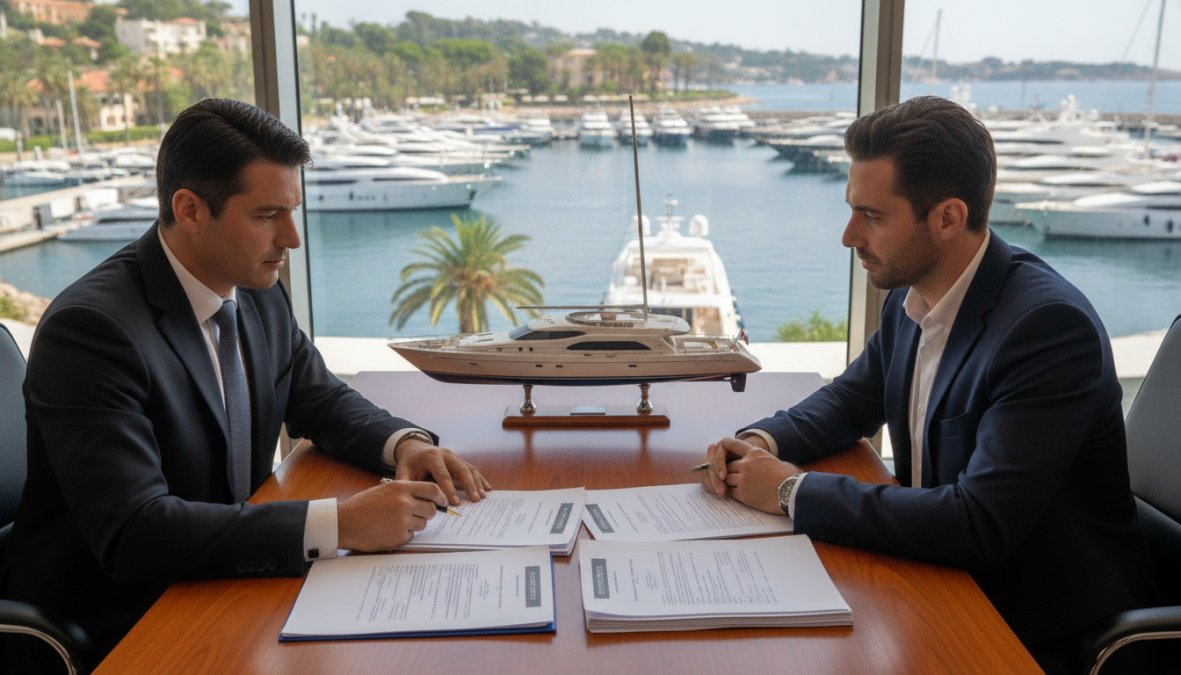
Tax implications vary significantly by jurisdiction. In many European countries, VAT applies based on where the vessel is registered and operates. The French leasing model is specifically designed to reduce VAT liability by structuring the acquisition as a lease rather than an outright purchase. In the United States, some buyers explore whether a yacht used as a primary or secondary residence qualifies for mortgage interest deduction treatment, a nuanced area requiring qualified tax counsel. Buyers in the Middle East should verify local customs duty and registration tax requirements before finalizing purchase structures.
Insurance requirements for financed yachts are non-negotiable. Every secured marine lender requires proof of hull and machinery insurance before releasing funds, with the policy naming the lender as loss payee. Coverage must address hull damage, liability, crew liability if applicable, in-transit coverage, and for larger vessels, pollution liability.
Marine survey requirements are equally critical. Most lenders require a certified survey on pre-owned vessels to assess condition, confirm the hull identification number, and produce an appraised value for the loan-to-value calculation. A survey revealing deferred maintenance can reduce the appraised value below the purchase price, creating a financing gap the buyer must cover.
How to Qualify for a Boat Loan: Requirements and Down Payment Guidance
Qualifying for yacht financing requires meeting thresholds across several dimensions simultaneously.
Credit score requirements: Most specialized marine lenders look for good-to-excellent credit, with the best rates reserved for the highest scorers. General banks like U.S. Bank tend to apply stricter thresholds than marine specialists. LightStream requires excellent credit as a baseline.
Debt-to-income ratio: Marine lenders generally prefer a DTI below 40% to 45%. High existing debt loads, even with strong income, can disqualify borrowers from preferred rate tiers.
Yacht financing down payment requirements typically range from 10% to 20%, with older or larger vessels requiring more due to conservative loan-to-value ratios.
Down payment guidance by vessel category:
New production yachts: 10% to 15% down payment is common
Pre-owned yachts under 10 years old: 15% to 20% typically required
Older or higher-risk vessels: 20% or more, depending on survey findings
Superyachts via private banking: terms are negotiated individually
Loan term considerations: Longer terms reduce monthly payments but increase total interest paid. A 20-year amortization produces meaningfully lower monthly payments than a 10-year term, but the total cost difference is substantial. Refinancing is an option if rates improve, though it involves the same survey and documentation requirements as the original loan.
As documented in Consumer Financial Protection Bureau guidance on secured lending, lenders are required to disclose the full APR, all origination fees, and prepayment penalty structures before loan consummation. Always compare APR rather than nominal interest rates when evaluating marine loan offers.
A genuine yacht purchase involves financing complexity that rewards preparation. The lenders on this list represent the most credible options across different buyer profiles and vessel categories, but the right choice depends on your credit profile, the vessel’s characteristics, and how much specialist guidance you need.
Palm Lifestyle works with buyers at every stage of the acquisition process, from vessel selection through financing coordination and legal procedures, with particular focus on clients in the GCC region and the Mediterranean. Our end-to-end service includes professional yacht valuation, strategic guidance on purchase structure, and direct access to a worldwide fleet for buyers who want to charter before committing to ownership. Get in touch with Palm Lifestyle to discuss your acquisition requirements and let our team match the right vessel and financing approach to your specific situation.
Frequently Asked Questions
How does yacht financing work for individuals?
Yacht financing works similarly to a secured auto or home loan. A lender — such as a marine lender, credit union, or private bank — provides funds to purchase the vessel, which then serves as collateral. You repay the loan in fixed monthly payments over an agreed loan term, with interest calculated at either a fixed-rate or variable-rate APR. Lenders assess your credit score, debt-to-income ratio, and the vessel's appraised value before approving a loan. Higher-value yachts may require a marine survey and formal vessel documentation before funding is released.
What is the typical down payment for a yacht loan?
Yacht financing down payment requirements typically range from 10% to 20% of the vessel's purchase price, though this varies by lender and loan size. Jumbo boat loans for higher-value superyachts may require 20% or more. A larger down payment improves your loan-to-value ratio, which can help you secure a lower APR and better loan terms. Some unsecured personal loan options, like LightStream, require no down payment since no collateral is involved, but these generally demand excellent credit to qualify.
Is it better to finance a yacht through a bank or a marine lender?
The marine mortgage vs personal loan decision depends on your vessel size and financial profile. Specialized marine lenders like Trident Funding or Newcoast Financial Services understand hull identification numbers, marine surveys, and vessel documentation — making the closing process smoother for large yachts. Major banks like U.S. Bank offer competitive rates and dealer integration. For superyachts, private banking institutions like J.P. Morgan provide bespoke terms. Marine lenders often offer more flexible underwriting criteria than general banks for yacht-specific purchases.
What credit score do you need to finance a yacht?
Most marine lenders and financial institutions look for a minimum credit score of around 680–700 to qualify for a boat loan, though the most competitive interest rates are typically reserved for borrowers with scores of 720 or higher. Lenders also evaluate your full credit report, debt-to-income ratio, and income stability. Unsecured loan options like LightStream explicitly require excellent credit. If your score is below the threshold, improving it before applying — or offering a larger down payment — can significantly strengthen your application.
Can you get a loan for a used yacht?
Yes, most of the best yacht financing options for individuals cover both new and pre-owned vessels. Lenders like Trident Funding, Sterling Acceptance Corporation, and Newcoast Financial Services all support used yacht purchases. However, used yachts typically require a professional marine survey to confirm the vessel's condition and market value before the lender finalizes the loan. The age, condition, and hull identification number of the vessel can affect the loan-to-value ratio, interest rates, and maximum loan term a lender is willing to offer.