
Table of Contents
- What Is the Difference Between Private and Commercial Yacht Registration?
- UAE Yacht Registration Requirements and Legal Framework
- Dubai Maritime Authority (DMA) Yacht Registration Process
- Vessel Size, Tonnage Thresholds, and Classification
- Safety Certification, Crew Requirements, and Compliance Standards
- Chartering, Passenger-for-Hire, and Yacht Charter License Dubai
- Benefits of Commercial Yacht Registration UAE and Tax Implications
- Switching Between Private and Commercial Status
Private vs Commercial Yacht Registration: Key Differences
Last Updated: July 28, 2026
Understanding the difference between private and commercial yacht registration is essential for any yacht owner in the UAE. The choice between these categories fundamentally shapes your vessel’s legal status, operational flexibility, and financial obligations. It determines whether your yacht can generate revenue, what crew certifications are required, and which maritime authorities govern your vessel. Misclassifying your yacht’s registration status can expose you to serious penalties, including fines and vessel detention. Conversely, understanding these distinctions opens opportunities for revenue generation through chartering or legitimate commercial operations.
Defining Private Yacht Registration
A private yacht registration designates your vessel as a pleasure craft used exclusively for personal recreation and leisure purposes. Private yachts require fewer crew certifications and less stringent safety equipment compared to commercial counterparts, though they must still meet basic maritime safety standards.
However, "private" comes with hard boundaries. If you charter your yacht to third parties for payment, even occasionally, you’ve technically crossed into commercial territory. The moment money changes hands for passenger transport or vessel use, your registration status becomes invalid unless you’ve obtained proper commercial endorsement.
Defining Commercial Yacht Registration
A commercial yacht registration permits your vessel to operate for revenue-generating activities, including yacht chartering, passenger transport, diving operations, and fishing expeditions. Commercial registration transforms your yacht from a personal asset into a business platform.
The trade-off is substantial. Commercial vessels must comply with the International Safety Management Code (ISM Code), maintain crew certifications aligned with the Standards of Training, Certification and Watchkeeping (STCW) standards, and undergo regular technical inspections. For owners who want to generate revenue and offset operational costs through chartering, commercial registration makes this possible legally and opens access to professional yacht management services and charter marketing platforms.
UAE Yacht Registration Requirements and Legal Framework
The UAE maritime regulatory landscape involves multiple authorities depending on where your vessel is registered. The Federal Transport Authority (FTA) oversees vessel registration across the entire UAE, handling national registrations for both pleasure and commercial vessels. The Dubai Maritime City Authority (DMCA) operates as a specialized free zone within Dubai, offering an alternative registration pathway with its own set of rules.
For most yacht owners in Dubai, the choice comes down to FTA registration (federal, nationwide recognition) versus DMCA registration (free zone benefits, potentially lower fees). Both pathways exist for private and commercial vessels, but the technical requirements and documentation differ.
[Clarify with your broker or registration agent](/2026/07/09/choosing-right-yacht-broker-uae/) whether your intended operations and vessel size make FTA or DMCA registration more advantageous before committing to a registration pathway.
Dubai Maritime Authority (DMA) Yacht Registration Process
For a private yacht, the registration process typically involves submitting proof of ownership, vessel specifications, hull identification number, and basic safety documentation. The timeline is relatively straightforward, often completed within 2-4 weeks with proper documentation.
Commercial vessel registration requires additional documentation including ISM Code documentation, crew certification records, vessel classification certificates from an approved classification society (such as Emirates Classification Society, TASNEEF), and proof of adequate insurance coverage. The registration authority conducts a more thorough technical inspection, and the approval timeline extends to 4-8 weeks depending on the vessel’s complexity.
Professional registration services like Ibhar Registration and Marine Registration Services LLC specialize in navigating these requirements, accelerating approval timelines and reducing the risk of rejection due to documentation gaps.
Vessel Size, Tonnage Thresholds, and Classification
Vessel size and gross tonnage (GT) determine which regulatory framework applies to your yacht. Vessels under 24 meters in length and under 500 GT often qualify for simplified registration and reduced compliance requirements, even if registered commercially.
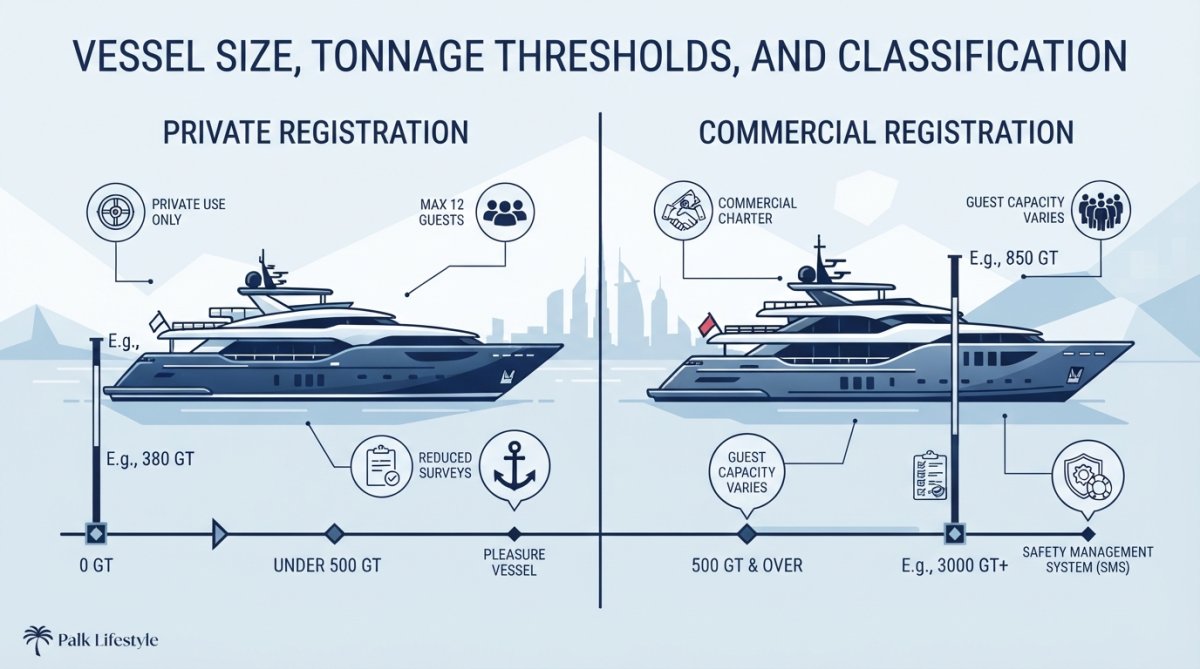
Gross tonnage is calculated based on the vessel’s internal volume. This calculation matters because many UAE regulations reference GT thresholds. Vessels under 500 GT may be exempt from certain ISM Code requirements, while larger vessels face stricter compliance mandates.
The vessel classification system, overseen by classification societies like TASNEEF, assigns your yacht to a specific category based on its design, construction, and intended service. For commercial yachts operating in UAE waters, vessel length also triggers specific requirements. Vessels over 24 meters used for passenger charter must comply with the International Convention for the Safety of Life at Sea (SOLAS) in its entirety.
Your vessel’s GT and length determine which international conventions apply. A 40-meter commercial yacht cannot be treated the same as a 20-meter pleasure craft; the regulatory framework expands substantially at these thresholds.
Safety Certification, Crew Requirements, and Compliance Standards
Safety certifications separate private and commercial yacht operations visibly. Private yachts need basic safety equipment and crew members don’t require formal maritime certifications. Commercial vessels operate under entirely different rules: all crew members involved in vessel operation must hold appropriate STCW certifications, with captains holding Master’s certificates or higher.
The ISM Code applies to most commercial vessels over 500 GT and all passenger vessels regardless of size. ISM compliance requires documented safety management systems, crew training records, maintenance protocols, and incident reporting procedures. Your vessel must have a designated Document of Compliance (DoC) and a Safety Management Certificate (SMC), requiring annual audits and periodic renewal.
For private yachts, crew requirements are minimal. You can hire an experienced captain without formal certifications if operating in personal waters, though most professional captains hold certifications anyway.
Flag State and International Conventions
Your yacht’s flag state, the country under whose flag it is registered, determines which international maritime conventions govern your vessel’s operation. A UAE-flagged yacht must comply with UAE maritime law and the international conventions that the UAE has ratified, including SOLAS (Safety of Life at Sea) and MARPOL (Marine Pollution).
When your yacht operates internationally, your flag state’s regulations follow you. UAE registration carries strong international credibility and ensures that your vessel meets globally recognized safety and environmental standards. The UAE’s maritime authorities take compliance responsibilities seriously, which is why UAE-flagged vessels are generally well-regarded internationally.
Chartering, Passenger-for-Hire, and Yacht Charter License Dubai
If you own a private yacht and want to generate revenue through chartering, you must first obtain a commercial endorsement to your registration and secure a yacht charter license from the appropriate maritime authority.
A yacht charter license Dubai formally authorizes your vessel to operate commercially. The application process requires submission of your vessel’s documentation, crew certifications, insurance coverage, and safety compliance records. The distinction between chartering and commercial operations matters legally: a "crewed charter," where your crew operates the vessel while paying guests enjoy the experience, is unambiguously commercial and requires full commercial registration and licensing.
Many yacht owners discover too late that their private registration prohibits any revenue-generating activity. A single charter, even an informal arrangement with friends who offer to cover fuel costs, technically violates your registration status.
Operating a private yacht commercially without proper licensing exposes you to vessel detention, substantial fines, and potential criminal liability. If chartering is in your future, obtain commercial registration before accepting any paying guests.
Benefits of Commercial Yacht Registration UAE and Tax Implications
Commercial yacht registration unlocks revenue potential that private registration cannot offer. The most obvious benefit is the ability to operate a charter business, generating income that offsets operational costs. Beyond chartering, commercial registration enables diving operations, fishing expeditions, corporate team-building events, or specialized maritime services.
Commercial registration introduces tax considerations that private registration avoids. Commercial vessels are subject to VAT (Value Added Tax) on services provided. If you operate a charter business, you must collect VAT from charter clients and remit it to the UAE tax authority.
Tax fraud risks are real and serious. Underreporting charter income or misclassifying a commercial vessel as private to avoid tax obligations can result in substantial penalties, criminal prosecution, and vessel seizure.
Switching Between Private and Commercial Status
Re-registering a yacht from private to commercial status is administratively straightforward but operationally complex. The vessel registration itself can be amended relatively quickly, typically 2-4 weeks if all documentation is in order. However, the operational readiness for commercial status takes considerably longer.
Before transitioning to commercial operations, you must ensure that your vessel meets all commercial safety standards, your crew holds appropriate STCW certifications, and your vessel has obtained ISM Code compliance documentation. The re-registration process requires submission of updated documentation to the maritime authority, and the authority conducts a fresh technical inspection to verify that the vessel now meets commercial standards.
The reverse process, switching from commercial to private registration, is typically faster because you’re moving to a less stringent regulatory category. However, you must formally notify the maritime authority and surrender your commercial endorsement and charter license.
If you’re considering future commercial operations, factor the transition costs into your [yacht purchase decision](/yacht-purchase/). Some vessels are inherently better suited to commercial conversion than others.
Operational Cost Analysis
Operating a private yacht involves ownership costs, maintenance, insurance, mooring, crew salaries, and fuel, all borne entirely by the owner with no revenue offset. Commercial operations introduce both additional costs and revenue potential. Insurance for commercial vessels is more expensive because coverage must protect against liability from paying passengers. Safety equipment upgrades, crew training, and ongoing compliance audits add operational expense. However, these costs are offset by charter revenue if the charter program is well-managed.
The financial break-even point depends on the vessel’s size, charter market demand, and operational efficiency. Many owners find that commercial registration makes financial sense only if they’re committed to active charter operations.
Jurisdictional Comparison Table
| Aspect | FTA Registration | DMCA Registration |
|---|---|---|
| Jurisdiction | Federal UAE-wide | Dubai Maritime City Free Zone |
| Vessel Types | All sizes and types | All sizes and types |
| Registration Timeline | 2-4 weeks (private), 4-8 weeks (commercial) | 1-3 weeks (private), 3-6 weeks (commercial) |
| Inspection Authority | Federal maritime inspectors | DMCA-designated inspectors |
| International Recognition | Full UAE flag recognition globally | UAE flag with free zone status |
| Compliance Standards | Full UAE maritime law | DMCA regulations (often aligned with FTA) |
| Best For | Standard operations, international trade | Free zone benefits, simplified processes |
Resale Value Impact
A yacht’s registration status influences its resale value and marketability. A vessel with clean private registration history often appeals to buyers seeking a personal pleasure yacht. Conversely, a vessel with commercial history and established charter track record appeals to buyers interested in commercial operations and may command a higher price as an established revenue-generating asset.
The registration category itself doesn’t inherently increase or decrease value. Rather, the vessel’s condition, maintenance history, and operational track record determine value. A vessel already registered commercially with existing charter programs in place offers significant advantage to buyers planning to charter, as they can begin revenue operations immediately.
Tax Planning Strategies
Strategic planning around yacht registration can optimize tax efficiency. Owners considering commercial operations should consult with tax advisors before establishing their operational structure. Some structures, such as registering the yacht through a corporate entity rather than personally, can provide tax benefits and liability protection.
The VAT treatment of charter services requires careful attention. Understanding the mechanics of VAT recovery, exemptions, and reporting obligations is essential for tax compliance. Properly documenting all operational expenses, crew salaries, fuel, maintenance, and insurance ensures that you capture all available deductions and protects you in the event of tax authority review.
Navigating the choice between private and commercial yacht registration requires understanding both the regulatory framework and your own operational intentions. At Palm Lifestyle, we guide clients through this decision by clarifying their goals, assessing vessel suitability, and ensuring compliance with UAE maritime law. Whether you’re seeking a personal pleasure yacht or planning commercial charter operations, our team manages the registration process, coordinates with maritime authorities, and ensures that your vessel meets all applicable standards. The difference between these two registration categories is substantial; choosing the right path from the outset prevents costly corrections later. Get in touch with us to discuss your yachting needs and determine the registration strategy that aligns with your vision.
Frequently Asked Questions
What is the main difference between private and commercial yacht registration in the UAE?
Private yacht registration is for vessels used solely for personal pleasure and recreational purposes, with no commercial activity permitted. Commercial yacht registration allows the vessel to be used for chartering, passenger-for-hire services, or other revenue-generating maritime activities. Commercial registration requires stricter compliance with safety standards, crew certifications (STCW), and ISM Code requirements, whereas private yachts have fewer regulatory obligations.
Can a privately registered yacht be used for charter in Dubai?
No. A privately registered yacht cannot legally be used for chartering or passenger-for-hire activities in Dubai. Doing so constitutes tax fraud and violates maritime law. To operate a yacht charter business or accept paying passengers, the vessel must be registered as a commercial yacht with the Dubai Maritime Authority (DMA) and obtain a yacht charter license Dubai. This registration change involves re-documentation, safety inspections, and crew certification compliance.
What are the UAE yacht registration requirements for commercial vessels?
Commercial yacht registration in the UAE requires comprehensive compliance including STCW (Standards of Training, Certification and Watchkeeping) crew certifications, ISM Code implementation for safety management, technical inspections by Emirates Classification Society (TASNEEF), and detailed vessel documentation. The vessel must meet gross tonnage (GT) thresholds and international maritime conventions. Registration is processed through the Federal Transport Authority (FTA) or Dubai Maritime City Authority (DMCA), depending on the vessel's location and ownership structure.
What are the benefits of commercial yacht registration in the UAE?
Commercial yacht registration enables revenue generation through chartering and passenger services, allowing owners to offset operational costs. It provides legal compliance and protection for commercial activities. Commercial vessels often have better resale value in certain markets and can access additional financing options. However, benefits must be weighed against higher insurance costs, mandatory crew training, regular safety inspections, and VAT implications. Many yacht owners use commercial registration strategically to balance personal use with income generation.
How does VAT apply to private versus commercial yachts in the UAE?
Private yachts used solely for personal recreation are generally exempt from VAT on certain services and operations. Commercial yachts, however, are subject to VAT on chartering income and related services. Yacht owners must carefully structure their registration and activities to avoid tax fraud, misrepresenting a commercial vessel as private to evade VAT is illegal. Consulting with maritime legal experts and tax advisors before registration ensures compliance with UAE tax law and proper VAT handling.
