

Last Updated: November 4, 2026
Quick Summary
Hiring a marine surveyor for yacht inspection means choosing an independent specialist with recognised marine qualifications and direct experience on your vessel type and size. Vet candidates on credentials, insurance, sample reports and references, then confirm the scope in writing before paying anything.
- Build a written yacht survey checklist covering vessel type, hull material, engine hours and survey purpose before calling anyone.
- Independence is the first filter: a surveyor paid or recommended by the seller or broker has compromised findings.
- Ask for the report template and a redacted recent report to judge inspection depth before booking.
- A pre-purchase survey is visual and non-invasive, so it will not dismantle engines or test every system under load.
- Read the report within a day and sort findings into safety-critical, price-relevant and cosmetic groups.
Table of Contents
- What a Marine Surveyor Actually Does on a Yacht Inspection
- Building Your Yacht Survey Checklist Before You Call Anyone
- How to Vet a Marine Surveyor: Qualifications, Experience and Independence
- What a Pre-Purchase Yacht Survey Covers and Where It Stops
- Survey Day: Preparing the Vessel and the Owner for Inspection
- The Sea Trial for Yacht Inspection: What to Watch and Record
- Reading the Marine Survey Report and Prioritising Defects
- Commissioning Your Survey Through Palm Lifestyle
- Frequently Asked Questions
What a Marine Surveyor Actually Does on a Yacht Inspection
A marine surveyor is an independent specialist who inspects a vessel’s hull, structure, systems and safety equipment, then documents condition and risk in a written report.
A surveyor’s role is to provide an independent assessment for the buyer.
Here is what most buyers get wrong: they treat the survey as a formality after agreeing a price. It is the opposite. The report is your last real chance to renegotiate, walk away, or budget for repairs before money changes hands.
Below, we break the process into seven steps, from your first checklist to reading the final report.
Building Your Yacht Survey Checklist Before You Call Anyone
Start with a written yacht survey checklist before you speak to a single surveyor. It keeps the process organised and stops you paying for work you do not need.
Your checklist should cover:
- Vessel type, length and build year
- Hull material: GRP, steel, aluminium or wood
- Engine make, hours and service history
- The purpose: pre-purchase, insurance or valuation
- Any known defects the seller has disclosed
- Where the vessel is berthed and whether it can be lifted
A common mistake is booking a full pre-purchase survey on a boat you have not seen in person. Inspect it yourself first if you can.
Decide early whether you need one survey or several. A pre-purchase survey, an insurance survey and a valuation are different jobs, and one report does not always cover all three.
How to Vet a Marine Surveyor: Qualifications, Experience and Independence
Choose an independent surveyor with recognised marine qualifications and direct experience on your vessel type and size. Independence is the first filter: if the surveyor is paid or recommended by the seller or broker, their findings are compromised.
Look for membership of a recognised marine surveying body and current professional indemnity insurance. Ask for the certificate, not just a verbal confirmation, and check the policy is current and covers the type of work you are commissioning. Ask for the surveyor’s report template before you book.
Watch out: a cheap survey from an unqualified inspector often misses structural issues that a proper hull inspection would catch, and you carry that risk for years.
A Practical Vetting Checklist for Comparing Surveyors
When you have two or three candidates, compare them side by side on the same criteria rather than on price alone. Use this checklist and score each surveyor against it:
- Credentials: Which recognised marine surveying body are they a member of, and is the membership current?
- Relevant vessel experience: How many vessels of your type, length and hull material have they surveyed in the last two years? Ask for examples, not totals.
- Sample report: Request a redacted recent report. Check whether it separates safety-critical findings from cosmetic ones and whether it includes photographs and moisture readings.
- Insurance: Confirm professional indemnity cover is in place and ask what it covers.
- Conflicts of interest: Ask whether they have surveyed this vessel before, whether they have any commercial relationship with the seller, broker or yard, and whether they receive referral fees.
- References: Ask for two recent clients on comparable vessels and actually call them. Ask what the surveyor missed and how they handled follow-up questions.
- Scope in writing: Get the proposed scope, exclusions and deliverables confirmed in writing before paying anything.
Questions That Reveal Real Survey Experience
Ask these directly, and listen for specifics:
- How many vessels of this type and size have you surveyed in the last two years?
- Will you attend the sea trial and the haul-out personally?
- Which parts of the vessel fall outside your scope?
- Do you use thermal imaging or moisture meters, and when?
- Can you provide two recent client references?
- Have you surveyed this specific vessel before, and if so, what did you find?
- What is your turnaround time for the written report, and who writes it?
Vague answers are your signal to move on. A surveyor with real experience answers these without hesitation, and a good one will welcome the questions rather than deflect them.
What a Pre-Purchase Yacht Survey Covers and Where It Stops
A pre-purchase yacht survey covers hull condition, structural integrity, onboard systems, mechanical systems and safety equipment, usually with the vessel hauled out of the water. It does not cover everything, and knowing the gaps protects you.
Standard coverage includes:
Get in touch with us to discuss your yachting needs. →
- Hull inspection below and above the waterline
- Structural condition of bulkheads and stringers
- Engine and mechanical systems, often on a visual basis
- Electrical, plumbing and navigation systems
- Safety assessment of lifesaving and fire equipment
Where it stops matters just as much. Most surveys are visual and non-invasive. If you are moving toward a purchase, it helps to understand how to finance a luxury yacht purchase while the survey findings are fresh. And if you are still shortlisting vessels, you can browse yachts for sale in Dubai and the wider market to see what fits your budget and survey expectations.
Survey Day: Preparing the Vessel and the Owner for Inspection
Survey day runs smoothly when the vessel is clean, accessible and fully powered, and when you have cleared time to attend. Your presence matters: you see the defects firsthand and can ask questions on the spot.
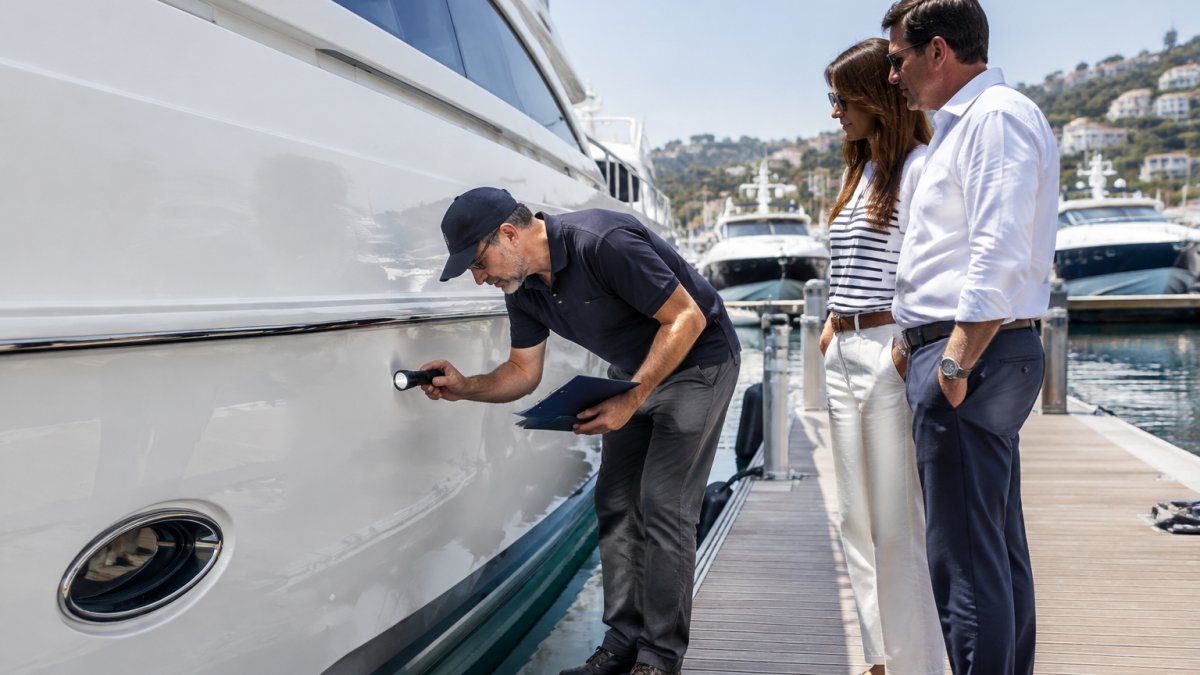
As the hull and onboard systems are checked, the marine inspection process also highlights how a vessel’s condition can inform a broader assessment of waterfront property.
Prepare the vessel like this:
- Empty lockers and bilges so the surveyor can inspect them
- Charge batteries and confirm shore power works
- Have the engine started and warmed before arrival
- Gather service records, manuals and any previous survey reports
- Confirm the haul-out slot and yard access in advance
Bring a notebook and photograph anything the surveyor flags. The inspection process moves fast, and memory is unreliable.
The Sea Trial for Yacht Inspection: What to Watch and Record
The sea trial for yacht inspection tests the vessel under load, which a static survey cannot do. Run the engines through their full range, watch for smoke, vibration and unusual noise, and note top speed against the manufacturer’s figures.
Record these during the trial:
- Engine rpm, temperature and oil pressure at cruise and full throttle
- Any vibration, noise or steering pull
- Gearbox and shaft behaviour under load
- Electronics: autopilot, radar, GPS and depth sounder
- Anchor windlass and thrusters under real use
If the sea trial is skipped, the mechanical side of the report is incomplete. Insist on it, and make sure the surveyor is aboard.
Reading the Marine Survey Report and Prioritising Defects
Read the marine survey report within a day of receiving it, and sort findings into three groups: safety-critical, price-relevant and cosmetic. The report is a risk assessment, not a verdict, so your job is to weigh each defect against the price you agreed.
| Defect type | Example | Action |
|---|---|---|
| Safety-critical | Failed seacock, no working bilge pump | Fix before use or walk away |
| Price-relevant | Osmosis blisters, worn engine mounts | Renegotiate the price |
| Cosmetic | Faded gelcoat, worn upholstery | Note and budget later |
How to Read Severity, Not Just Category
A defect’s category tells you what to do; its severity tells you how urgently. Look for the surveyor’s language: words like “monitor”, “recommend further investigation” and “noted” usually signal lower urgency, while “immediate”, “unsafe” and “failed” signal a stop-and-fix item. Read the report with the surveyor on the phone if you can, and ask them to rank the top five findings in order of risk.
When to Bring In a Specialist
A general survey is visual and non-invasive, so it will not dismantle engines, open sealed compartments or test every system under load. That means some findings need a second opinion from a specialist before you can price them:
- Engine and drivetrain: a mechanic’s compression test or oil analysis goes beyond a visual check.
- Rigging: a rigger’s inspection of standing rigging, chainplates and terminals is a separate commission on sailboats.
- Electrical and electronics: a marine electrician can test batteries, charging systems and navigation equipment under load.
- Structural: if the surveyor flags moisture, delamination or corrosion, a structural specialist or yard can advise on repair scope and cost.
- Valuation: a valuation is a distinct deliverable from a condition survey, so confirm whether you need one separately.
Next Steps After the Report
Once you have the report and any specialist quotes, decide which of three paths you are on: proceed at the agreed price, renegotiate using the priced defects as evidence, or walk away if safety-critical items are extensive or the seller will not move. Put any renegotiation in writing, tied to specific report items and quotes, rather than a round number. If you proceed, use the report as a maintenance baseline and schedule the safety-critical fixes before first use. Before you finalise anything, review the best yacht purchase deals and buyer guidance to compare what else is available at your price point.
Commissioning Your Survey Through Palm Lifestyle
We can also help if you are selling, through our yacht sale service.
For buyers ready to move, the simplest next step is to speak with a yacht broker directly and request a survey on the vessel you have in mind.
Frequently Asked Questions
What does a marine surveyor inspect on a yacht?
A marine surveyor inspects the hull below and above the waterline, structural condition, deck fittings, onboard systems including electrical and plumbing, mechanical systems, safety equipment and the general condition of the vessel. The survey also documents defects and gives recommendations. A pre-purchase yacht survey usually includes a sea trial and haul-out, while an insurance survey focuses on valuation and risk. The final marine survey report sets out findings in enough detail to support negotiation or underwriting.
How long does a yacht inspection take?
A yacht inspection typically takes one full day for a vessel in the 15 to 24 metre range, with larger yachts and superyachts needing two or more days depending on systems and access. The sea trial adds several hours. The marine survey report usually follows within a few working days. Schedule the inspection so the yacht is hauled out and cleaned beforehand, and confirm with the surveyor how long they need so the yard and crew are booked for the right window.
Can a marine surveyor inspect a yacht while it is in the water?
A marine surveyor can carry out much of the inspection afloat, covering onboard systems, structure above the waterline and safety equipment. However, the hull below the waterline, running gear, through-hull fittings and keel or propeller condition can only be assessed properly with the vessel hauled out. For a pre-purchase yacht survey, insist on a haul-out as part of the scope. An in-water inspection alone leaves the most expensive structural risks unverified.
What should you do after receiving a yacht survey report?
Read the marine survey report in full and separate defects into three groups: safety-critical items, defects that affect value, and maintenance items. Ask the surveyor to clarify anything ambiguous and request quotes for the significant repairs. Use those findings to renegotiate price or make the sale conditional on rectification. If specialist referrals are recommended, such as an engine or rigging expert, arrange them before committing. Keep the report on file for insurance and future reference.
The real risk in any purchase is skipping the survey to save time, then discovering the problem after the deal closes. Palm Lifestyle manages the full purchase journey, from sourcing and valuation through to the survey, financing and legal steps, so nothing gets missed. Get started with Palm Lifestyle and buy with the full picture in front of you.
