

Last Updated: November 13, 2026
Quick Summary
To conduct a yacht sea trial, confirm your checklist first: a signed offer conditional on a satisfactory trial, a captain and surveyor aboard, and calm-to-moderate conditions. Then run a timed protocol of roughly 85 minutes covering cold start, slow-speed handling, acceleration, cruising speed hold, a full-throttle burst, steering and systems, recording every reading against the maker’s spec sheet.
- A sea trial should last one to three hours of active testing for most yachts, plus transit time.
- Record RPM, speed, temperature, oil pressure and fuel burn against the maker’s specification sheet, not impressions.
- A full-throttle run on a cold engine can cause real damage, so warm it up first.
- Repeat the trial or affected runs if conditions were flat calm, loads were unusual, or a fail item was repaired.
- Write the report the same day and sort findings into pass, watch and fail buckets.
Table of Contents
- Why a Yacht Sea Trial Decides the Purchase
- Preparing for the Trial: Your Yacht Sea Trial Checklist
- What to Check During a Sea Trial: Engine, Steering and Systems
- A Timed, Step-by-Step Sea Trial Protocol
- How Long a Sea Trial Should Last and What Changes It
- Writing a Sea Trial Report That Protects the Buyer
- Book Your Sea Trial with Palm Lifestyle
- Frequently Asked Questions
Why a Yacht Sea Trial Decides the Purchase
A yacht sea trial is the underway test of a vessel before purchase, where the buyer and a captain run the engines, steering, and systems in real sea conditions to confirm the boat performs as promised.
Paperwork and photos tell you what the seller wants you to see. A trial tells you what the boat actually does.
Most buyers spend weeks on the search and a single afternoon on the trial. That ratio is backwards.
The trial is also your last clean chance to renegotiate. Once you sign without testing, defects become your problem.
Preparing for the Trial: Your Yacht Sea Trial Checklist
A yacht sea trial checklist is the written list of documents, people, and conditions you confirm before the boat leaves the dock.
Start with the sea trial checklist below. Confirm every line before you board.
- Signed purchase offer with trial terms and a deposit held in escrow
- Marine survey booked, ideally the day before or the same week
- Engine service records and last oil analysis
- Fuel and water tanks at the agreed level
Documents, Crew and Test Conditions to Confirm First
Three things decide whether the trial is valid: the paperwork, the people, and the weather.
A purchase offer is commonly written so that the deal is conditional on a satisfactory trial.
On crew, you want the captain at the helm, the surveyor recording findings, and your broker watching the clock.
Test conditions matter just as much. A trial in flat calm water flatters the boat.
What to Check During a Sea Trial: Engine, Steering and Systems
You check the engine, steering, and systems by running each one through its full range and comparing the readings to the vessel’s own specification sheet, not to a feeling.
Before you leave the dock, run a short safety briefing: life jacket locations and fit, fire extinguisher and bilge pump locations, VHF channel and radio use, man-overboard procedure, emergency stop location, and the agreed limits of the test (maximum speed, maximum sea state, turnaround point).
Powerboat and Motor Yacht Checks
- Cold start: clean catch, idle stability within the maker’s stated RPM band, no smoke beyond a brief puff
- Gauges at idle and under load: oil pressure, coolant temperature, voltage, and tachometer all within the maker’s range
- Cooling water: steady flow at the exhaust at idle and at cruise; no steam, no interruption
- Exhaust: light color at cruise, no heavy smoke or fuel sheen on the water
Sailboat Checks
- Engine: same cold-start, gauge, cooling, and exhaust checks as a powerboat, plus the folding or feathering propeller operation
- Rig: standing rigging tension, no cracks at swages or terminals, mast step and chainplate condition
- Running rigging: halyards, sheets, and control lines run freely, no chafe
- Winches: smooth operation under load, no slipping pawls
Objective Benchmarks Against the Specification Sheet
Do not rely on impressions. Carry the maker’s spec sheet and record each reading against it:
- RPM vs speed: at the stated cruising RPM, the boat should reach the maker’s stated cruising speed within a reasonable tolerance
- Wide-open throttle: top speed should be close to the maker’s published figure; a large shortfall points to prop pitch, engine health, or hull fouling
- Engine temperature: should climb and then hold steady within the maker’s range, not creep upward at cruise
- Oil pressure: should settle quickly at start and hold steady under load
A boat meeting spec at cruise but falling well short at wide-open throttle may warrant a specialist look before closing.
Test Conditions That Change the Result
A trial in flat calm flatters the boat; a trial in a chop reveals how the hull, props, and cooling system behave under load. Record sea state, wind, load (fuel, water, people), and air and water temperature alongside every reading.
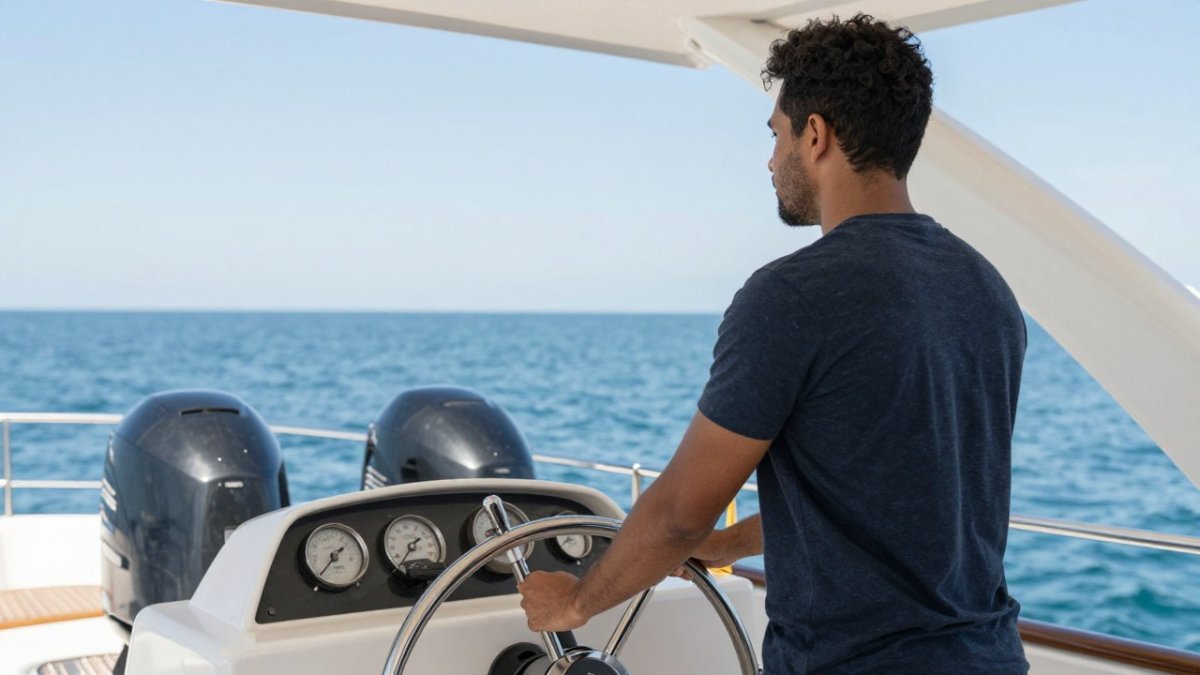
Engine Startup, Gauges and Cooling Water
Engine startup is the first real test. Listen for a fast, clean catch. A labored start or a cloud of smoke that lingers points to trouble.
Watch the gauges as the engine warms. Oil pressure should settle quickly. Engine temperature should climb and then hold steady within the maker’s range.
Cooling water flow is the check most buyers skip. Look for a steady stream at the exhaust.
Acceleration, Cruising Speed and the Full-Throttle Test
Acceleration, cruising speed, and the full-throttle test tell you whether the boat meets its manufacturer specs.
Note three numbers: time to plane or to target speed, cruising speed at the stated RPM, and top speed at wide-open throttle. Compare each to the spec sheet.
Then bring it back to idle and check for smoke, smells, and vibration. Watch out: a full-throttle run on a cold engine can cause real damage.
A Timed, Step-by-Step Sea Trial Protocol
A structured protocol keeps the trial honest and repeatable. Set a clock and work through it in order.
- Safety briefing (5 minutes): life jackets, exits, and radio use.
- Cold start and idle check (10 minutes): gauges, cooling water, exhaust.
- Slow-speed handling (10 minutes): docking, reverse, and turning circle.
- Acceleration run (10 minutes): time to plane and to target speed.
- Cruising speed hold (15 minutes): steady RPM, temperature, fuel burn.
- Full-throttle burst (5 minutes): top speed against spec.
- Steering and maneuverability (10 minutes): tight turns and response.
- Systems check (15 minutes): navigation, electrical, and sail handling.
- Return and shut-down check (5 minutes): idle, smells, and leaks.
Total: roughly 85 minutes of active testing, plus transit time.
The protocol runs in a fixed order so every check is repeatable and nothing gets skipped.
| Step | What to do | Time |
|---|---|---|
| Safety briefing | Life jackets, exits, radio use | 5 minutes |
| Cold start and idle check | Gauges, cooling water, exhaust | 10 minutes |
| Slow-speed handling | Docking, reverse, turning circle | 10 minutes |
| Acceleration run | Time to plane and target speed | 10 minutes |
| Cruising speed hold | Steady RPM, temperature, fuel burn | 15 minutes |
| Full-throttle burst | Top speed against spec | 5 minutes |
| Steering and maneuverability | Tight turns and response | 10 minutes |
| Systems check | Navigation, electrical, sail handling | 15 minutes |
Time
How Long a Sea Trial Should Last and What Changes It
A sea trial should last between one and three hours of active testing for most yachts, plus transit time to and from open water. Smaller powerboats need less. Larger vessels, sailboats, and older boats need more. The number that matters is not the clock but whether every item on your protocol was tested in conditions that represent how you will actually use the boat.
Several factors stretch the timeline:
- Vessel size: bigger boats mean longer warm-up and more systems to cycle
- Propulsion type: twin engines, sail drives, and pod drives take longer to test than a single shaft
- Age and condition: older boats warrant repeat testing and a second look at any fail item
- Sea state: rough water slows every run and can make some checks unsafe
When to Repeat a Trial
A trial is only valid if it was run in representative conditions. Repeat the trial, or at least the affected runs, when:
- the sea state was flat calm but you intend to cruise in a chop
- the fuel or water load was far from the level you will normally carry
- a fail item was repaired and you need to confirm the fix
- the engine did not reach operating temperature before the performance runs
If a seller rushes you or resists a repeat run, that is a signal. A confident seller will give you the hours you need and will not object to a second look at a repaired item.
Documenting Findings and Deciding What Happens Next
Write the report the same day, while details are fresh. Include the date, sea conditions, load, crew, and every reading against the spec.
For fail items, request a written fix plan and a second trial before you release funds. Before you commit, it also helps to see what to check before buying a yacht so the trial fits into the wider inspection.
Writing a Sea Trial Report That Protects the Buyer
A sea trial report is the written record of what the boat did, what it failed, and what needs fixing before closing.
Write it the same day, while details are fresh. Include the date, sea conditions, load, and crew.
Then separate findings into three buckets:
- Pass: meets spec, no action
- Watch: minor issue, note for negotiation
- Fail: material defect, needs remedial work and repeat testing
For fail items, request a written fix plan and a second trial before you release funds. For guidance on the survey that supports it, see our guide on hiring a marine surveyor.
Before you commit, it also helps to see what to check before buying a yacht so the trial fits into the wider inspection.
Book Your Sea Trial with Palm Lifestyle
The trial is where a good deal is proven or exposed. Get it right and you buy with confidence. Get it wrong and you inherit someone else’s problems.
If you are weighing a new build against a used vessel, our Yacht Builders service can help you explore options, and our Yacht for Sale listings let you compare candidates before you ever schedule a trial.
If you are still mapping the steps, our practical buyer’s guide shows where the trial sits. Review our current buyer’s guide to deals, then contact our team to arrange your trial.
A sea trial rewards the buyer who prepares, times every run, and documents the result.
Frequently Asked Questions
What should you check during a yacht sea trial?
Work through the vessel system by system while underway. Start the engine from cold and watch oil pressure and temperature settle, confirm steady cooling-water flow at the exhaust, then run acceleration, cruising speed and a full-throttle test against the manufacturer’s figures. Check steering response both ways, the turning circle, reverse gear and idle speed. Below deck, test navigation systems, electrical systems and instruments, and note any vibration or unusual noise before you return to the dock.
How long should a yacht sea trial last?
Sea trial duration depends on the vessel and its propulsion. A small powerboat may need only one to two hours, while a larger motor yacht with complex systems warrants a full day, and a sailing yacht needs extra time to test sail handling, winches, furling systems and steering under sail. Build in time to run the engine at cruising speed and full throttle long enough for temperatures to stabilise, and to repeat any test that raised a question.
Can a sea trial reveal mechanical problems a survey misses?
Yes. A pre-purchase inspection and marine survey assess structure and condition at rest, while the sea trial shows how the vessel behaves under load. Transmission faults, vibration, cooling issues and steering play often only appear once the engine is working at cruising speed or full throttle. That is why the two should be treated as complementary, and why findings from the trial belong in the sea trial report alongside the surveyor’s notes.
What should you do if a yacht fails its sea trial?
Document every defect in the sea trial report with the conditions under which it appeared. Then decide whether to renegotiate the purchase offer to reflect remedial work, ask for the faults to be fixed and the affected tests repeated, or withdraw. Repeat testing matters: a repaired cooling or steering fault should be verified underway, not just at the dock. Bring your buyer broker into that conversation early so the next step is agreed in writing.
