

Last Updated: November 18, 2026
Quick Summary
A yacht charter for family and business works when the planning starts with both groups side by side. Choose a yacht with distinct zones, age-suitable safety and comfort for children and older relatives, and an itinerary built around the business objective. Compare quotes by total cost rather than the headline rate.
- Describe the ages and mobility of every guest before shortlisting any yacht.
- Look for a separate lounge or sundeck so business and family can use different zones.
- Map a typical day to spot clashes between swimming, meetings and meals.
- Keep sailing legs manageable and return to the same berth each evening.
- Rebuild every quote into five cost lines before comparing totals.
Table of Contents
- Why One Yacht Charter Can Serve Family and Business Together
- Family Yacht Charter Needs: Comfort, Safety and Age Suitability
- Corporate Yacht Charter Needs: Capacity, Privacy and Event Logistics
- Choosing a Yacht for Mixed Family and Business Groups
- Planning Your Yacht Charter Itinerary
- How Long Your Yacht Charter Should Be
- Comparing Charter Options and Total Costs Before You Book
- Next Step: Request a Tailored Charter Quote from Palm Lifestyle
- Frequently Asked Questions
Why One Yacht Charter Can Serve Family and Business Together
Palm Lifestyle, a yacht brokerage and charter company, sees a growing number of requests that blend a family holiday with business hospitality. A single charter can serve both purposes, but only if the yacht, crew and itinerary are chosen with both groups in mind. The starting point is an honest answer to a simple question: who is on board, and what does each group need from the day?
Families usually want comfort, space for children, and a schedule that does not feel rushed. Business guests usually want privacy, a dining area that works for a meeting or a formal dinner, and reliable timing. Many charters fail because they are built for one group and then awkwardly stretched to cover the other. A yacht charter for family and business works best when the planning begins with both lists side by side.
Consider the yacht charter as one shared space with two rhythms. Mornings might suit a relaxed family swim, while the afternoon could hold a private briefing on the sundeck. The best yacht charter plans leave room for both without forcing either group into the other’s routine.
Family Yacht Charter Needs: Comfort, Safety and Age Suitability
Family suitability is not one quality but several, and they change with the age of the youngest and oldest guests on board. A yacht that suits a family with teenagers can be a poor fit for a family with toddlers, so describe the ages and mobility of every guest before shortlisting.
For infants and toddlers, the practical questions are shade, safety and supervision. Ask whether the yacht has a shaded, enclosed area where a child can play without access to the water, and whether the crew can supply age-appropriate life jackets rather than adult sizes.
For primary-school children, water equipment and supervised activity usually decide the day. Ask what water equipment is on board and whether a crew member is assigned to supervise water activity.
For teenagers, independence and space matter more than supervision. A separate lounge, a reliable Wi-Fi connection and a schedule with free time will do more for the day than any amenity list. Ask whether cabins can be allocated so older children have their own space without crossing a business meeting area.
Older relatives bring a different set of needs. Ask about step-free access from the boarding point to the main saloon, the height of thresholds, the availability of handholds along the side decks, and whether cabins are on a single level. Shaded seating and a stable anchorage are worth more than speed.
Safety should be verified rather than assumed. Ask which safety equipment is carried, how the crew is briefed for emergencies involving children, and whether the captain has experience with family groups.
Watch out: age suitability is often decided by the itinerary, not the yacht. Short sailing legs, a calm anchorage for swimming and a return to the same berth each evening will suit young families better than an ambitious route, so match the plan to the youngest guest rather than the most energetic one.
Corporate Yacht Charter Needs: Capacity, Privacy and Event Logistics
Business charters are judged on different criteria. Guest capacity is the first concern: a yacht that sleeps eight may still hold only a small seated dinner. Check the number of guests for each use, including dining, lounging and any presentation space. Privacy matters too, so confirm how cabins are separated and whether crew access can be limited during meetings.
Event logistics often decide whether a corporate charter succeeds. Plan catering timing, audiovisual needs, Wi-Fi reliability and how guests will board and disembark. Confirm the departure point and the transfer arrangements in advance. Many planners underestimate how long boarding takes for a group of twenty or more, so build in buffer time.
Outcomes should also be defined. Are you hosting a client dinner, a team retreat or a product showcase? The answer changes the layout you need, the crew you should request and the amount of structured time in the schedule.
Choosing a Yacht for Mixed Family and Business Groups
When the two groups share one charter, the yacht must offer distinct zones. Look for a yacht with a separate lounge or sundeck that can be used for business while family members relax elsewhere. Cabin count matters, but so does how easily the cabins can be reached without passing through meeting areas.
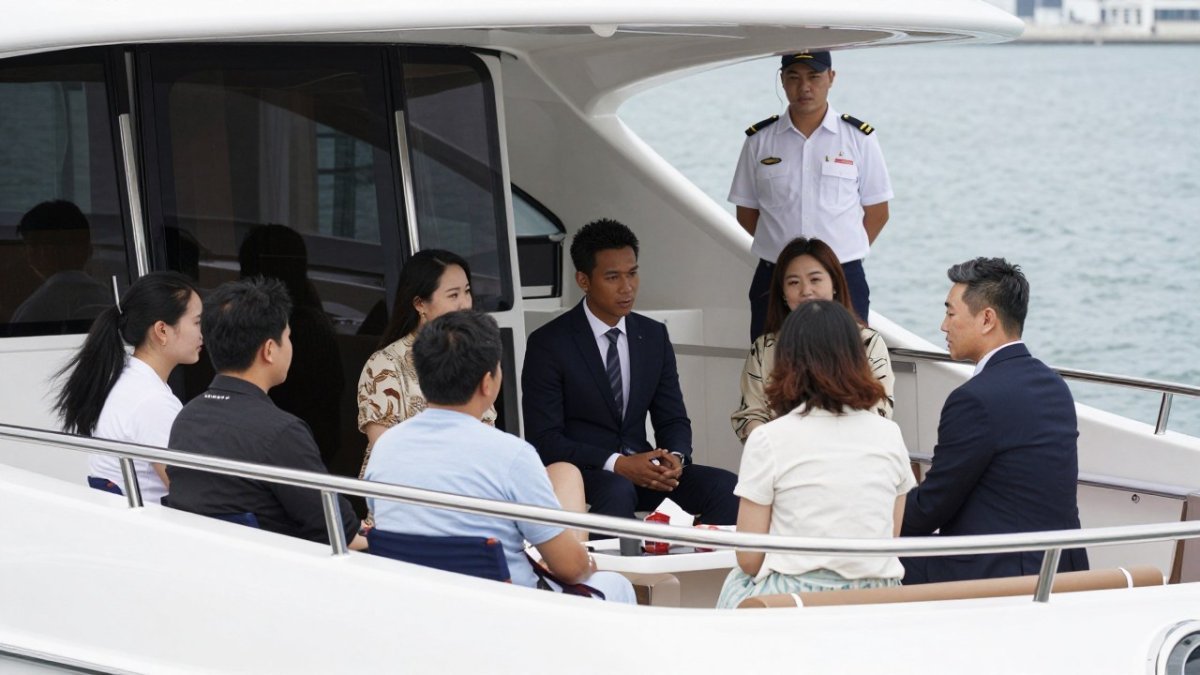
A practical test is to map a typical day. Write out when the family swims, when the business session runs, when meals are served and when guests want quiet. If two of those activities regularly collide, the yacht is probably the wrong choice.
Crew experience also matters more in a mixed charter. Ask the operator whether its captain and hospitality team have experience balancing children and executives, and request references from similar groups.
Our recommendation is to shortlist two or three yachts, then compare them against your map of the day rather than their brochure specifications. The yacht that works on paper may not suit the rhythm of your group.
Planning Your Yacht Charter Itinerary
An itinerary should balance sailing time, anchorage time and free time. Long transits eat into family leisure and business schedules alike, so keep sailing legs manageable. Charters can work well with a base port and day trips, which lets the group return to the same berth each evening.
Build the itinerary around the business objective first. If there is a formal dinner, choose an anchorage or marina with reliable access for guests. Leave at least one fully unscheduled afternoon so family members are not waiting on meetings. For more route ideas, see our Yacht Charter Itineraries overview, and for a broader planning guide covering destinations and timing, read Yacht Charter Mediterranean: Complete 2026 Guide.
Weather is the variable most itineraries underestimate. Ask the broker how the plan changes if conditions turn, and keep a backup list of sheltered anchorages.
How Long Your Yacht Charter Should Be
Duration depends on how much business content you need to fit in. A short charter of two to three days suits a single event or a family weekend with a client dinner. A week gives both groups enough time to settle in and enjoy the sea, but requires a more detailed schedule.
Minimum booking periods vary, so confirm them early. Factor in embarkation and disembarkation days, which often reduce the usable time on board. Many families find that the second half of a charter feels more relaxed than the first, because routines have settled.
Ask how the rate is calculated, whether by day, by hour or by package, and what changes if the itinerary extends. Clear answers prevent disputes later.
Comparing Charter Options and Total Costs Before You Book
Charter quotes can be difficult to compare directly, because providers may bundle different services into the headline rate. Rebuilding each quote into the same structure and comparing totals for an identical brief is a practical way to compare them.
Start by asking each operator to break the quote into five lines. First, the charter fee itself, which is usually quoted per day or per week and reflects the yacht, the captain and the standard crew. Second, fuel, which is often excluded and can vary widely with route and speed; ask whether fuel is charged at cost or at a fixed allowance. Third, port and marina fees, which depend on the berths used and are rarely included in a headline rate. Fourth, food and beverages, which may be a per-guest package, a provisioning list charged at cost plus a handling fee, or a fixed catering menu. Fifth, taxes and any local levies, which should be shown separately rather than folded into the rate.
Once those five lines are visible, add the common extras that quietly change the total: water toys and tender use, an onboard host or additional crew, audiovisual setup for a business session, transfers to and from the departure point, and any cleaning or turnaround charge between bookings. A quote that looks lower on the charter fee line can end up higher once fuel and provisioning are added, so compare the all-in total for the same brief rather than the headline number.
Minimum booking periods also distort comparisons. Some operators price by the hour with a minimum block, others by the day, and others by the week with embarkation and disembarkation days counted separately. Convert every quote to the same unit, for example a total for a six-hour day for twenty guests, before you judge value.
Watch out: deposit schedules and cancellation terms are part of the total cost. Ask what is due on signing, when the balance falls due, and how changes or cancellations are handled, and confirm these terms in writing.
A simple comparison sheet with one column per yacht and one row per cost line, filled in from written quotes rather than brochure figures, will show within minutes which option is genuinely better value for your group. Ask each operator to confirm inclusions and exclusions in writing, and treat any verbal assurance as provisional until it appears on the quote.
The five cost lines below show what a charter quote usually includes, so you can compare totals on the same basis.
| Cost line | What it covers | Watch for |
|---|---|---|
| Charter fee | Yacht, captain and standard crew, per day or week | Headline rate often excludes other lines |
| Fuel | Route and speed dependent | Charged at cost or fixed allowance |
| Port and marina fees | Berths used | Rarely included in headline rate |
| Food and beverages | Package, provisioning or fixed menu | Provisioning may carry a handling fee |
| Taxes and levies | Local charges | Should be shown separately |
| Deposit and cancellation | Payment schedule and change terms | Confirm in writing |
Next Step: Request a Tailored Charter Quote from Palm Lifestyle
A yacht charter that serves both family and business takes careful planning, and the details that matter most are often the ones that are easiest to miss. Palm Lifestyle can help you match a yacht to both groups, design an itinerary around your objectives and provide a transparent quote. To see the Cannes offering, visit Yacht Charter Cannes, or start by reviewing our Yacht Charter for Family Vacations: A Complete Guide and our Benefits of Putting Your Yacht on the Charter Market for the broader picture.
Frequently Asked Questions
How do I choose a yacht charter for a family outing?
Start with the number of guests, the ages in your group and what the days should feel like. Families with young children usually need enclosed sleeping cabins, swim platforms with safe access and a calm cruising pace. Ask the charter provider to confirm guest capacity, cabin layout and whether a captain and crew are included, since these shape both comfort and safety.
What should I consider when chartering a yacht for a business event?
Confirm the guest limit, the deck space for presentations or networking and whether the crew can handle catering timings around your schedule. Check the vessel’s Wi-Fi and power access, the availability of a private lounge for meetings and how the day will be paced. A written event plan agreed with the provider before booking prevents most logistical surprises.
How far in advance should I book a yacht charter?
Lead times depend on the season, the vessel size and the destination. Peak months and popular cruising areas can book out well ahead, so requesting availability early gives you more choice of yacht and dates. Palm Lifestyle can confirm current availability and lead times for your specific dates when you get in touch.
What questions should I ask before confirming a yacht charter?
Ask what is included in the price, which fees and taxes apply, how the itinerary can be changed and what the cancellation and weather policies are. Confirm guest capacity, crew size, catering arrangements and the minimum charter duration. Clear answers on these points make it much easier to compare options fairly.
