
Last Updated: November 22, 2026
Quick Summary
Annual operating expenses for a 20-metre superyacht depend mainly on crew size, cruising days, maintenance and dockage rather than on purchase price. Routine running costs can be modelled line by line, with a total ranging from roughly AED 539,000 to AED 1,958,000 per year.
- Crew is often the largest recurring cost after the purchase itself.
- Fuel is the most usage-sensitive line, rising steeply with cruising speed and days.
- Set aside a major refit reserve spread across the expected lifespans of key systems.
- Length and purchase price are not the same, so budget from the actual vessel specification.
- Review the operating budget at least once a year as crew, fuel and insurance change.
Table of Contents
- How Much Does It Cost to Run a 20m Superyacht per Year?
- Why a 20-Metre Yacht and an AED 80 Million Yacht Are Not the Same Budget
- Crew Costs and What Your Staffing Model Requires
- Superyacht Fuel Costs by Usage and Cruising Days
- Yacht Maintenance Costs and Major Refit Reserves
- Building a 20m Yacht Operating Budget Line by Line
- Planning Your Next Step with a 20m Superyacht Budget
- Frequently Asked Questions
How Much Does It Cost to Run a 20m Superyacht per Year?
Running a 20-metre superyacht is a serious annual commitment, and the figure depends far more on how the vessel is used, crewed and maintained than on its price tag. The purchase is only the first line of the budget, and the running costs that follow shape the real cost of ownership.
Operating expenses for a vessel of this size typically cover crew, fuel, maintenance, insurance and the berth itself. Each moves independently, so two owners with identical yachts can report very different annual totals. Treat any single figure you read online as a starting point and test it against your own cruising plans.
Here is a simplified framework of the main categories and what drives each one:
| Cost category | What drives it | Variability |
|---|---|---|
| Crew | Crew size, qualifications, rotation | High |
| Fuel | Cruising days, speed, sea conditions | High |
| Maintenance | Age, systems, service schedule | Medium to high |
| Insurance | Vessel value, cruising area, coverage | Medium |
| Dockage | Location, berth availability, season | Medium |
Because each line behaves differently, a useful budget separates fixed costs from usage-driven costs. Insurance and basic crew wages recur whether the yacht sails 20 days or 100, while fuel scales with every day at sea.
Why a 20-Metre Yacht and an AED 80 Million Yacht Are Not the Same Budget
A common source of confusion is treating a 20-metre length and an AED 80 million price as the same thing. Length tells you the physical size and rough crew and maintenance demands, while value reflects equipment, finish, age and brand.
This matters because the operating budget is driven mostly by size and systems, not by price. A high-value vessel may carry premium finishes that are expensive to restore, yet its engines and crew requirements are set by its length and class. Conversely, an older, lower-value yacht of the same length can carry heavy maintenance backlogs that inflate costs.
Model the two scenarios separately. For a 20-metre yacht, the budget is anchored to physical size: a small professional crew or owner-operated model, modest fuel burn, routine servicing, and a berth sized to the hull. For an AED 80 million yacht, it is anchored to systems and finish: larger crew complement, higher fuel burn, premium insurance based on agreed value, and maintenance reserves for complex systems and finishes.
| Cost category | 20-metre yacht (indicative annual range) | AED 80 million yacht (indicative annual range) | What changes |
|---|---|---|---|
| Crew | AED 350,000 to AED 700,000 | AED 1,200,000 to AED 2,500,000 | Larger complement, higher qualifications, more rotation travel |
| Fuel | AED 40,000 to AED 120,000 | AED 150,000 to AED 400,000 | Greater displacement, higher cruise speeds, longer passages |
| Routine maintenance | AED 80,000 to AED 180,000 | AED 250,000 to AED 600,000 | More systems, premium finishes, tighter service intervals |
| Major refit reserve | AED 60,000 to AED 150,000 | AED 300,000 to AED 800,000 | Complex systems, paint and interior work at higher cost |
| Insurance | AED 25,000 to AED 60,000 | AED 100,000 to AED 250,000 | Agreed value and cruising area drive premium |
| Dockage and mooring | AED 60,000 to AED 150,000 | AED 150,000 to AED 400,000 | Berth length, location and season |
| Contingency (10%) | AED 60,000 to AED 130,000 | AED 220,000 to AED 500,000 | Scales with total budget |
Anchor your budget to the specific vessel rather than to a headline price. Ask for the actual specification, age, engine hours, crew complement and class society status. Those details tell you far more about annual costs than the purchase price alone. Request this information before you commit to any estimate.
Crew Costs and What Your Staffing Model Requires
Crew is often the largest recurring cost after the purchase itself, and it is shaped by the way you intend to operate the yacht. Staffing levels depend on the vessel’s length, its systems and how many guests you carry. A 20-metre yacht typically requires a small professional team, and the exact complement should reflect the safety and operational standards that apply where the yacht is flagged and where it sails. According to International Maritime Organization data, safety compliance is the primary driver for manning levels.
Crew costs extend beyond base salaries. Budget for accommodation and provisioning, training and certification renewals, travel between rotations, and the employer obligations that apply to your flag state. Those extras can add a meaningful share to the headline wage bill, so include them from the start.
Superyacht Fuel Costs by Usage and Cruising Days
Fuel is the most usage-sensitive line in the budget. The same yacht can burn very different volumes depending on how many days it spends underway, how fast it cruises and how the sea and weather behave. Because consumption rises steeply with speed, a few knots of extra cruising speed can change the bill substantially. As noted by industry research on vessel efficiency, fuel consumption is non-linear relative to speed.
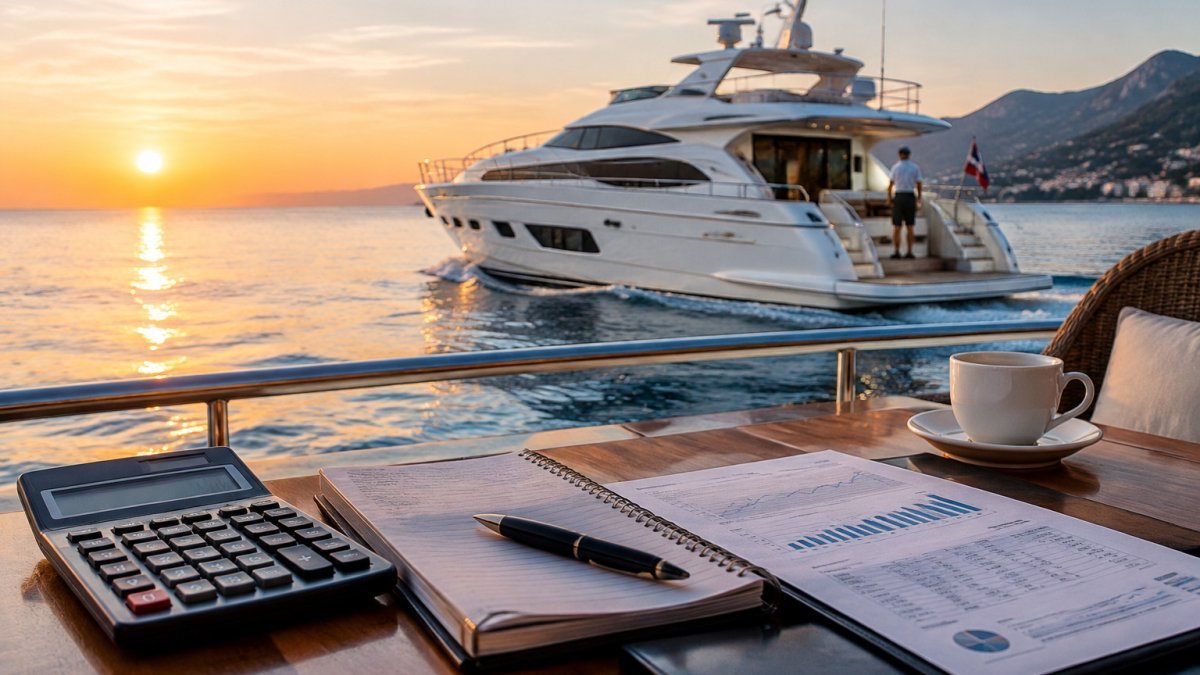
To estimate fuel properly, start with the number of cruising days you expect each year, then multiply by the average daily consumption at your typical cruising speed. Separate time at anchor or on a berth, when engines are often idle or running generators only, from time underway.
Yacht Maintenance Costs and Major Refit Reserves
Maintenance splits into two categories that owners often conflate: routine servicing and periodic major work. Routine servicing covers engine checks, filter changes, antifouling, cleaning and the ongoing care of systems. It is predictable and recurring, and it should be budgeted as a steady annual figure.
Major refits are irregular but significant. Engine overhauls, hull and deck work, interior refurbishment and the replacement of large systems can cost far more than routine upkeep, and they arrive in lumps rather than evenly. A common mistake is to budget only for routine items and then face a large unplanned bill when a major component reaches the end of its life. Setting aside a dedicated capital expenditure fund is a standard practice in maritime asset management.
Building a 20m Yacht Operating Budget Line by Line
With the categories understood, you can assemble a complete operating budget. Work through each line and write down a figure, a basis for that figure and a confidence level. Keeping the basis visible makes it easier to revisit and adjust as your plans change.
| Line item | Basis and assumptions | Low (AED) | Typical (AED) | High (AED) |
|---|---|---|---|---|
| Crew salaries, benefits, training and rotation travel | Small complement; low assumes owner-operated with minimal paid crew, high assumes full professional team | 250,000 | 500,000 | 800,000 |
| Fuel | Low assumes 30 cruising days at low speed, high assumes 90 days at higher speed and long passages | 30,000 | 75,000 | 150,000 |
| Routine maintenance and servicing | Engine checks, filters, antifouling, cleaning, system care | 70,000 | 120,000 | 200,000 |
| Major refit reserve | Spread across expected system lifespans; high assumes older vessel or heavy usage | 50,000 | 100,000 | 200,000 |
| Insurance | Hull, machinery and liability; high assumes higher agreed value and broader cruising area | 20,000 | 40,000 | 70,000 |
| Dockage, mooring and marina fees | Low assumes low-season berth, high assumes prime location in season | 50,000 | 100,000 | 180,000 |
| Provisioning, consumables and guest running costs | Scales with guest days and service level | 20,000 | 45,000 | 90,000 |
| Management and administration | External operator or shore support; low assumes owner-administered | 0 | 40,000 | 90,000 |
| Contingency | Set at 10% of the subtotal | 49,000 | 102,000 | 178,000 |
| Total | Sum of the lines above | 539,000 | 1,022,000 | 1,958,000 |
Low (AED)
Once the lines are filled in, total them and compare the result against the yacht’s purchase price and your intended use. Registration rules can also add recurring costs, so check the legal requirements for private yacht registration before finalising the figures. Many owners find that the annual figure, while substantial, is manageable once it is laid out clearly.
Revisit the budget at least once a year. Crew rotations change, fuel prices move, insurance renews and the maintenance schedule evolves. A budget that is reviewed annually stays useful; one that is set once and forgotten quickly drifts from reality.
Planning Your Next Step with a 20m Superyacht Budget
Once you have a realistic annual figure, the next decision is how to act on it. If the numbers suggest ownership is too costly for your current plans, chartering a vessel for the periods you need can be a sensible alternative. For owners who want to exit, a considered sale can release capital, and Palm Lifestyle can advise on the options for selling your yacht. According to market analysis by McKinsey & Company, liquidity in the secondary market remains a key consideration for luxury assets.
Whichever route you take, base the decision on a complete budget rather than a single headline number. Reviewing how to evaluate superyacht resale value alongside your operating estimate gives a fuller picture of the long-term cost of ownership. To see how a charter compares with ownership for your intended use, you can also explore superyacht charter options in the Mediterranean, or review a specific 27-metre charter yacht as a point of comparison, the Azimut Grande 27.
Get in touch with us at https://palmlifestyle.ae to discuss your yachting needs and we can help you build an operating budget that fits your plans.
Frequently Asked Questions
How much does it cost to run a 20m superyacht each year?
The annual cost varies widely with crew size, cruising days, maintenance needs and dockage.
Is a 20-metre yacht the same as an AED 80 million yacht?
No. The operating costs are driven by technical complexity, system maintenance and crew requirements rather than the initial purchase price.
Should I set aside money for major refits?
Yes. Major systems such as engines and large interior or hull work arrive irregularly and can be expensive. Establishing a reserve fund is essential for long-term financial stability.
How often should the operating budget be reviewed?
At least once a year, since crew rotations, fuel prices, insurance and maintenance schedules change over time.
Frequently Asked Questions
How much does it cost to run a 20m superyacht per year?
Annual running costs for a 20-metre superyacht depend on crew size, cruising days, maintenance scope and berthing. Owners should build a line-by-line budget covering crew salaries, fuel, insurance, maintenance reserves and dockage, then test it against how many days the yacht will actually operate.
What are the main annual expenses of owning a 20m superyacht?
The main recurring expenses are crew costs, fuel, insurance, routine maintenance, periodic refit and painting, and marina or mooring fees. Irregular major repairs and reserves for equipment replacement also matter, because they can exceed routine spending in a given year. Separating fixed costs from usage-driven costs makes the budget easier to test.
How much fuel does a 20m superyacht use?
Fuel consumption varies with engine type, cruising speed, sea conditions and the number of cruising days in a season. Fuel is usually one of the most variable line items, so owners should model several usage scenarios instead of a single figure. Comparing fuel costs per cruising day gives a clearer picture than an annual total alone.
Do yacht operating costs change depending on how often the yacht is used?
Yes. Fuel, provisioning, crew overtime and wear on systems rise with use, while insurance, basic crew retainers and berthing are largely fixed. A yacht used for a few weeks a year carries a very different cost per day than one that cruises most of the season.
