

Table of Contents
- What Is the 12-Person Rule on Yachts?
- Why the 12-Person Rule Exists: Safety and Regulatory Compliance
- SOLAS Regulations for Yachts and International Maritime Standards
- Chartering a Yacht for Large Events: Solutions Beyond 12 Guests
- Commercial Yacht Registration in the UAE: What You Need to Know
- Private Yacht vs. Commercial Passenger Vessel: Key Differences
- What Happens if You Exceed the 12-Person Limit?
- Conclusion
Last Updated: August 10, 2026
What Is the 12-Person Rule on Yachts?
The 12-person rule classifies vessels based on passenger capacity. A yacht operating under this rule can safely carry a maximum of 12 passengers plus professional crew without triggering commercial vessel classification. This distinction determines which maritime regulations apply, what safety equipment is required, how the vessel is registered, and whether it can legally operate for charter purposes.
The rule separates private recreational vessels from commercial passenger ships. Exceeding this threshold transitions your yacht from a private vessel into a commercial passenger vessel, which carries far more stringent regulatory requirements, higher insurance costs, and mandatory professional crew certifications. For yacht owners and charter operators in the Mediterranean, Middle East, and beyond, understanding this boundary is essential to legal compliance.
The rule stems from international maritime law, specifically the Safety of Life at Sea (SOLAS) convention and the Passenger Yacht Code (PYC). These frameworks ensure vessels carrying passengers operate under safety standards proportional to their risk.
Why the 12-Person Rule Exists: Safety and Regulatory Compliance
Maritime safety regulations reflect practical realities. A typical luxury yacht accommodating 12 guests plus crew can be safely operated with a captain and small support team. The vessel’s size, stability, navigation systems, and emergency procedures are calibrated for this passenger load. Exceeding 12 passengers changes evacuation complexity, bridge watch-keeping requirements, and life-saving appliance standards.
For yacht owners considering charter operations, the 12-person limit represents a regulatory sweet spot. Operating below this threshold allows owners to charter while maintaining flexibility in crew requirements and avoiding burdensome commercial vessel regulations. Many private yacht owners use this threshold strategically to generate revenue without reclassification.
The rule also protects consumers. Passengers on vessels exceeding 12 people are entitled to stronger protections under maritime law, including additional safety certifications, comprehensive crew training records, and rigorous inspection protocols.
SOLAS Regulations for Yachts and International Maritime Standards
SOLAS, the International Convention for the Safety of Life at Sea, establishes minimum safety standards for commercial vessels and influences how yachts are classified and regulated. Under SOLAS, a passenger ship is any vessel carrying more than 12 passengers, triggering stability standards, compartmentalization rules, lifeboat capacity calculations, radio watch-keeping protocols, and crew certification mandates.
For yachts operating internationally, SOLAS compliance matters even if your vessel technically falls below the 12-passenger threshold. Port state control authorities in Mediterranean ports, Middle Eastern harbours, and globally enforce SOLAS-aligned standards. A 12-person rule yacht must demonstrate through its design, documentation, and operational procedures that it genuinely cannot safely accommodate more than 12 passengers.
The Passenger Yacht Code (PYC) Explained
The Passenger Yacht Code provides a proportionate regulatory regime for yachts carrying between 13 and 250 passengers. Its existence reinforces the importance of the 12-person rule: vessels carrying 12 or fewer passengers can operate under minimal regulatory frameworks, but the moment you carry 13 passengers, the PYC applies.
A yacht reclassified under the PYC must undergo formal stability assessments, implement a safety management system, ensure crew holds appropriate certificates of competency, and maintain comprehensive documentation. Insurance premiums increase substantially. For yacht owners, the PYC represents the first major regulatory escalation.
Flag State Variations and Their Impact
A yacht’s flag state significantly influences how the 12-person rule is interpreted and enforced. Different flag states implement SOLAS with varying strictness, and some offer more flexibility in passenger capacity calculations. However, this flexibility disappears when your yacht enters port in jurisdictions with strict port state control.
For yacht owners and charter operators in the Middle East and Mediterranean, the 12-person rule is effectively a global standard. Attempting to circumvent it through strategic flagging is legally risky and operationally impractical.
Chartering a Yacht for Large Events: Solutions Beyond 12 Guests
The 12-person rule creates operational constraints for event planners and corporate charters requiring larger groups. However, several legitimate solutions allow you to accommodate groups larger than 12 while maintaining legal compliance.
Multi-Vessel Charters and Flotilla Options
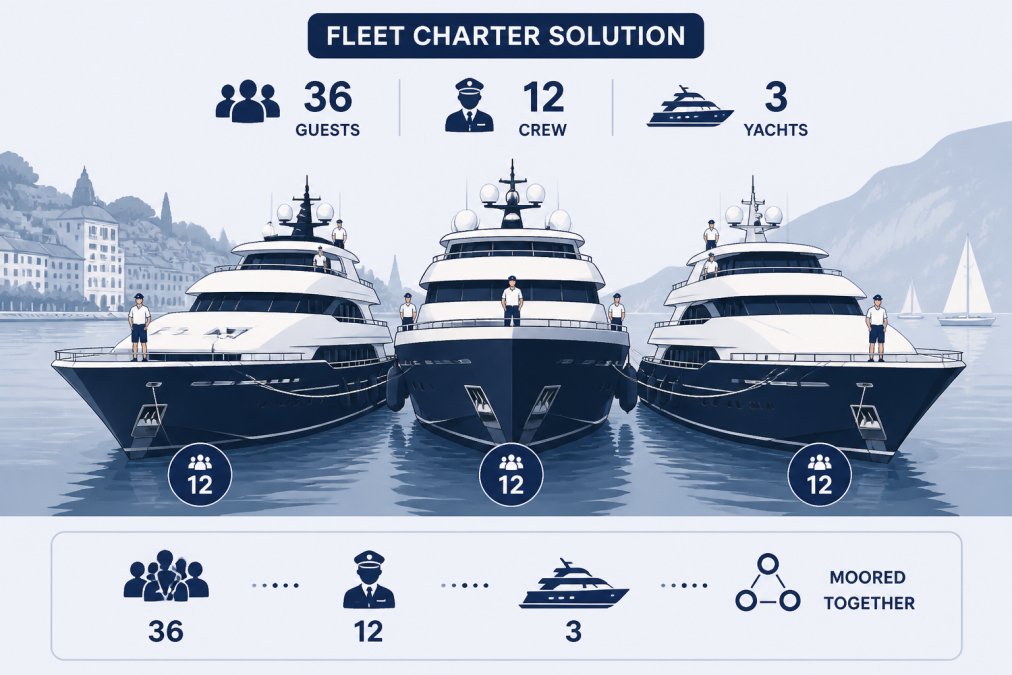
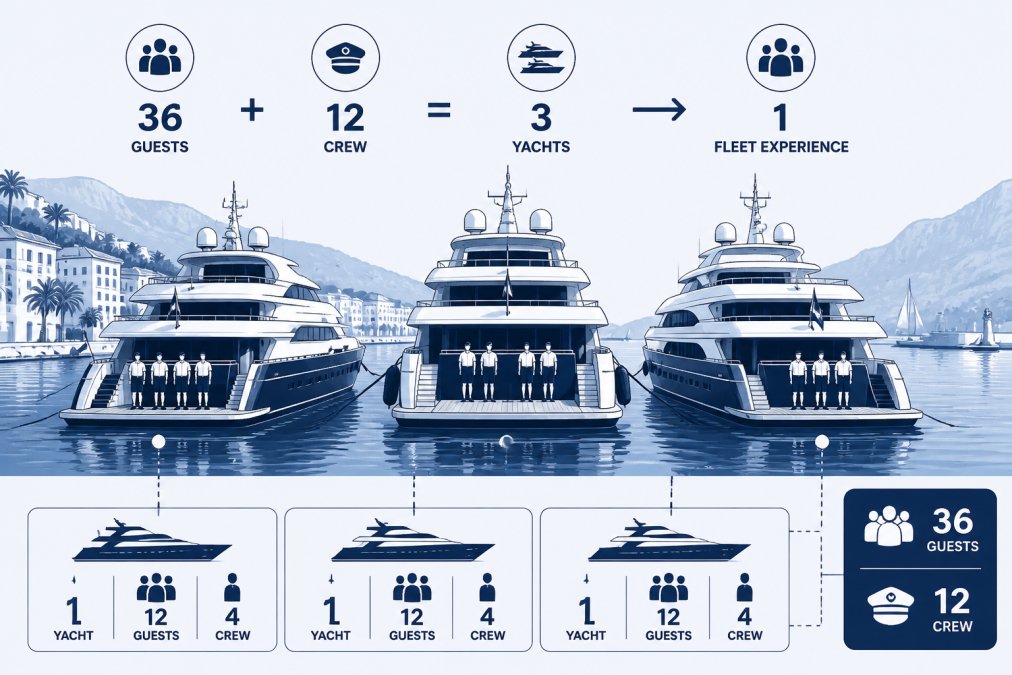
The most elegant solution for larger groups is chartering multiple vessels simultaneously. A flotilla arrangement allows you to accommodate 25, 50, or more people by deploying several yachts operating in close proximity. Each vessel independently complies with the 12-person rule, but collectively they create a larger experience.
Flotilla charters work well for corporate events, family reunions, and milestone celebrations. Participants can move between vessels, enjoy shared meals and activities, and benefit from coordinated itineraries. Each yacht remains a private vessel operating within the 12-person limit, avoiding commercial vessel reclassification entirely.
Flotilla charters command premium pricing compared to single-vessel charters, but they offer flexibility and regulatory simplicity that commercial vessel charters cannot match.
Commercial Yacht Registration and Reclassification
The alternative to flotillas is deliberately reclassifying your vessel as a commercial passenger yacht. This means transitioning from a private vessel operating under the 12-person rule to a commercial vessel operating under the Passenger Yacht Code or SOLAS requirements.
Reclassification unlocks the ability to carry 13 or more passengers legally. However, it triggers substantial regulatory, operational, and financial changes. Your vessel must undergo formal stability assessment and classification society approval. The crew must hold commercial certificates of competency. You must implement a formal safety management system. Insurance costs increase significantly. Annual compliance inspections become mandatory.
For yacht owners considering commercial charter operations, reclassification is sometimes the right choice. A vessel operating commercially year-round, carrying groups of 20-30 passengers, generates sufficient revenue to justify the regulatory burden. However, reclassification is a permanent decision with significant cost implications.
Commercial Yacht Registration in Mediterranean and European Ports: What You Need to Know
For yacht owners and charter operators in Mediterranean and European regions, commercial vessel registration involves navigating both local maritime law and international maritime standards. These jurisdictions, as signatories to SOLAS and other international maritime conventions, enforce these standards through their respective maritime authorities.
A yacht registered commercially must comply with local maritime regulations, which align with international standards but include specific regional requirements. The vessel must be surveyed by a recognized classification society such as the American Bureau of Shipping (ABS) or Lloyd’s Register. The survey assesses hull integrity, stability, life-saving equipment, navigation systems, and safety management systems.
Crew certification requirements follow international maritime standards established by the International Maritime Organization (IMO). A captain operating a commercial passenger yacht must hold a Master’s Certificate of Competency appropriate to the vessel’s size and type. Additional crew members must hold certifications matching their roles.
Get in touch with us to discuss your yachting needs. →
Insurance for commercial yachts follows international maritime insurance practices. Liability coverage is mandatory and substantial. A commercial passenger yacht carrying 20 guests requires significantly higher liability limits than a private vessel.
For operators considering commercial charter activities, the process typically involves selecting a flag state, engaging a classification society for formal assessment, obtaining commercial registration from maritime authorities, and securing appropriate insurance. Professional yacht brokerage firms facilitate this process, managing the regulatory pathway and ensuring compliance with both regional requirements and international maritime standards.
Private Yacht vs. Commercial Passenger Vessel: Key Differences
Understanding the distinction between private yachts and commercial passenger vessels clarifies why the 12-person rule matters profoundly. These represent fundamentally different operational models with distinct safety frameworks, crew requirements, and commercial implications.
A private yacht operating under the 12-person rule is legally classified as a non-commercial vessel. The owner can invite guests aboard without triggering commercial vessel regulations. Crew requirements are minimal, often just a captain and perhaps a deckhand or steward. Safety equipment must meet certain standards, but not the full complement required for commercial vessels. Insurance is considerably less expensive. The vessel can be registered under simplified procedures.
However, a private yacht cannot legally carry paying passengers. If your guests pay for their charter experience, the vessel becomes a commercial operation, triggering all regulatory requirements regardless of passenger count.
A commercial passenger vessel is explicitly designed and certified to carry paying passengers. It operates under formal safety management systems. The crew holds commercial certifications. Life-saving equipment, stability calculations, and emergency procedures are formally documented and regularly inspected. Insurance is substantially higher. Documentation is comprehensive and auditable.
For many yacht owners, the 12-person rule creates a strategic middle ground. You can operate a private vessel carrying up to 12 guests without commercial vessel requirements, yet still generate charter revenue through careful structuring.
What Happens if You Exceed the 12-Person Limit?
The consequences of exceeding the 12-person limit without proper commercial vessel classification are serious and multi-faceted, ranging from regulatory enforcement to liability exposure to criminal penalties in some jurisdictions.
Port state control authorities are the primary enforcement mechanism. When your yacht enters port in any jurisdiction, authorities can conduct inspections to verify that the vessel’s actual passenger capacity matches its declared classification. If they discover a vessel claimed to be operating under the 12-person rule is actually carrying 15 or 20 passengers, enforcement follows immediately.
The typical enforcement sequence begins with a port state control inspection. Authorities examine the vessel’s documentation, crew certificates, life-saving equipment inventory, and operational records. If discrepancies emerge, the vessel will be detained until the operator demonstrates compliance or accepts reclassification.
Detention is expensive. Crew costs continue while the vessel sits immobilized in port. Charter revenue evaporates. Reputational damage spreads through the charter industry. Future bookings cancel.
Beyond detention, substantial financial penalties apply. Most maritime jurisdictions impose significant fines for operating an unclassified commercial vessel. Insurance claims may be denied if the loss occurred during non-compliant operation. Liability exposure increases dramatically; if an accident occurs while the vessel illegally carries excess passengers, the owner faces personal liability that insurance will not cover.
In some jurisdictions, including EU member states and increasingly, international ports, criminal penalties can apply. Operating a commercial vessel without proper classification and crew certification can result in criminal charges against the owner or captain.
Operating beyond the 12-person limit without proper safety classification creates genuine safety risks. The vessel’s design, stability calculations, life-saving equipment, and crew training are calibrated for 12 passengers plus crew. Exceeding this capacity compromises safety margins.
Conclusion
The 12-person rule is a safety boundary that defines how yachts are regulated, insured, and operated internationally. Understanding this rule is essential for yacht owners, charter operators, event planners, and anyone considering large-group maritime experiences.
If you’re planning a yacht charter for a group larger than 12 people, multiple legitimate solutions exist: flotilla charters, commercial vessel reclassification, or restructuring your event to accommodate the 12-person limit. Each approach carries different cost, complexity, and regulatory implications.
For those operating in the Mediterranean, Middle East, or globally, the 12-person rule is a genuine constraint backed by international maritime law, port state control enforcement, and comprehensive liability frameworks. Attempting to circumvent it is legally risky and operationally impractical.
At Palm Lifestyle, we specialize in navigating these regulatory complexities for clients seeking sophisticated yacht charter solutions. Whether you’re chartering a private vessel within the 12-person framework or exploring commercial reclassification for larger operations, our team understands the regulatory landscape and can structure your charter to ensure compliance, safety, and seamless execution. Get in touch with us to discuss your yachting needs and explore solutions tailored to your specific requirements.
Frequently Asked Questions
Why do yachts have a 12-person limit?
The 12-person rule stems from international maritime regulations designed to determine whether a vessel qualifies as a private yacht or a commercial passenger vessel. Vessels carrying 12 or fewer passengers do not require the same extensive safety infrastructure, crew certifications, and regulatory oversight as commercial ships. Once a yacht exceeds 12 guests, it must comply with SOLAS (Safety of Life at Sea) standards, including enhanced life-saving appliances, professional crew requirements, and regular maritime safety inspections. This threshold balances operational flexibility for private charters with public safety mandates.
Can I legally charter a yacht for more than 12 people?
Yes, but it requires reclassification. You can charter for larger groups through several approaches: reclassify the yacht as a commercial passenger vessel under maritime law, hire multiple yachts for a flotilla charter, or book a vessel already registered as a commercial passenger ship. Commercial registration involves meeting enhanced safety standards, obtaining proper crew certifications, and securing appropriate liability insurance. In the Middle East and Mediterranean, many charter companies offer multi-vessel solutions specifically designed for corporate events and large family celebrations that exceed the 12-guest threshold.
Does the 12-person rule apply to all yachts in the region?
The 12-person rule applies internationally under SOLAS conventions, but specific enforcement and flag state regulations vary. A yacht's flag state (the country of registration) determines which maritime authority has jurisdiction and how strictly the rule is applied. Some flag states have stricter interpretations than others. In the UAE and Mediterranean, commercial vessels and those operating internationally must comply with international maritime law. Private yachts registered under certain flags may have different crew and safety requirements. Always verify regulations with your yacht's flag state authority and your charter broker before booking.
What is the difference between a private yacht and a commercial passenger vessel?
A private yacht carrying 12 or fewer guests is regulated as a private vessel and does not require the same safety certifications, professional crew mandates, or regulatory inspections as a commercial passenger vessel. Commercial vessels carrying more than 12 passengers must comply with SOLAS standards, maintain classification society certifications, employ qualified professional crews, conduct regular safety drills, and undergo port state control inspections. The classification determines insurance requirements, operational costs, and liability exposure. For charter operations in the Mediterranean and Gulf regions, understanding this distinction is essential for compliance and cost planning.