

Table of Contents
- Yacht Charter Planning: Types of Charters and Vessel Classes
- Choosing the Right Yacht Size for Your Group
- Luxury Yacht Charter Booking Tips: Budgets, Agreements, and Timing
- Designing a Custom Mediterranean Yacht Charter Itinerary
- Provisioning, Onboard Program, and Yacht Charter Guest Etiquette
- Insurance, Connectivity, and Sustainability in Modern Chartering
- Frequently Asked Questions
Last Updated: September 25, 2026
Yacht Charter Planning: Types of Charters and Vessel Classes
Luxury yacht charter planning begins with one decision that shapes everything downstream: the charter structure and the hull beneath your feet. Get this wrong and no amount of itinerary polish will rescue the week. This guide breaks down how experienced charterers approach that first fork in the road.
Crewed vs. Bareboat Charters
A crewed charter includes captain, crew, and full onboard service; a bareboat charter hands you the vessel and leaves navigation, provisioning, and safety to you. Most first-time luxury charterers in this region choose crewed, and for good reason: crewed vessels remove the operational burden entirely, letting you focus on guests rather than mooring lines.
Bareboat suits licensed sailors who want full control and lower overhead. It also demands proof of competence and, in many cruising grounds, a formal sailing qualification before the charter agreement is signed.
Displacement Hulls, Stabilizers, and Flybridge Configurations
Vessel class matters more than length on paper. A displacement hull delivers a smoother, quieter ride at cruising speed, which matters on longer passages between islands. Stabilizers, whether fin or gyro, determine how comfortable your guests remain at anchor in open water. A flybridge adds an upper deck for socializing and views, though it changes the vessel’s wind profile and berthing considerations.
Ask specifically whether stabilizers are zero-speed capable. Many yachts stabilize only while underway, which means your guests feel every roll during dinner at anchor.
Choosing the Right Yacht Size for Your Group
The right yacht size is determined by guest count, crew-to-guest ratio, and how you intend to use the space, not by prestige alone. A common mistake is booking to maximum capacity, which leaves no room for the service standards guests expect.
As a working rule, look at usable deck space per guest rather than the headline number. A vessel rated for twelve often feels crowded at ten once tenders, water toys, and crew movement are factored in. For groups mixing family and business hosting, separate deck zones matter more than raw length.
| Group Profile | Priority Specification | Why It Matters |
|---|---|---|
| Family with children | Shallow draft, beach club | Easier anchorage access, safe swim platform |
| Business hosting | Separate saloon, strong connectivity | Client privacy, remote work continuity |
| Mixed family and clients | Dual deck zones, tender capacity | Flexible onboard program |
| Long-range cruising | Displacement hull, zero-speed stabilizers | Comfort on passage and at anchor |
Luxury Yacht Charter Booking Tips: Budgets, Agreements, and Timing
Booking early is the single highest-leverage decision in charter planning, and the calendar is more compressed than most first-time charterers expect. The practical pattern across the Mediterranean and European cruising grounds runs roughly like this:
| Booking Window | What Is Typically Still Available | Trade-Off |
|---|---|---|
| 12+ months ahead | Full fleet choice, peak July and August weeks, preferred embarkation days | You commit before you have final guest numbers |
| 9 to 12 months ahead | Strong crewed fleet, most popular hulls, some peak weeks | Choice narrows on the largest vessels |
| 6 to 9 months ahead | Good vessels outside the busiest weeks, shoulder-season strength | Peak weeks largely gone on premium yachts |
| Under 6 months | Late availability, repositioning legs, shoulder season | Itinerary flexibility is limited by the vessel’s existing schedule |
Two structural quirks drive this. First, many crewed yachts run back-to-back weekly cycles, so a single booked week removes that hull from the pool entirely rather than just narrowing it. Second, crews are contracted per season, so a vessel’s calendar is effectively fixed once the season’s bookings fill. Booking early is not about securing a discount; it is about securing the specific hull and crew combination you want.
Reading the Charter Agreement Before You Commit
The charter agreement is the governing document, and it sets out the charter fee, the cruising area, delivery and redelivery terms, cancellation terms, and the advanced provisioning allowance (APA). Read it in that order, because the cruising area clause quietly determines what you can actually do: a vessel contracted for one cruising region cannot simply cross into another without a contractual amendment, and insurance and local permissions follow the cruising area, not your wishes.
How the APA Actually Works
The APA is a prepaid fund held against onboard and shore costs: fuel, food and beverage, berthing and harbour fees, shore transport, and similar running expenses.
- The APA is typically collected with the charter fee, before embarkation.
- The captain or management company draws against it during the charter.
- At the end, a reconciliation statement itemises what was spent.
- Any unspent balance is normally returned to the client; any overage is settled by the client after the charter.
Never sign a charter agreement that lists the APA without a defined reconciliation process, a stated holder of the funds, and a deadline for returning the unspent balance. Vague accounting is the most common source of post-charter friction.
Tax Treatment Varies by Route, Not by Flag
Deposits, Payment Schedules and Cancellation Exposure
Get in touch with us to discuss your yachting needs. →
- The exact vessel and hull, not just the class.
- The named captain, where the crew is already contracted.
- The cruising area and any restricted zones.
- The APA amount, the holder, and the reconciliation process.
- The tax treatment for your specific route.
- The cancellation schedule, in full.
- Delivery and redelivery ports and times.
Designing a Custom Mediterranean Yacht Charter Itinerary
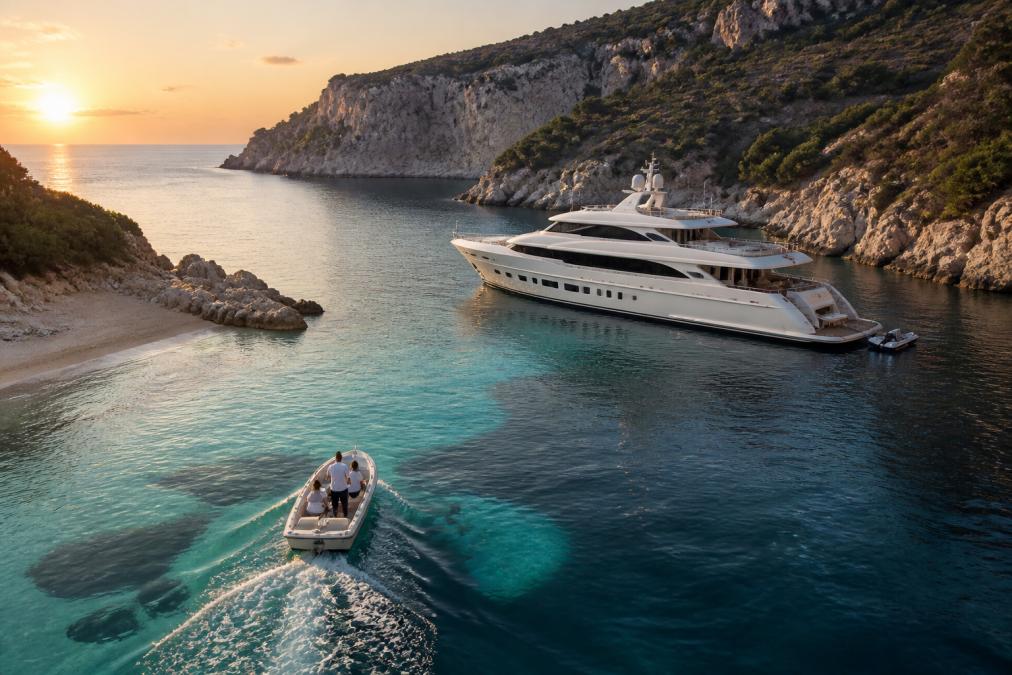
A custom Mediterranean yacht charter itinerary balances cruising distance, anchorage quality, and shore time against the pace your guests actually want. The strongest itineraries are built around two or three anchorages guests will remember, not ten they will forget.
Weather Routing and Secluded Anchorages
Provisioning, Onboard Program, and Yacht Charter Guest Etiquette
Provisioning is where a charter either feels effortless or constantly slightly off. Your guest brief, covering dietary requirements, preferred beverages, and daily rhythms, should reach the crew well before embarkation.
Insurance, Connectivity, and Sustainability in Modern Chartering
Most planning guides stop at the itinerary and the provisioning list. The three concerns below are what separate a well-run charter from a stressful one, and they are the areas where the standard advice is thinnest.
Insurance and Risk Mitigation
Two further points are worth confirming before you board:
- Medical evacuation and repatriation. Confirm what the vessel’s cover includes for medical evacuation, and whether your own policy extends to the cruising area. Remote anchorages are exactly where this matters.
- Liability for damage. Clarify in the agreement who is liable for damage to tenders, water toys and onboard equipment, and whether a security deposit or damage waiver applies.
The three questions that reveal whether a charter is properly run: who insures the vessel and to what limit, what bandwidth you actually get offshore, and how the crew manages fuel and waste. Ask them before you book, and get the answers in writing.
Digital Connectivity and Remote Work
Three systems matter, and they behave differently:
- Coastal mobile and 4G/5G. Fast and cheap near shore, unreliable or absent on passage and at remote anchorages.
- Traditional satellite (VSAT-class). Broad coverage but higher latency and metered bandwidth, which makes video calls and large file transfers painful.
- Low-earth-orbit satellite (Starlink-class). Low latency and genuinely usable bandwidth offshore, but coverage is not uniform across every cruising ground, and the terminal needs a clear view of the sky, which matters at anchor in a steep-sided cove.
Sustainability and Eco-Conscious Chartering
Beyond fuel, the practical levers are:
- Waste management. Ask how the crew separates and disposes of waste, and whether the vessel avoids single-use plastics.
- Provisioning. Reef-safe sunscreens, locally sourced produce and reduced food waste are increasingly standard on well-run vessels.
- Anchor and tender practice. Anchoring on sand rather than coral, and using tenders responsibly, protects the grounds you are there to enjoy.
- Refit and efficiency. Newer hulls and hybrid or efficient propulsion systems reduce consumption per mile, so vessel age and propulsion type are sustainability questions as well as comfort questions.
Frequently Asked Questions
What factors should be considered when selecting a luxury yacht for charter?
Focus on group size, itinerary demands, and onboard amenities. A yacht’s specifications, such as displacement hull and stabilizers, affect comfort at anchor. For a custom Mediterranean yacht charter itinerary, prioritize a shallow draft for secluded anchorages and a high crew-to-guest ratio for service. Verify the charter agreement includes all desired water toys and tender capabilities.
How far in advance should you book a luxury yacht charter?
For peak Mediterranean summer season, book 6 to 12 months ahead. This secures preferred yachts and allows time for detailed provisioning and itinerary design. Last-minute bookings are possible but limit choice on popular vessels. Early planning also helps lock in charter rates and avoid seasonal premium surcharges.
How much does it cost to charter a luxury yacht?
Charter pricing depends on yacht size, season, duration, and itinerary. A base charter fee covers the vessel and crew, while the advanced provisioning allowance (APA) covers fuel, berthing fees, and food. VAT and local taxes apply. For a precise quote tailored to your dates and guest list, contact Palm Lifestyle directly.
What is included in a typical luxury yacht charter agreement?
A standard agreement details the charter duration, cruising grounds, and crew-to-guest ratio. It specifies the base fee, APA, and VAT. Inclusions often cover yacht maintenance, navigation safety, and onboard service standards. Exclusions typically list fuel consumption, berthing fees, and special requests. Always review the guest brief and cancellation terms carefully.
How do you create a custom itinerary for a yacht charter?
Start by defining your priorities: secluded anchorages, dining experiences, or water sports. A charter broker then maps a route balancing cruising time and marina logistics. Weather routing ensures safety and comfort. For the Mediterranean, consider island hopping versus coastal exploration. A tailored itinerary also schedules provisioning and any special events.
What are the essential etiquette tips for guests on a luxury yacht?
Respect the crew’s schedule and the yacht’s rules. Follow the captain’s guidance on safety and areas off-limits. Keep noise levels considerate, especially in marinas. Dress appropriately for meals and ashore. Tipping is customary but discretionary. A clear guest brief before boarding helps everyone enjoy the experience without misunderstandings.