

Table of Contents
- Yacht Charter in Greece: What Changes in 2026
- Bareboat, Skippered or Crewed Yacht Charter Options
- The Best Time for Yacht Charter in Greece
- Sailing Regions: Cyclades, Ionian, Saronic and Dodecanese
- Building a Luxury Yacht Charter Itinerary in Greece
- The Yacht Charter Booking Process, Step by Step
- What a Yacht Charter in Greece Costs
- What to Pack and How to Prepare for a Sailing Holiday
- Hidden Gems, Family Logistics and Lower-Impact Sailing
- Frequently Asked Questions
Last Updated: September 18, 2026
Yacht Charter in Greece: What Changes in 2026
Booking a yacht charter in Greece in 2026 means planning around tighter peak-season berth availability and a booking window that now starts earlier than most travellers expect. The single biggest shift is timing: prime July and August weeks in the Cyclades are typically committed well before spring, and the practical answer is to reserve by late winter. This guide from Palm Lifestyle breaks down the options, the regions, the costs and the booking process so you can plan with confidence.
Greece remains one of the most sought-after sailing destinations in the Mediterranean, and the reasons are structural rather than fashionable. Thousands of islands sit within a few hours of each other, the meltemi winds deliver reliable summer sailing, and the country’s nautical tourism infrastructure has matured considerably. The trade-off is that popularity has consequences: marinas fill up, popular anchorages get crowded, and the gap between a well-planned charter and a last-minute one has widened.
Below, we’ll show you exactly how to choose between bareboat, skippered and crewed options, when to sail, which region suits your group, and what the whole thing realistically costs.
Bareboat, Skippered or Crewed Yacht Charter Options
The three charter structures differ mainly in who runs the boat and how much responsibility you carry. Bareboat means you take the vessel without crew and skipper it yourself. Skippered means you charter the yacht and hire a professional captain. Crewed means the vessel comes with a full team, typically a captain, chef and stewardess.
Bareboat charter is the most economical route and the right choice for experienced sailors. You’ll need a recognised sailing licence and, in most cases, an ICC (International Certificate of Competence) or an equivalent qualification, plus a sailing CV that the charter company will review. Expect a security deposit and a formal charter agreement that sets out your liabilities.
Skippered charter suits groups who want the freedom of a private yacht without the navigation and berthing responsibility. The captain handles routing, anchoring and port formalities, which matters enormously in the Cyclades where afternoon winds and crowded anchorages demand local knowledge.
Crewed yacht charter options add a private chef, stewardess and sometimes a deckhand. This is the structure most of our clients in the GCC region choose, because it converts a sailing trip into a fully hosted holiday. Meals, service and water sports equipment are handled onboard, and the itinerary flexes around your schedule rather than the other way round.
Charter Type | Who Runs the Yacht | Best For | Skill Required |
|---|---|---|---|
Bareboat | You | Experienced sailors, tight budgets | Licence plus sailing CV |
Skippered | Professional captain | Groups wanting freedom without responsibility | None |
Crewed | Captain, chef, stewardess | Hosted holidays, corporate groups, families | None |
Whichever route you take, read the charter agreement carefully. A common mistake is treating the security deposit as a formality and skipping the inventory check at embarkation. Photograph everything at handover.
The Best Time for Yacht Charter in Greece
The best time for yacht charter in Greece runs from late April to early October, with late May, June and September offering the strongest combination of warm weather, manageable winds and available berths. July and August deliver the most reliable sunshine but also the highest demand and the strongest meltemi.
The sailing season divides into three practical windows. Late April to early June brings wildflowers, cooler evenings and quiet anchorages. July and August are hot, busy and windy, which experienced sailors love and beginners sometimes don’t. September and early October are widely considered the sweet spot: the sea is still warm, the meltemi has softened, and the crowds have thinned.
The meltemi is the defining weather pattern of the Aegean. These northerly summer winds build through the afternoon and can reach forces that make exposed crossings uncomfortable. In the Ionian Islands, the same season delivers gentler conditions, which is why the Ionian is the better choice for families and less experienced crews.
If your dates are fixed by school holidays or business calendars, plan around the wind rather than against it. Sail early in the day, keep afternoon passages short, and build buffer days into the itinerary.
Sailing Regions: Cyclades, Ionian, Saronic and Dodecanese
Each region has a distinct character, and matching the region to your group matters more than matching it to a photograph. The Cyclades deliver iconic whitewashed villages and strong winds. The Ionian offers calm water and green landscapes. The Saronic Gulf is the easiest weekend region from Athens. The Dodecanese rewards longer charters with quieter, more varied cruising.
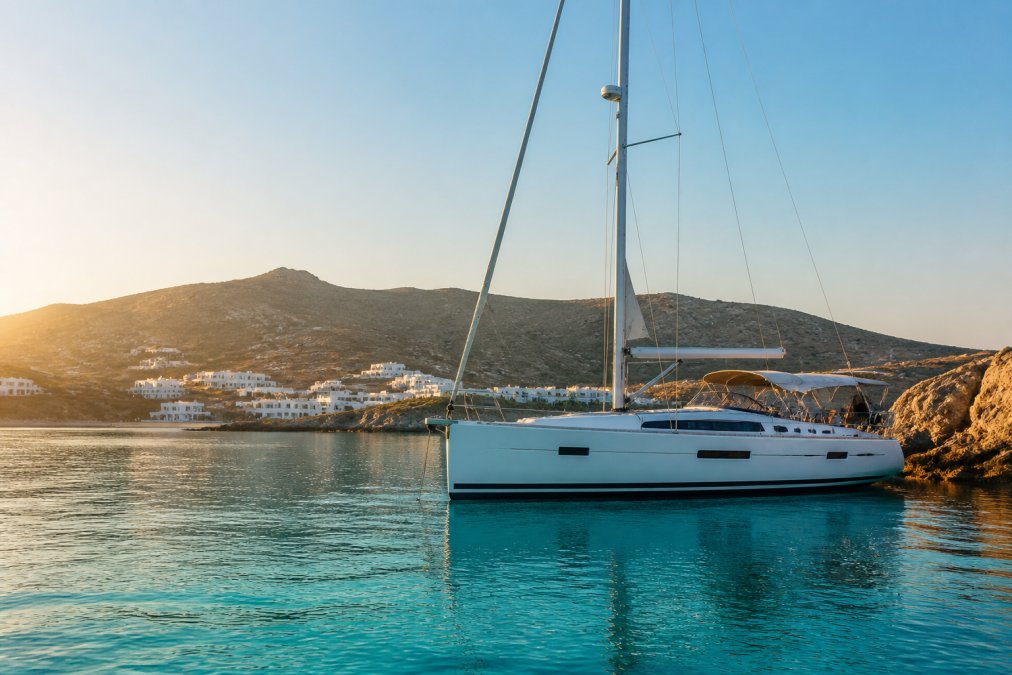
The Cyclades are the postcard Greece: Mykonos, Santorini, Paros, Naxos and a scatter of smaller islands between them. Distances are short in nautical miles but the meltemi makes some passages genuinely demanding. This is prime territory for skippered and crewed charters.
The Ionian Islands along the western coast are sheltered, green and gentle. Corfu, Lefkada, Kefalonia and Zakynthos sit within easy reach of each other, and the afternoon winds are far more forgiving. For families with young children or first-time charterers, the Ionian is the sensible starting point.
The Saronic Gulf is where Athenian sailors spend their weekends. Aegina, Poros, Hydra and Spetses are close together, which makes the Saronic ideal for a short charter or a first taste of island hopping.
The Dodecanese stretch along the eastern Aegean toward Turkey. Rhodes, Kos, Symi and Patmos offer a slower rhythm, longer passages and fewer crowds. These islands reward a two-week charter rather than a single week.
Building a Luxury Yacht Charter Itinerary in Greece
A luxury yacht charter itinerary in Greece works best when it alternates busy anchorages with quiet ones, and when it treats sailing time as a feature rather than a cost. The template below suits a seven-day Cyclades charter, but the logic transfers to any region.
- Day 1: Embarkation at the base marina, provisioning, safety briefing and a short evening sail to a nearby anchorage
- Day 2: A three to four hour passage to a larger island, with an afternoon ashore
- Day 3: A quiet cove for swimming and water sports, then a marina night for shore power and dining
- Day 4: The longest passage of the week, timed for the morning when winds are lightest
- Day 5: A hidden anchorage with no facilities, dinner onboard prepared by your private chef
- Day 6: A short hop to a village harbour, with time for local markets and a taverna lunch
- Day 7: Return passage and disembarkation, allowing a buffer for weather
The itinerary planning principle that matters most is the buffer day. Weather in the Aegean can close a passage for a day, and a schedule with no slack turns a minor forecast change into a ruined week. Build in one flexible day for every four planned.
At Palm Lifestyle, we build itineraries around fixed commitments first, whether that’s a business call that needs reliable connectivity or a family celebration that needs a specific anchorage, and then fill the sailing days around them.
The Yacht Charter Booking Process, Step by Step
The yacht charter booking process follows a predictable sequence, and understanding it upfront prevents most of the friction people encounter. The single most useful thing to know is the timeline: for peak July and August weeks, the practical booking window opens in late winter, and the best vessels in the most popular regions are typically committed by early spring.
A realistic booking timeline:
- Six to nine months ahead, define dates, group size and region, and start requesting availability on specific vessels
- Four to six months ahead, confirm the vessel, sign the charter agreement and pay the deposit
- Two to three months ahead, settle crew preferences, provisioning notes and any special requests
- Four to six weeks ahead, submit licensing documentation for bareboat charters and confirm embarkation logistics
- One week ahead, reconfirm the marina, handover time and transfer arrangements
The steps in detail:
Get in touch with us to discuss your yachting needs. →
- Define your dates, group size and guest profile. Cabin count, crew requirements and whether you will host guests onboard all shape the vessel shortlist. A group of six adults has a very different shortlist from a family of four with two young children.
- Choose your region and charter type. This narrows the fleet dramatically and sets your budget range. The Cyclades, Ionian, Saronic and Dodecanese each have different vessel availability and different peak-season pressure.
- Request availability for specific vessels. Availability in peak weeks moves quickly, so request several options at once rather than negotiating one vessel at a time.
- Review the charter agreement and deposit terms. Confirm what is included, what is excluded, how the security deposit works, and what the cancellation terms are. Read the fine print on fuel and port fees, because these are the lines most often misunderstood.
- Confirm provisioning and onboard preferences. Dietary requirements, water sports equipment and any special requests should be settled well before embarkation, not in the final week.
- Arrange crew and licensing documentation. For bareboat, submit your sailing CV and licence, typically an ICC or an equivalent qualification. For crewed, confirm crew preferences early, because the best captains and chefs are booked first.
- Plan embarkation and disembarkation logistics. Confirm the marina, the handover time and your transfer arrangements. Build in a buffer for flight delays, especially if you are arriving on the day of embarkation.
The mistakes that cost the most. Leaving provisioning and preferences until the week before departure is the most common one, because by then the best crew and the specific vessels are committed elsewhere and you are choosing from what remains. The second is treating the security deposit as a formality and skipping the inventory check at embarkation.
What a Yacht Charter in Greece Costs
Pricing for a yacht charter in Greece depends on vessel size, charter type, season, crew and itinerary, so any single figure quoted without those details is misleading. What matters more is understanding how a quote is built, because the same yacht can produce very different totals depending on how the week is structured.
The cost lines that make up a charter quote:
- Charter fee, the base rental of the vessel for the agreed period, set by vessel size, age and season
- Crew costs, for skippered and crewed charters, the captain’s day rate plus, on crewed yachts, chef and stewardess costs, often quoted as an advance provisioning allowance (APA) rather than a flat fee
- Provisioning, food and drink for the week, either self-provisioned on a bareboat or handled by the crew on a crewed charter
- Fuel, usually charged on consumption at the end of the charter, not included in the headline fee
- Port fees and marina charges, levied per night in most harbours, and higher in the busiest Cycladic marinas in peak season
- Extras, water sports equipment, paddleboards, seabobs, guided shore excursions and any specialist provisioning requests
- Crew gratuity, customary on crewed charters and typically handled separately at the end of the trip
How season moves the total. The Greek charter market prices in three broad bands. Peak season covers roughly mid-July to the end of August, when demand is highest and berth availability is tightest. Shoulder season covers late May to early July and September to early October, when conditions are still excellent but pricing eases. Low season runs from late April to mid-May and from mid-October, when some bases reduce their fleet or close entirely.
How vessel size and type move the total. A monohull is generally the most economical platform per berth. A catamaran costs more to charter but adds deck space, shade and stability, which often makes it better value for families and groups. Crewed yachts sit at the top of the range because the fee covers the vessel and the team running it.
What is usually included versus extra. Most charter fees include the vessel, standard safety equipment, tender and outboard, and basic galley equipment. Fuel, port fees, provisioning, crew gratuity and specialist extras are usually separate. Confirm each line in writing before you pay a deposit, because inclusions vary between operators and between vessel categories.
A practical way to budget. Start with the charter fee for your chosen vessel and week, then add crew costs where applicable, then provisioning, then fuel and port fees, then a contingency line for weather-driven changes such as an extra marina night. Treating the charter fee as the total is the fastest way to blow a budget.
Because pricing is genuinely bespoke, we would rather give you an accurate quote than a generic range. For current availability and pricing on specific vessels, Palm Lifestyle’s yacht charter service can put together a tailored proposal based on your dates and group.
What to Pack and How to Prepare for a Sailing Holiday
Pack for a sailing holiday in layers, in soft bags, and with far less than you think. Space onboard is measured in centimetres, not square metres, and hard suitcases are genuinely difficult to stow on a monohull or catamaran.
What to pack:
- Soft-sided bags only, with a foldable daypack for shore trips
- Non-marking deck shoes with white or light soles
- Swimwear, quick-dry towels and a rash vest for sun protection
- Light layers, a windproof jacket and a warm top for evening sailing
- High-factor sunscreen, a hat with a chin strap, and polarised sunglasses
- Personal medication, seasickness remedies and a basic first aid kit
- A universal adapter and a power bank for devices
What to leave behind:
- Hard luggage, which cannot be stowed easily
- Dark-soled shoes that mark the deck
- More clothing than you’ll realistically wear
Before you travel, confirm your documentation. For bareboat charters, bring your original sailing licence and your ICC. Check passport validity and any entry requirements well in advance, and share your arrival details with the base so transfers can be arranged.
Hidden Gems, Family Logistics and Lower-Impact Sailing
The quieter side of Greek sailing is where the best weeks happen, and it rewards a little planning. Beyond the famous islands, smaller anchorages and less-visited islands offer the same water and light with a fraction of the traffic.
Hidden gems worth building into an itinerary:
- Small Cycladic islands with a single harbour and one taverna, reachable only by boat or a long ferry
- Anchorages on the leeward side of larger islands, sheltered from the meltemi and often empty by evening
- The smaller Dodecanese islands, where a crewed yacht can stay for days without seeing another charter boat
Family logistics for younger children:
- Choose the Ionian over the Cyclades for calmer water and shorter passages
- Book a catamaran rather than a monohull: the stable platform and shaded cockpit make a real difference with small children
- Insist on properly fitted children’s life jackets, confirmed with the charter company before departure
- Keep daily passages under three hours and plan a swimming stop every afternoon
- Bring familiar snacks, entertainment for downtime, and a shade solution for the cockpit
Lower-impact sailing practices:
- Use mooring buoys and designated anchorages rather than anchoring on seagrass
- Carry refillable water bottles and minimise single-use plastic onboard
- Follow local waste separation rules at each marina and never discharge waste overboard
- Respect protected marine areas and local restrictions on fishing and anchoring
Local culinary immersion: the best meals of a Greek charter are rarely in the marinas. Ask your captain where the fishing boats land, buy from the morning market, and let your chef build the menu around what’s actually in season. A private chef who knows the islands will source locally and cook dishes you won’t find on any restaurant menu.
If your goal extends beyond a single charter, Palm Lifestyle also handles yacht purchase and can advise on whether owning and chartering out a vessel makes sense for your usage pattern.
Planning a sailing holiday in Greece is a logistics exercise as much as a holiday decision. The variables that decide whether your week is memorable or merely adequate are timing, region, vessel type and the quality of the people running the boat.
Frequently Asked Questions
Where can I charter a yacht in Greece?
Charter bases cluster around Athens and the Saronic Gulf, the Cyclades, the Ionian Islands and the Dodecanese, with smaller departure points in the Sporades and Crete. Athens works best for island hopping across multiple groups because flights and provisioning are straightforward. The Ionian suits gentler winds and shorter hops, while the Cyclades deliver the classic Aegean look with stronger summer breezes. Where you start shapes the whole route, so choose the region before the yacht.
How does the charter process work for international clients?
The yacht charter booking process usually runs in five stages: confirm your dates and guest numbers, receive a shortlist of suitable yachts, sign the charter agreement and pay the deposit, complete provisioning and crew briefings, then embark. For bareboat charter you also need a recognised sailing licence such as the ICC, plus a sailing CV. A broker handles the paperwork, security deposit terms and embarkation details so nothing is left to the last minute.
What is the ideal duration for a luxury yacht charter in the Greek islands?
Seven nights is the standard unit and gives enough time for a relaxed island hopping route with two or three anchorages per island group. Ten to fourteen nights suits the Dodecanese or a Cyclades-to-Saronic combination without rushing. Shorter three to four night charters work for a single region, but you will spend more of the trip close to your embarkation point. Match duration to distance, not to ambition.
What should be included in a bespoke yacht charter itinerary?
A strong itinerary balances sailing time, anchorages and shore days. Include daily nautical miles that suit your group, a mix of marinas and quiet bays, one or two standout dining stops, and buffer time for meltemi winds. Add water sports equipment, a private chef or stewardess if you want full service, and any cultural visits you care about. Share your priorities early so the captain can plan around weather rather than against it.