

Table of Contents
- Understanding Base Charter Rates and Weekly Pricing
- Advanced Provisioning Allowance Explained
- Standard Crew Gratuity Guidelines for Luxury Charters
- Yacht Charter Fuel Consumption Calculation
- Luxury Yacht Charter Tax Regulations and VAT
- Seasonal Pricing Variations and Hidden Costs
- Total Cost of Ownership vs. Chartering
- Conclusion
Last Updated: August 14, 2026
Understanding luxury yacht charter pricing requires unpacking multiple cost layers that extend far beyond the base rate. Most charter brokers quote a weekly rate and leave clients to discover hidden expenses later. Here’s what actually determines the true cost of chartering a superyacht, and how to navigate the pricing structure with confidence.
Understanding Base Charter Rates and Weekly Pricing
The base charter rate is the foundation of any yacht charter agreement, but it’s only the starting point. This figure represents what you pay for the vessel itself, typically quoted as a daily or weekly rate depending on the charter duration and yacht size.
Weekly rates vary dramatically based on vessel size, age, location, and season. A 30-metre motor yacht in the Mediterranean during winter might command a certain rate, while the same vessel in summer peak season costs substantially more. Smaller vessels under 24 metres often have more flexible daily pricing, while superyachts over 50 metres typically work exclusively on weekly minimums.
The base charter rate does NOT include fuel, crew gratuity, provisions, or port fees. This is where confusion begins. Many clients assume the quoted rate is all-inclusive, only to face significant additional invoicing at the end of their charter.
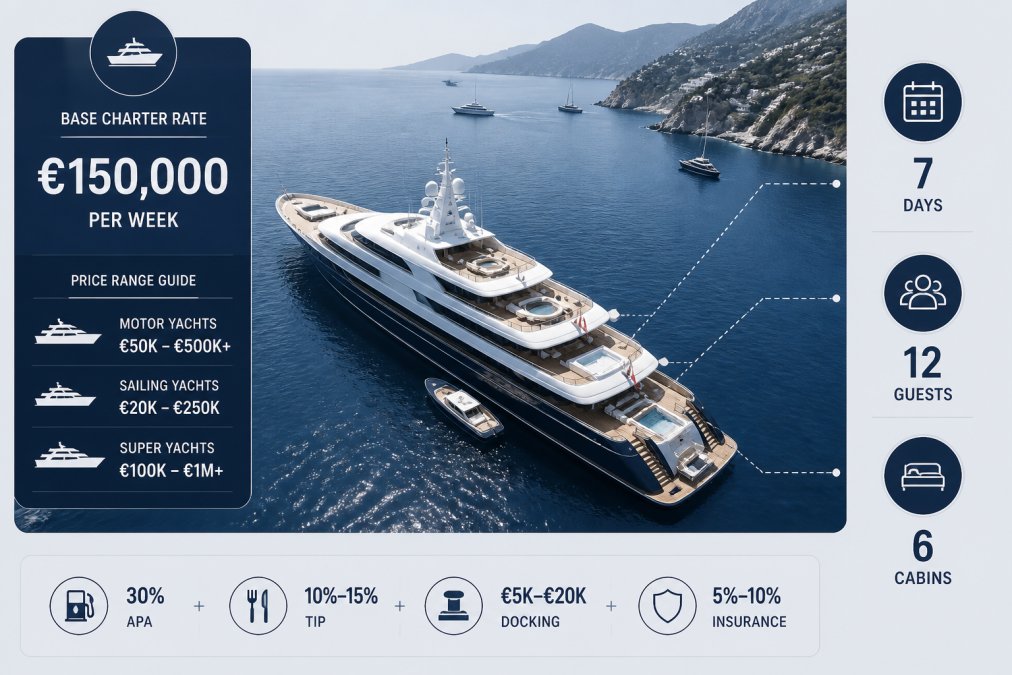
When evaluating base rates, compare vessels of similar size and specification. A newer build with advanced technology costs more than an older vessel of equivalent length. Crew experience and vessel condition directly impact pricing. Season matters significantly. High season (typically June through September in the Mediterranean) commands premium pricing, sometimes 30-50% above low season rates. Shoulder seasons offer a middle ground. Understanding these variations helps with budget planning and negotiation strategy.
Request the base rate, then ask explicitly what’s included. Many brokers bundle fuel differently, some include it in the base rate, others charge it separately as a plus-expense model. Clarifying this upfront prevents surprises.
Advanced Provisioning Allowance Explained
The Advanced Provisioning Allowance (APA) is a separate cost that catches many first-time charterers off guard. This is an upfront payment to the yacht owner or charter company, typically calculated as a percentage of the weekly base rate, commonly 25-30% of that rate.
Think of the APA as a working fund for expenses incurred during your charter. The yacht owner uses this money to cover fuel consumption, port fees, customs clearance, berthing charges, and provisions (food and beverages). At the end of your charter, you receive a detailed invoice showing exactly how the APA was spent. Any unused portion is refunded; if expenses exceed the APA, you pay the difference.
This system protects both parties. The owner has capital upfront to operate the vessel, and the client knows costs are being tracked transparently. However, the APA amount is often underestimated, leading to additional invoices after the charter ends.
Fuel consumption is the largest APA expense. A superyacht burning 150-300 litres per hour at cruising speed can consume 2,000-4,000 litres daily depending on size and speed. Fuel costs in Mediterranean ports vary by location and global market conditions. A week of cruising at moderate speed easily consumes 10,000-20,000 litres, representing a substantial portion of the APA.
Port fees and berthing charges vary dramatically. Premium marinas in Monaco, Saint-Tropez, or Ibiza charge significantly more than secondary ports. A week moored in a top-tier marina can cost several thousand euros in berthing alone.
Provisions (food, beverages, water, ice) depend on guest count and dining preferences. A chef preparing gourmet meals for 12 guests requires a substantial provisions budget. Standard provisioning runs 50-100 euros per person per day, though luxury charters often exceed this.
APA disputes are common because clients underestimate fuel and port costs. Request historical APA usage data for comparable charters on the same vessel before committing. This gives you a realistic baseline.
Standard Crew Gratuity Guidelines for Luxury Charters
Crew gratuity is a customary expense that many clients don’t anticipate. Unlike the APA, gratuity is typically a separate line item calculated at the end of your charter, not included in advance.
Standard gratuity ranges from 10-20% of the base charter rate, depending on charter duration, guest count, and service quality. A one-week charter typically sees gratuity at the higher end (15-20%), while longer charters sometimes settle at 10%. Some clients calculate gratuity per crew member (typically 100-200 euros per crew member per week) rather than as a percentage.
The crew on a superyacht includes the captain, chief stewardess, chef, deckhand, and engineer. Each crew member contributes to your experience. Gratuity is distributed by the captain according to crew hierarchy and individual contributions. It’s customary to provide gratuity in cash if possible, though some yachts accept transfers.
Gratuity is not mandatory legally, but it’s standard maritime practice. Refusing to tip after a week of professional service damages the industry and reflects poorly on future charter opportunities. Crew members depend on gratuity as part of their compensation structure.
If service is exceptional, many clients increase gratuity beyond standard percentages. Conversely, if significant issues occur, clients may reduce gratuity or withhold it entirely, though this should be discussed with the broker and captain before the end of the charter.
Yacht Charter Fuel Consumption Calculation
Fuel consumption is the most variable and often underestimated cost component in yacht charter pricing. Understanding how fuel consumption is calculated helps you budget accurately and negotiate APA amounts realistically.
Fuel consumption depends on yacht size, engine type, cruising speed, and sea conditions. A 30-metre motor yacht cruising at 10 knots consumes far less fuel than the same vessel running at 15 knots. Speed increases fuel consumption exponentially, doubling speed more than doubles fuel burn.
Most charter brokers provide fuel consumption figures in litres per hour at various speeds. A typical 40-metre superyacht might consume 120 litres per hour at 8 knots (economy cruise) and 250 litres per hour at 12 knots (standard cruise). These figures are estimates; actual consumption varies with sea state, wind, and vessel load.
Calculating weekly fuel cost requires knowing your intended itinerary and cruising profile. If you plan to cruise 6 hours daily for 7 days at 12 knots, that’s 42 hours of cruising. At 250 litres per hour, you’re looking at 10,500 litres. Fuel prices in Mediterranean ports range from 0.80 to 1.20 euros per litre depending on location and market conditions. This single week of fuel could cost 8,400 to 12,600 euros.
Most clients dramatically underestimate this figure. Brokers often quote conservative APA amounts, knowing fuel will be the primary expense. If you plan an ambitious itinerary with significant daily cruising, fuel costs will be substantial.
Request the vessel’s fuel consumption curve (a graph showing litres per hour at various speeds) and calculate your own fuel estimate based on intended cruising hours and speed. This removes guesswork from APA budgeting.
Luxury Yacht Charter Tax Regulations and VAT
Value Added Tax (VAT) on yacht charters is a critical cost component that varies significantly by jurisdiction. Understanding where your charter is based determines the tax treatment of your costs.
In the European Union, VAT on yacht charters is typically 17-23% depending on the member state. This is applied to the base charter rate and sometimes to the APA, depending on how the charter agreement is structured. A charter starting and ending in Greece, for example, is subject to Greek VAT (24%). A charter in Croatia faces Croatian VAT (25%).
Get in touch with us to discuss your yachting needs. →
The UAE and Gulf Cooperation Council countries have different tax structures. The UAE implemented VAT at 5% in 2018, applied to yacht charter services. This is significantly lower than European rates, making Middle Eastern charters more tax-efficient for certain clients.
Charter agreements often specify where VAT is calculated and who bears the cost. Some brokers quote rates excluding VAT; others include it. This distinction dramatically affects your total cost. A 100,000-euro weekly rate excluding 20% VAT becomes 120,000 euros with tax included.
Clients based outside the EU may be able to recover VAT in certain circumstances, though this requires proper documentation and advance planning. Non-EU residents chartering within the EU should discuss VAT recovery options with their broker.
Customs and immigration fees vary by destination. Charters crossing multiple countries may incur customs clearance charges, particularly if entering or leaving the Schengen area. These costs are typically covered by the APA but should be anticipated in budget planning.
Professional yacht charter brokers navigate these tax complexities.
Seasonal Pricing Variations and Hidden Costs
Seasonal demand drives dramatic pricing variations. High season (June-September) in the Mediterranean commands premium rates, sometimes 40-60% above low season pricing. Shoulder seasons (April-May and October-November) offer moderate pricing with excellent weather and fewer crowds.
Low season (December-March) provides the lowest rates but brings weather challenges. Winter cruising in the Mediterranean is possible but requires careful itinerary planning and acceptance of rougher sea conditions.
Hidden costs emerge throughout the charter period. These include:
- Customs and immigration fees: Charges for vessel clearance when crossing borders
- Mooring and docking fees: Premium marinas charge substantially more than basic anchorages
- Water and waste disposal: Some marinas charge for freshwater and waste pump-out services
- Communication charges: Satellite phone and internet costs if not included in provisions
- Tender fuel: Costs for operating the yacht’s tender (small boat) for shore excursions
- Miscellaneous services: Laundry, repairs, or additional crew services requested during charter
Many clients discover these costs only when reviewing the final APA invoice. Transparent brokers itemize potential hidden costs upfront. Request a detailed cost breakdown covering all anticipated expenses, not just base rate and fuel.
Total Cost of Ownership vs. Chartering
Comparing yacht ownership to chartering reveals why many affluent individuals choose chartering for flexibility and cost efficiency. Ownership involves substantial fixed costs regardless of usage; chartering aligns costs with actual use.
Ownership costs include annual maintenance (5-10% of vessel value), crew salaries (if kept on permanent payroll), insurance, mooring fees, and capital depreciation. A 50-million-euro superyacht costs 2.5-5 million euros annually just to maintain and operate. Add crew salaries, and annual costs easily exceed 6-8 million euros before a single nautical mile is cruised.
Chartering eliminates fixed costs entirely. You pay only for the weeks you use the vessel. A four-week annual charter costs 400,000-800,000 euros depending on vessel size and season. This is a fraction of ownership costs, and you experience different yachts and locations without the burden of asset management.
Chartering also provides access to superyachts you couldn’t afford to own. A 100-million-euro megayacht might cost 500,000 euros per week to charter, expensive, certainly, but far more achievable than purchasing.
For clients who charter frequently (8+ weeks annually), ownership becomes economically competitive, particularly if the yacht generates charter revenue during periods of non-use. This hybrid model, owning a yacht and chartering it commercially when not in personal use, appeals to many UHNWI investors.
The decision hinges on usage patterns and capital availability. Occasional charterers benefit from the flexibility and cost efficiency of rental. Frequent users or those seeking specific vessels for extended periods often find ownership or fractional ownership more practical.
Luxury yacht charter pricing extends far beyond the headline weekly rate. Base rates, Advanced Provisioning Allowances, crew gratuity, fuel consumption, and VAT combine to create total costs that often exceed initial expectations. Understanding each component and requesting detailed cost breakdowns prevents surprises and enables informed decision-making.
Palm Lifestyle specializes in transparent pricing and comprehensive charter planning. Our team breaks down every cost component, provides realistic APA estimates based on your intended itinerary, and structures charters to optimize value. Whether you’re chartering for the first time or managing a complex multi-week voyage, we ensure you understand exactly what you’re paying for and why. Get in touch with us to discuss your yachting needs and receive a detailed charter proposal tailored to your specifications.
Frequently Asked Questions
What does a base charter rate typically include?
The base charter rate covers the vessel, captain, and crew salaries for the duration of your charter. It does not include fuel, provisioning, port fees, or gratuities. Additional costs such as the Advanced Provisioning Allowance (APA), delivery fees, and berthing charges are calculated separately. Always request a detailed breakdown from your charter broker to understand exactly what the quoted rate includes and what remains as separate expenses.
How does the Advanced Provisioning Allowance (APA) work?
The APA is an estimated advance payment covering operational expenses during your charter: fuel, food, beverages, port fees, and customs clearance. Your charter broker estimates this amount based on yacht size, itinerary, and duration. You pay the APA upfront, and after the charter ends, your broker reconciles actual expenses against this estimate. Any surplus is refunded; if expenses exceed the APA, you pay the difference. Request an itemized APA breakdown before committing to understand what costs fall under this allowance.
What are standard crew gratuity guidelines for luxury yacht charters?
Crew gratuities are customary in the luxury charter industry, typically ranging from 10-15% of the base charter rate. Some clients prefer to tip crew members individually based on service quality. Gratuities are separate from the base rate and are paid directly to the crew at the end of your charter. Discuss gratuity expectations with your charter broker beforehand, as practices may vary by region and vessel. This ensures clarity and allows the crew to understand your expectations for service.
How are fuel consumption costs calculated for yacht charters?
Fuel costs depend on the yacht's engine type, size, cruising speed, and distance traveled. Brokers estimate consumption based on typical cruising patterns: a 40-metre yacht might consume 150-250 litres per hour at cruising speed. The APA includes an estimated fuel allocation. Actual fuel used during your charter is reconciled after completion. Fuel prices fluctuate, so your final bill may differ from the initial estimate. Slower cruising speeds reduce fuel consumption and overall costs, so discuss your preferred itinerary pace with your broker.
What hidden costs should I expect beyond the base charter price?
Beyond the base rate and APA, expect delivery fees (positioning the yacht to your starting location), berthing fees at marinas, security deposits (typically 10-25% of charter cost), customs and immigration clearance, special event services (catering beyond provisioning, entertainment), water sports equipment rentals, and communication costs. Some charters also charge for crew changes or additional services. Request a comprehensive cost summary that itemizes every potential expense before confirming your booking to avoid surprises.