
Table of Contents
- Understanding Sustainable Yacht Chartering
- Choosing Fuel-Efficient Yacht Charter Options
- Selecting Eco-Friendly Yacht Charter Destinations
- Best Practices for Yacht Waste Management
- Implementing Sustainable Sailing Practices Onboard
- Planning Your Itinerary with Environmental Responsibility
- Calculating and Offsetting Your Charter’s Carbon Footprint
- Conclusion
Last Updated: August 15, 2026
Understanding Sustainable Yacht Chartering
A sustainable yacht charter combines luxury maritime travel with environmental responsibility. At Palm Lifestyle, we recognize that discerning clients increasingly want their Mediterranean getaways to reflect their values, without compromising on comfort or experience. This approach means selecting vessels and practices that minimize ecological impact while delivering the seamless, personalized service that defines premium chartering.
The concept has evolved significantly. Early sustainability efforts in maritime tourism focused narrowly on fuel consumption. Today’s sustainable yacht charter encompasses waste management, marine habitat protection, crew practices, route planning, and carbon accounting. It’s no longer an afterthought, it’s a central consideration for clients who understand that their choices shape the future of Mediterranean cruising.
What makes this shift meaningful is that it doesn’t require sacrifice. Modern eco-conscious vessels offer the same amenities, performance, and style as conventional yachts. The difference lies in engineering, operational discipline, and intentional decision-making throughout the charter experience. When you plan a sustainable yacht charter, you’re not settling for less, you’re choosing smarter.
Choosing Fuel-Efficient Yacht Charter Options
Fuel efficiency is the foundation of any sustainable yacht charter. The vessel you select determines roughly 40-50% of your environmental footprint over a week-long charter period. This makes it the single most consequential decision you’ll make.
Three main propulsion categories dominate the charter market: traditional diesel monohulls, hybrid-powered vessels, and sailing catamarans with auxiliary engines. Each has distinct efficiency profiles.
Traditional diesel monohulls remain the most common charter option. Modern engines are far cleaner than older models, but they consume significant fuel. A 45-meter motor yacht typically burns 100-150 litres per day at cruising speed. For longer itineraries or frequent engine use, this adds up quickly.
Hybrid-powered yachts combine diesel engines with battery systems and solar panels. They switch to electric propulsion in harbors and calm conditions, reserving fuel for open-water transit. A hybrid vessel might reduce fuel consumption by 25-35% compared to a conventional equivalent. The trade-off: hybrid yachts command premium charter rates, and availability remains limited in the Mediterranean.
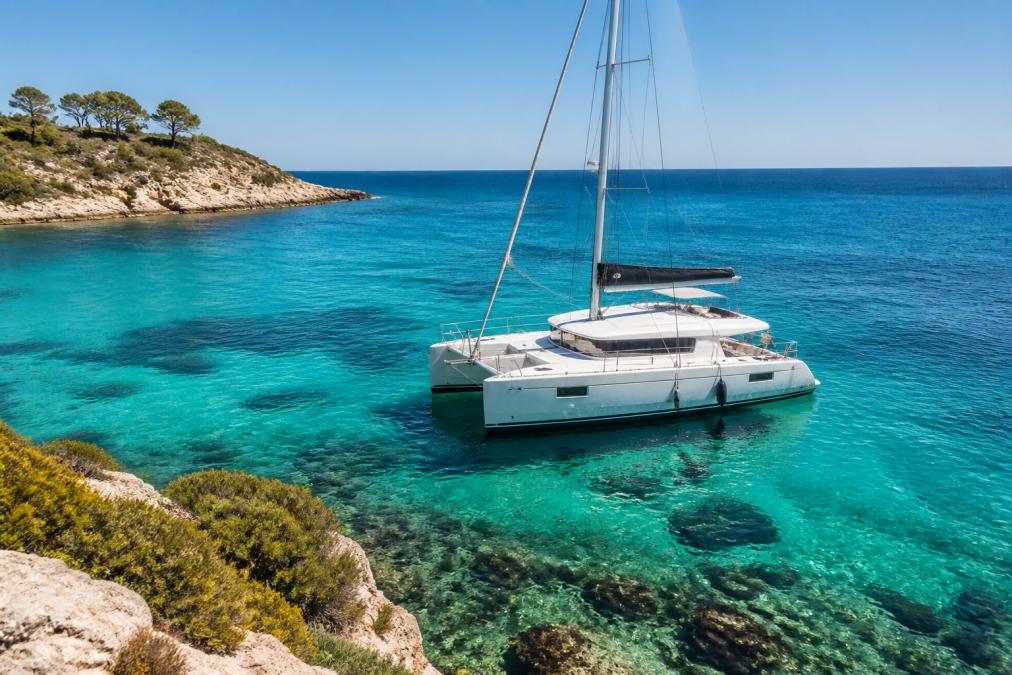
Sailing catamarans with auxiliary engines offer the most efficient option for many charterers. Under sail, they consume virtually no fuel. Even when motoring, a catamaran’s hull design and lighter weight mean fuel consumption drops to 40-60 litres per day. The catch: sailing requires favorable wind patterns and a more flexible schedule. If your itinerary demands strict timing, a catamaran may not suit your needs.
When selecting a sustainable yacht charter, ask your broker for fuel consumption data specific to your planned route and season. Weather conditions, sea state, and cruising speed dramatically affect actual consumption. Palm Lifestyle can provide detailed fuel projections based on historical data for your chosen route, this transparency helps you understand the true environmental cost before committing.
Selecting Eco-Friendly Yacht Charter Destinations
Not all Mediterranean destinations are equal from an environmental perspective. Some regions have established marine protection frameworks, active conservation programs, and infrastructure designed to minimize cruiser impact. Others lack regulatory oversight, making it easier to damage sensitive ecosystems.
The best eco-friendly yacht charter destinations share three characteristics: marine protected areas with clear guidelines, active environmental management, and infrastructure that supports sustainable practices (waste disposal, water refilling, recycling programs).
Croatia’s Adriatic coast has emerged as a leader in sustainable chartering. The country designated several national parks and marine reserves with strict anchoring and fishing regulations. Mljet National Park and the Kornati Islands require permits but offer pristine waters and well-managed visitor infrastructure. Local authorities actively enforce environmental rules, making compliance straightforward.
Greece’s Ionian Islands balance accessibility with conservation. The region has fewer protected areas than Croatia but strong local environmental awareness. Many harbors now offer recycling facilities and water-saving infrastructure. The islands’ smaller scale means less overtourism pressure than popular Spanish or French destinations.
Southern France’s Côte d’Azur presents mixed sustainability credentials. The region has excellent waste management and environmental regulations, but high-traffic anchorages around Saint-Tropez and Antibes experience significant seagrass damage from anchor drag. If you choose this region, select less-crowded anchorages and practice careful mooring techniques.
Italy’s Aeolian Islands offer dramatic scenery with moderate environmental oversight. The islands have marine protected status, but enforcement varies. Anchoring restrictions exist around Stromboli and Panarea, respect them. Local communities depend on tourism but also on fishing, creating natural incentives for environmental stewardship.
The worst choices for sustainable yacht chartering are high-traffic, unregulated areas where anchoring damage accumulates unchecked and waste infrastructure is absent. These typically include overcrowded Spanish beach destinations in July-August and unprotected Turkish anchorages with minimal environmental management.
Best Practices for Yacht Waste Management
Waste management separates genuine sustainable yacht charter practice from superficial greenwashing. Proper protocols require discipline, planning, and sometimes inconvenience. They’re also non-negotiable if you take environmental responsibility seriously.
The Mediterranean generates strict regulations around marine waste. International maritime law (MARPOL Annex V) prohibits dumping most waste at sea. EU member states enforce additional rules through port state control. Violating these regulations carries fines up to several thousand euros and potential vessel detention.
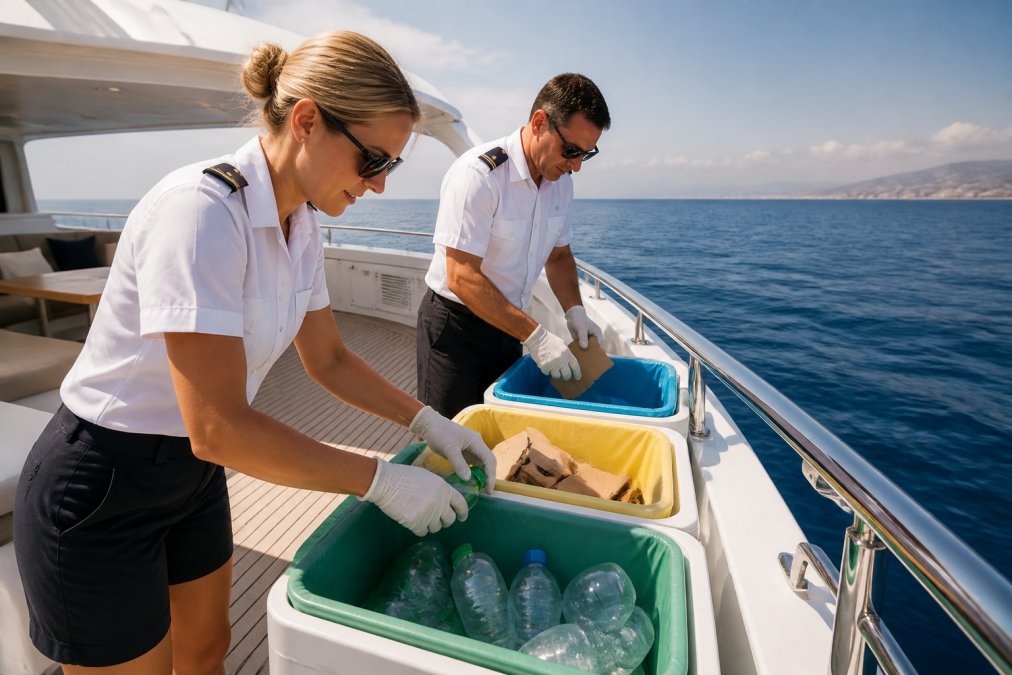
Solid waste requires segregation from the moment it’s generated. Establish separate containers for food waste, recyclables (plastic, glass, metal), paper, and general refuse. Food waste can be composted onboard if your vessel has a system, or stored for disposal at port. Never assume that "biodegradable" items break down quickly at sea, they don’t.
Plastic management demands vigilance. Single-use plastics should be eliminated entirely. Bring reusable containers, bottles, and bags from home. Refuse plastic-wrapped provisions when provisioning. Microplastics from synthetic textiles enter the ocean during laundry, use a microfiber-catching washing machine bag if available.
Greywater (wastewater from sinks, showers, and galley) can be discharged at sea under MARPOL rules, but only beyond 12 nautical miles from shore and only if it’s filtered. Better practice: store greywater and discharge it at port facilities. This requires larger holding tanks but eliminates the risk of harming coastal ecosystems.
Engine oil and fuel residues must never enter the water. Use absorbent pads for minor spills. Store used oil in sealed containers for proper disposal at port. Many Mediterranean marinas now offer free or low-cost oil disposal services.
Hazardous materials (batteries, paint, cleaning products) require special handling. Minimize purchases of these items before departure. Store what you must have in sealed, labeled containers. Never attempt to dispose of hazardous materials overboard, penalties are severe, and the environmental damage is irreversible.
Create a waste management schedule and assign responsibility. Designate crew members to manage sorting, storage, and port disposal. Document what you dispose of and where. This record demonstrates your commitment to compliance and helps identify areas for improvement on future charters.
Implementing Sustainable Sailing Practices Onboard
Sustainable sailing practices extend beyond waste management into daily operational choices. These practices reduce fuel consumption, protect marine life, and minimize cumulative ecosystem damage.
Anchor management is perhaps the most consequential daily decision. Anchoring in seagrass meadows (Posidonia oceanica in the Mediterranean) causes permanent damage, the plant grows only centimeters per year and takes decades to recover from anchor drag. Before anchoring, study your chart and identify sandy or rocky bottoms. Use a GPS anchor alarm to alert you if your vessel drifts. Consider using a mooring buoy if available, these are specifically designed to protect seagrass.
Get in touch with us to discuss your yachting needs. →
Speed optimization directly affects fuel consumption and marine life disturbance. Reducing cruising speed from 10 knots to 8 knots can cut fuel consumption by 20-30%. Slower speeds also reduce noise pollution, which disrupts whale and dolphin communication. Plan your itinerary with realistic transit times that allow for lower-speed cruising.
Engine idle time wastes fuel and creates unnecessary emissions. Turn off the engine when anchored or moored. Use natural ventilation when possible instead of air conditioning. If you’re waiting in harbor, kill the engine, don’t let it run idle while you’re ashore.
Water conservation matters onboard. Mediterranean freshwater is precious, especially in summer. Use saltwater for deck washing and engine cooling. Limit showers to 5 minutes. Repair leaks immediately. Some yachts now use watermakers (desalination units) powered by solar panels, if your charter vessel has this, use it responsibly.
Wildlife respect requires awareness and restraint. Never chase dolphins or whales. Avoid sudden course changes near marine mammals. Don’t feed seabirds, it disrupts their natural behavior and creates dependency. Observe marine life from a distance. If you encounter a protected species, reduce speed and maintain distance as required by local regulations.
Local sourcing for provisions supports coastal communities and reduces transportation emissions. Buy from local markets rather than supermarkets. Choose seasonal produce. Support fisheries that use sustainable practices. Ask your provisioning agent (or Palm Lifestyle’s team) to source from vendors with environmental certifications.
Planning Your Itinerary with Environmental Responsibility
Your itinerary structure determines your environmental impact as much as your vessel choice. A poorly planned route means excessive motoring, rushed transits, and pressure to ignore environmental guidelines. A well-designed itinerary builds in time for sustainable practices.
Start by identifying your priorities. Are you interested in marine protected areas, cultural heritage, or specific natural features? Your priorities shape which destinations make sense. Don’t force a destination into your itinerary because it’s "famous", choose places that align with your values and allow adequate time for exploration.
Distance and transit time require realistic planning. A common mistake is attempting to cover too much distance in too few days. This forces high-speed cruising, increases fuel consumption, and leaves no time for responsible anchoring or local engagement. A sustainable itinerary typically covers 50-80 nautical miles per day, allowing for leisurely morning departures, afternoon arrival, and evening exploration.
Seasonal timing affects environmental impact significantly. Peak season (July-August) concentrates boats in limited anchorages, causing cumulative seagrass damage and overcrowding. Shoulder seasons (May-June and September-October) offer calmer conditions, fewer crowds, and better weather predictability. If possible, avoid peak season entirely.
Protected area regulations require advance research. Many marine reserves require permits, have anchoring restrictions, or limit visitor numbers. Obtain permits before departure. Understand no-anchor zones and respect them. Some areas prohibit night anchoring or require mooring buoys, plan accordingly.
Rest days are essential. Build 1-2 rest days into every week-long charter. Use these days to explore a destination thoroughly, support local businesses, and reduce overall transit distance. Rest days also allow crew to rest and reduce fatigue-related mistakes.
Crew coordination ensures everyone understands sustainability protocols. Brief your crew on waste management, anchoring practices, and wildlife respect before departure. Assign specific responsibilities. Check in daily about compliance. Sustainable practices require buy-in from everyone onboard.
Calculating and Offsetting Your Charter’s Carbon Footprint
Understanding your charter’s carbon footprint transforms sustainability from an abstract concept into a measurable commitment. Once you know your impact, you can take concrete steps to offset it.
Fuel consumption is the primary driver of your carbon footprint. A litre of marine diesel produces approximately 3.15 kilograms of CO2 when burned. If your 45-meter yacht consumes 120 litres per day for seven days, that’s 840 litres total, or roughly 2,646 kilograms (2.6 metric tonnes) of CO2.
To calculate your specific footprint:
- Obtain fuel consumption data for your vessel (ask your charter broker or check the vessel’s specification sheet)
- Estimate total fuel consumption based on planned transit distance and speed
- Multiply total fuel consumption (in litres) by 3.15 to get CO2 emissions in kilograms
- Convert to metric tonnes by dividing by 1,000
This calculation assumes diesel propulsion. Hybrid vessels reduce the figure by 25-35%. Sailing yachts under sail produce zero emissions during sailing periods, calculate only engine-use time.
Carbon offset programs allow you to neutralize your emissions by funding environmental projects. Reputable programs include reforestation initiatives, renewable energy projects, and marine conservation. Offset costs typically range from €15-40 per metric tonne of CO2, depending on the program’s credibility and project type.
When selecting an offset program, verify its credentials. Look for third-party certification (Gold Standard, Verra) and transparency about how funds are used. Avoid programs that make vague claims about "carbon neutrality", legitimate programs specify exactly which projects your money supports.
Some charter companies now offer integrated carbon offsetting, where the offset cost is included in your charter fee. This simplifies the process but may limit your choice of offset programs. If your charter doesn’t include offsetting, you can arrange it independently through organizations like Carbon Footprint Ltd or similar verified providers.
Beyond offsetting, the most effective approach is reducing your footprint at source. Choosing a hybrid or sailing vessel, planning efficient routes, and limiting transit speed all reduce emissions more effectively than offsetting. Offsetting should complement, not replace, these primary reduction strategies.
Planning a sustainable yacht charter in the Mediterranean requires intentional decision-making across multiple dimensions: vessel selection, destination choice, onboard practices, and carbon accountability. The good news is that each decision compounds. A fuel-efficient vessel in a well-managed destination with disciplined crew practices creates a charter experience that honors both luxury and environmental stewardship.
At Palm Lifestyle, we specialize in designing sustainable yacht charter itineraries that align with your values and timeline. Our team has deep knowledge of Mediterranean destinations with strong environmental credentials, access to fuel-efficient vessels, and expertise in carbon accounting. We handle the complexity so you can focus on the experience. Get in touch with us to discuss your sustainable yacht charter needs and discover how we can create something truly meaningful for your next Mediterranean voyage.
Frequently Asked Questions
What makes a yacht charter sustainable?
A sustainable yacht charter combines several elements: selecting vessels with fuel-efficient engines or hybrid propulsion, choosing protected marine areas and responsible destinations, implementing strict waste management protocols, and calculating your carbon footprint. It also means working with operators who prioritize environmental compliance, support local communities, and minimize impact on marine ecosystems. Responsible tourism practices, like respecting marine reserves and using eco-certified provisioning, complete the picture.
How do I choose a fuel-efficient yacht for my charter?
Compare vessels by their fuel consumption per nautical mile and engine specifications. Modern hybrid-powered yachts and those with solar-assisted systems offer significant efficiency gains. Ask charter operators for fuel consumption data under typical cruising conditions. Catamarans often use less fuel than monohulls due to their hull design. Request information about the yacht's maintenance history and engine upgrades, as well-maintained vessels perform more efficiently. Smaller vessels naturally consume less fuel, so match your yacht size to your actual guest count.
What are the best practices for waste management on a yacht?
Establish a comprehensive greywater management system that treats wastewater before discharge. Use designated containers for recyclables, organic waste, and hazardous materials. Never dispose of plastics or fuel-contaminated waste overboard. Store all waste securely until reaching port facilities equipped for proper disposal. Implement a plastic-free policy by avoiding single-use items and using reusable alternatives. Train your crew on waste segregation protocols and maintain detailed logs of all waste handling. Partner with marinas that offer waste reception facilities compliant with maritime regulations.
Are there environmental regulations for yachts in the Mediterranean?
Yes. Mediterranean countries enforce strict maritime regulations protecting marine reserves and protected national parks. Many areas require permits for anchoring in sensitive zones and restrict discharge of pollutants. International maritime law governs ballast water management and fuel specifications. Local authorities enforce rules on noise pollution and wildlife disturbance. Charter agreements should clearly outline compliance with these regulations. Working with experienced operators ensures your charter meets all legal requirements while protecting fragile ecosystems.