
Table of Contents
Annual Yacht Maintenance Cost Breakdown: Key Expense Categories
Your Annual Yacht Maintenance Checklist and What Each Item Costs
DIY vs Professional Yacht Maintenance: Cost and Risk Compared
Last Updated: June 17, 2026
Owning a yacht is one of the most rewarding expressions of the luxury lifestyle, and one of the most financially complex. This guide from Palm Lifestyle examines every major cost category, regional variables, and the real difference between DIY and professional maintenance.
The “10% rule” is a starting point, not a budget. Actual annual operating expenses vary dramatically based on vessel age, size, flag state, and berth location.
Annual Yacht Maintenance Cost Breakdown: Key Expense Categories
Annual yacht maintenance covers all recurring, preventative, and corrective expenses required to keep a vessel seaworthy, compliant, and in premium condition. The most useful framework groups these into three tiers:
Tier 1: Fixed Annual Overhead
Dockage and mooring fees
Marine insurance premiums
Crew salaries (if applicable)
Flag state registration and annual survey fees
Tier 2: Scheduled Preventative Maintenance
Haul-out and anti-fouling treatment
Engine servicing and marine systems checks
Winterization (for northern European or US East Coast berths)
Electrical and navigation system inspections
Tier 3: Variable and Emergency Costs
Fuel consumption
Capital improvements and refit work
Emergency repairs
Yacht chartering management fees (if the vessel is placed on charter)
Fixed overhead is predictable; variable costs are where owners consistently underestimate exposure.

According to the International Maritime Organization’s vessel maintenance guidelines, regular preventative maintenance is the single most effective way to control long-term operating costs. A neglected seacock or failing bilge pump can escalate from a minor service item to a significant structural repair within a single season.
The 10% Rule: What It Actually Means
The 10% rule states that annual operating expenses typically equal roughly 10% of a vessel’s purchase price, a USD 1 million yacht should budget approximately USD 100,000 per year. This holds reasonably well for mid-size vessels in the 40-80 foot range. For superyachts above 30 meters, the percentage climbs higher because crew salaries, refit cycles, and insurance premiums scale faster than market value.
The rule also breaks down for older vessels. A 15-year-old 60-foot motor yacht may have a market value of USD 600,000 but require maintenance spend closer to a newer USD 900,000 vessel. Vessel age is a multiplier the 10% rule ignores entirely.
Your Annual Yacht Maintenance Checklist and What Each Item Costs
Haul-Out and Anti-Fouling
Haul-out is an annual requirement for most vessels. Skipping a cycle is a false economy: biofouling increases drag and can cause osmotic blistering in GRP hulls requiring expensive remediation.
Dockage and Mooring Fees
Dockage fees vary more by region than almost any other cost category. Berths in Monaco or Portofino command a significant premium over Croatia, Turkey, or the UAE. Long-term mooring contracts typically offer meaningful discounts versus nightly rates.
Crew Salaries and Vessel Management
Crew salaries represent the largest single line item for most vessels above 50 feet. Vessel management companies handle crew payroll, compliance, and provisioning for an annual fee, worth considering for owners not based near their vessel’s home port.
Marine Insurance Premiums
Premiums reflect hull value, cruising area, vessel age, and claims history. Agreed value policies are standard for premium yachts and preferred by most lenders and flag states.
Fuel Consumption
Fuel is the most variable and hardest-to-predict operating expense. Many owners underestimate annual fuel spend by planning passages at cruising speed but running at higher RPMs in practice.
Cost Category | Frequency | Notes |
|---|---|---|
Haul-Out and Anti-Fouling | Annual | Hull size and paint grade affect cost |
Dockage / Mooring | Annual or Monthly | Regional variation is significant |
Marine Insurance | Annual | Based on hull value and cruising area |
Crew Salaries | Monthly | Scales with vessel size and crew count |
Engine Servicing | Annual / Per Hours | Manufacturer intervals vary |
Winterization | Seasonal | Required for northern climates |
Survey / Inspection | Every 5 Years (Class) | Annual for insurance compliance |
Emergency Fund | Rolling Reserve | Typically 10-15% of maintenance budget |
According to the Royal Yachting Association’s ownership cost guidance, preventative maintenance schedules followed consistently reduce the likelihood of major unplanned repair events significantly over a vessel’s operating life.
DIY vs Professional Yacht Maintenance: Cost and Risk Compared
The right approach depends on the task, the owner’s technical competence, and the regulatory environment.
Where DIY Makes Sense
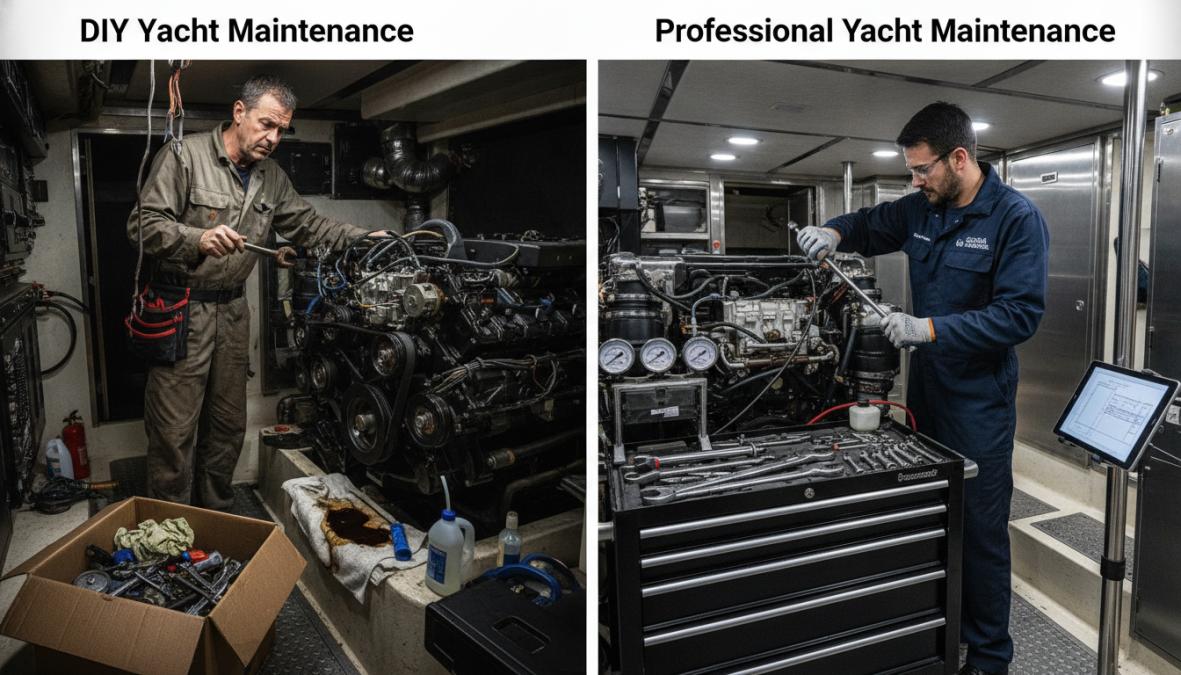
Cosmetic maintenance, basic cleaning, teak care, varnish work, canvas repairs, and routine bilge maintenance are well within the capability of most engaged owners. Learning basic engine checks and fluid top-ups is genuinely useful for owners who spend extended time aboard.
Where Professional Maintenance Is Non-Negotiable
Structural repairs, below-waterline work, gas systems, high-voltage electrical systems, and anything touching safety equipment must be handled by certified marine professionals. A DIY repair on a through-hull fitting that contributes to an incident will void your coverage and expose you to personal liability.
Regional Cost Variance
Professional marine labor rates vary considerably by region. Yards in Turkey and Croatia offer competitive rates compared to France, the UK, or the US. UAE-based yards now offer competitive quality and turnaround for vessels wintering in the Arabian Gulf.
As documented in Lloyd’s Register’s marine maintenance standards, class-certified maintenance records are a significant factor in vessel valuation at resale.
Yacht Insurance Cost Percentage and Refit Cost Estimation
Understanding Yacht Insurance as a Percentage of Value
Marine insurance premiums are calculated as a percentage of agreed hull value, adjusted for cruising area, owner experience, vessel age, and professional crew. Third-party liability coverage is separate from hull insurance, many marinas and flag states require minimum liability limits as a condition of entry. Owners who charter commercially face additional P&I (Protection and Indemnity) requirements beyond standard leisure policies.
Refit Cost Estimation: The Part Nobody Plans For
Refit covers significant maintenance work beyond routine annual servicing. A full refit on a 20-year-old motor yacht can encompass engine replacement, electrical rewiring, interior refurbishment, and structural repairs, the primary reason the 10% rule breaks down for older vessels. A practical approach is the depreciation-adjusted reserve model: set aside a dedicated annual refit reserve based on vessel age and condition rather than purchase price.
Maintenance for Older Vessels (10+ Years)
Older vessels require a different maintenance philosophy. Rubber seals, hoses, impellers, anodes, and electrical connections all degrade with time regardless of use. A pre-purchase survey by a qualified marine surveyor is essential before acquiring any vessel over a decade old, the hidden cost is not the purchase price but the capital improvement cycle that begins almost immediately after acquisition.
According to the American Bureau of Shipping’s guidance on vessel condition surveys, vessels that receive regular class surveys and maintain certified maintenance records retain significantly stronger market values and are easier to finance and insure.
Yacht Chartering as an Offset Strategy
Placing a vessel on charter through a reputable management company can cover a meaningful portion of dockage, crew, and insurance costs in a strong season. For owners who use their yacht fewer than 10-12 weeks per year, charter income often makes the ownership economics significantly more attractive.
Yacht ownership rewards those who plan carefully and budget honestly. The annual yacht maintenance cost breakdown is more complex than any single rule captures. Palm Lifestyle provides comprehensive end-to-end support for yacht owners and buyers across the GCC and Mediterranean, including professional yacht valuation, strategic marketing for sellers, and access to a worldwide fleet for charter. Get in touch with us to discuss your yachting needs and build an ownership plan that matches your lifestyle standards.
Frequently Asked Questions
What is the 10% rule for yacht maintenance costs?
The 10% rule is a widely used guideline suggesting that annual yacht maintenance and operating expenses will total approximately 10% of the vessel's purchase price each year. For example, a yacht valued at $1 million may incur around $100,000 in annual costs. While useful as a starting point, this rule can underestimate expenses for older vessels or those based in high-cost regions like the Mediterranean, where dockage fees and crew salaries are significantly higher.
What are the main categories in an annual yacht maintenance budget?
A comprehensive annual yacht maintenance cost breakdown typically includes dockage and mooring fees, fuel consumption, crew salaries, marine insurance premiums, haul-out and anti-fouling treatments, preventative maintenance on marine systems, and an emergency fund for unexpected repairs. Larger yachts also require capital improvements and periodic refit expenditure. Budgeting for each category separately — rather than relying solely on the 10% rule — gives owners a far more accurate operating budget.
Is it cheaper to DIY or hire professionals for yacht maintenance?
DIY yacht maintenance can reduce labour costs on straightforward tasks such as cleaning, varnishing, and minor cosmetic repairs. However, complex marine systems — including electrical, mechanical, and structural components — require certified professionals. Errors in DIY work on critical systems can void insurance coverage and lead to far more expensive repairs. For most owners, a hybrid approach works best: handle routine upkeep personally and engage qualified technicians for technical or safety-critical work.
How does yacht size affect annual maintenance costs?
Yacht size is one of the most significant factors in the annual yacht maintenance cost breakdown. Larger vessels demand higher crew salaries, greater fuel consumption, more expensive haul-out procedures, and higher marine insurance premiums. A 40-foot sailing yacht may cost a fraction of what a 100-foot superyacht requires annually. Regional dockage fees also scale with vessel length, making size a multiplier across virtually every operating expense category.
How often should a yacht undergo a major refit?
Most industry professionals recommend a full refit every five to ten years, depending on vessel age, usage intensity, and build quality. Older vessels — particularly those over ten years old — may require more frequent attention to hull integrity, mechanical systems, and safety equipment. A yacht refit cost estimation should account for labour, materials, haul-out time, and any capital improvements identified during a professional survey. Proactive refits typically cost less than emergency repairs deferred over time.
What is a typical yacht insurance cost percentage?
Marine insurance premiums generally range from 1% to 2% of the yacht's agreed insured value annually, though this varies based on cruising area, vessel age, crew experience, and claims history. Yachts operating in higher-risk regions or with limited professional crew may attract higher rates. Including insurance as a fixed line item in your annual operating budget — rather than treating it as optional — is essential for responsible yacht ownership and often required by marinas and charter operators.