
Table of Contents
- Understanding Yachts with Helipads for Sale
- Superyacht Helipad Requirements Explained
- Cost of Operating a Yacht with a Helipad
- Expedition Yachts with Helipads for Sale
- Modern Superyachts with Helipad Design
- Entry-Level Helipad Yachts for Sale
- Charter vs. Purchase: Finding Your Ideal Helipad Yacht
- How to Choose the Right Yacht with Helipad for Sale
Yachts with Helipads for Sale: A Buyer’s Guide
Last Updated: July 2, 2026
Acquiring a yacht with helipad represents one of the most significant decisions in luxury maritime ownership. This guide covers the technical specifications, operational realities, and strategic considerations that separate informed buyers from those who discover critical limitations after purchase.
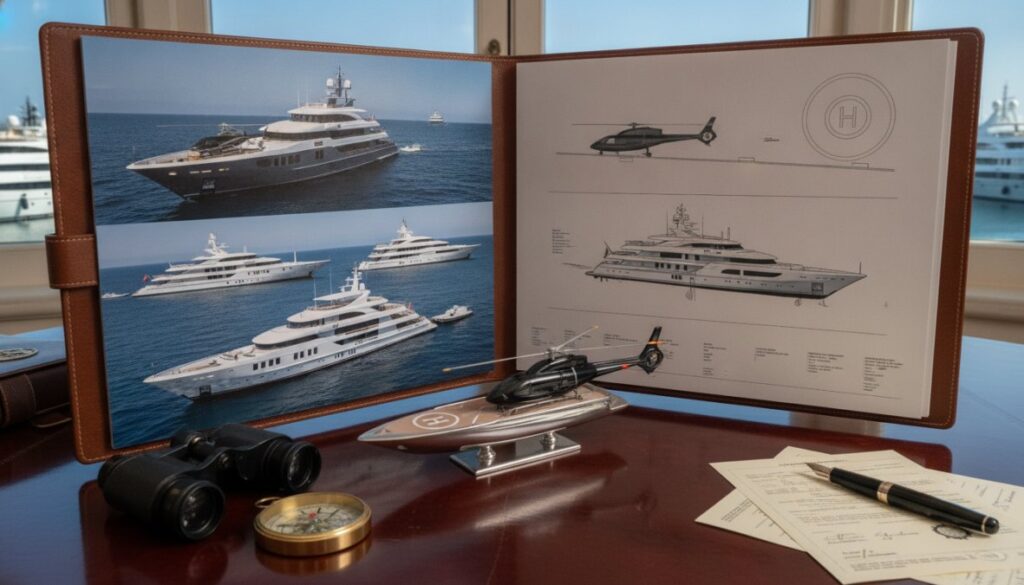
Understanding Yachts with Helipads for Sale
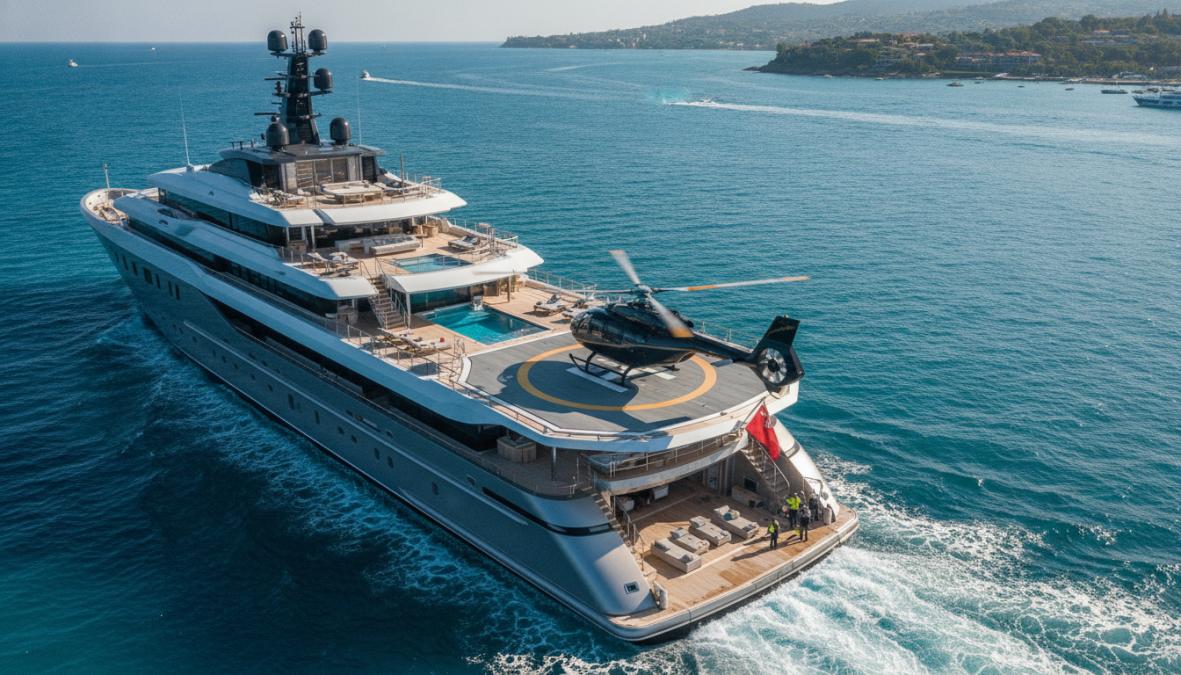
A helipad-equipped yacht requires structural reinforcement, specialized deck design, safety systems, and crew training that cascade through every aspect of vessel operation. The deck must accommodate rotor wash forces, landing gear impact loads, and fuel storage for helicopter operations.
The market bifurcates sharply. Entry-level options (45-55 meters) offer touch-and-go landing capability for occasional helicopter access. Expedition megayachts exceeding 100 meters feature integrated hangars, commercial-grade helipads, and support infrastructure rivaling small airports.
The single biggest mistake buyers make is treating the helipad as an afterthought. Vessel selection should begin with your aviation needs, not end with them. If you need to transport a 5-ton helicopter regularly, a touch-and-go deck won’t deliver the reliability you’re paying for.
Superyachts vs. Megayachts with Aviation Capabilities
Superyachts (typically 24-50 meters) with helipad capability feature lighter-duty landing pads for smaller helicopters and brief operations. The helipad serves primarily as a convenient transfer mechanism for guests.
Megayachts (50+ meters) incorporate hangar space, fuel storage, and maintenance facilities that transform the vessel into a mobile aviation platform. The operational cost differential is substantial. Superyachts with helipads typically add 8-12% to running costs. Megayachts with full aviation facilities can see operational expenses increase 20-30% when accounting for helicopter storage, fuel management, and specialized crew requirements.
Superyacht Helipad Requirements Explained
Helicopter compatibility hinges on three critical specifications: deck load rating, deck dimensions, and approach clearance. A typical light helicopter weighs 2,000-3,500 kilograms and requires a landing surface rated for at least 1.5 times that weight to accommodate dynamic landing loads.
Deck dimensions matter equally. A touch-and-go pad requires minimum 20×20 meter clear space. Full landing capability demands 25×25 meters or larger. Many superyachts marketed with "helipad capability" feature 18×18 meter decks that accommodate only the smallest helicopter models.
Approach clearance, the unobstructed airspace required for helicopter descent and ascent, determines whether your vessel can operate in all sea states. Masts, antennas, and radar domes create invisible hazards that constrain operations.
Request written confirmation from both the helicopter operator AND the yacht’s naval architect before purchase. A helicopter that technically fits may exceed the deck’s load rating or create approach conflicts that make operations unsafe.
Helicopter Compatibility and Weight Limits
Deck load ratings represent maximum static weight, but dynamic landing loads can reach 1.5 to 2 times the aircraft’s static weight. The Airbus H125, popular for expedition work, weighs approximately 2,500 kg and requires a deck rated for at least 3,750 kg. The Sikorsky S-76, commonly used for VIP transport, weighs 5,400 kg and demands a deck rated for 8,000+ kg.
Fuel storage capacity also constrains operations. A typical helicopter burns 150-250 liters per hour. Long-range operations require dedicated storage tanks and fuel management systems. Vessels without integrated fuel systems must rely on external refueling, limiting operational flexibility.
Touch-and-Go vs. Full Landing Certification
Touch-and-go operations represent minimum aviation capability. The helicopter briefly lands, passengers transfer, and the aircraft departs. The deck requires no fuel storage, minimal safety infrastructure, and lower load ratings.
Full landing certification demands comprehensive infrastructure including fuel delivery systems, tie-down points, and emergency equipment. The vessel requires aviation-grade fire suppression systems, trained aviation crew, and regular maintenance protocols. MCA certification involves detailed inspection extending the timeline by 6-12 months.
Touch-and-go operations can occur at most anchorages with minimal coordination. Full landing operations require designated landing zones and coordination with maritime authorities.
Maritime and Aviation Regulatory Compliance
Yachts with helipads must satisfy overlapping maritime and aviation regulatory frameworks. The maritime authority (MCA in UK waters) governs vessel design, construction, and operation. The aviation authority (EASA in Europe, FAA in US waters) establishes helicopter deck standards.
MCA certification requires detailed engineering plans, structural analysis, and third-party verification. The classification society (Lloyd’s Register, DNV-GL) conducts inspections certifying deck design compliance. This process typically requires 3-6 months.
Aviation authorities impose additional requirements. Helicopter deck design must comply with standardized guidelines covering deck dimensions, approach clearances, lighting systems, and emergency equipment.
Regulatory compliance is non-negotiable and expensive. Budget an additional 5-10% of vessel value for certification, training, and ongoing compliance infrastructure.
Cost of Operating a Yacht with a Helipad
Operating expenses extend far beyond standard superyacht running costs. Helicopter operations themselves cost between 3,000-5,000 per flight hour, depending on aircraft type and mission profile.
Deck maintenance adds substantial costs. Helipad surfaces require specialized non-slip coatings that deteriorate under salt exposure and rotor wash. Annual repainting can cost 50,000-150,000. Structural inspections add another 30,000-75,000 annually.
Crew training and certification represent ongoing expenses. Aviation crew members command premium salaries, typically 15-25% above standard yacht crew rates. Insurance premiums for aviation operations increase 25-40% above comparable non-aviation vessels.
Helipad Maintenance and Inspection Costs
Helipad decks endure extreme environmental stress from salt spray, UV exposure, and rotor wash. The non-slip surface coating requires complete renewal every 3-5 years, typically requiring 4-8 weeks in a shipyard.
Structural inspections occur annually, costing 25,000-50,000 per year for mid-size vessels. Lighting systems for night helicopter operations require specialized maintenance, adding 10,000-20,000 annually. Fire suppression systems require annual inspections and periodic recharging, budgeting 8,000-15,000 annually.
Crew Training and Safety Protocols
Aviation crew aboard helipad-equipped yachts require specialized training that standard yacht crew doesn’t possess. Training programs typically require 1-2 weeks of intensive instruction. Recurrent training occurs annually, costing 8,000-15,000 per crew member per year.
Safety protocols establish procedures for helicopter approach, landing, refueling, and emergency response. Documented procedures, crew briefings, and regular drills ensure everyone understands their role.
Expedition Yachts with Helipads for Sale
Expedition yachts represent the most sophisticated integration of helipad capability with long-range cruising. These vessels combine ice-class hulls, advanced navigation systems, and extensive helicopter infrastructure to enable exploration of remote regions.
Victorious: Explorer Capability Meets Luxury
Victorious, an 85-meter expedition megayacht, exemplifies the modern explorer vessel with integrated aviation capability. The steel hull provides durability in challenging sea conditions. The yacht accommodates 12 opulent staterooms for 24 guests. The helipad enables helicopter transfers from remote locations and scout operations for expedition planning.
Luna: Large-Scale Expedition Operations
Luna, a 114.2-meter expedition-style motor yacht, represents the pinnacle of large-scale helipad integration. The vessel features extensive deck space dedicated to helicopter operations, supporting heavy-duty helicopter access. The yacht accommodates 9 staterooms for 18 guests in expedition-ready configuration.
Serious explorers and adventurers requiring the highest safety and aviation standards. Luna’s commercial-grade aviation facilities enable sustained helicopter operations in polar regions where conventional yachts cannot operate safely.
SeaXplorer Series: Certified Commercial-Grade Aviation
The SeaXplorer Series from Damen Yachting represents the industry standard for expedition vessels with certified helipads. These purpose-built vessels feature fully certified, commercial-grade helipads designed for extreme environments. Ice-class hull construction enables polar exploration. The series incorporates integrated helicopter hangars, enabling helicopter storage and maintenance aboard.
Modern Superyachts with Helipad Design
Contemporary superyacht design increasingly integrates helipad capability as a standard feature.
Geco: Italian Design with Aviation Integration
Geco, a 55.2-meter modern motor yacht, demonstrates how contemporary Italian design balances aesthetic sophistication with functional aviation capability. The vessel features a touch-and-go helipad integrated seamlessly into the aft deck design. The yacht accommodates 12 guests in 6 cabins, emphasizing comfort and style.
Stern: Contemporary Engineering and Guest Comfort
Stern, a 49.56-meter motor yacht built in 2019, represents modern superyacht engineering applied to helipad-equipped vessels. The yacht features an integrated helipad designed for guest transfers. Advanced propulsion systems enable efficient long-range cruising. The vessel accommodates 10 guests in 5 staterooms.
Entry-Level Helipad Yachts for Sale
Entry-level helipad-equipped yachts provide accessible access to aviation capability without extreme megayacht costs. These vessels typically range from 44-50 meters and feature touch-and-go helipad capability.
All Star 1: Classic Superyacht with Helicopter Access
All Star 1, a 44.81-meter motor yacht, provides classic superyacht experience with helicopter accessibility. The vessel features a dedicated helipad area suitable for light helicopter operations. Steel hull construction reflects proven durability. The yacht accommodates 10 guests in 5 staterooms.
Asteria: Explorer Heritage and High Guest Capacity
Asteria, a 49.37-meter motor yacht, combines explorer heritage with impressive guest capacity. The vessel features a helipad suitable for remote access operations. The yacht accommodates 14 guests in 7 staterooms, offering substantial capacity for group expeditions.
Langkawi Lady: Accessible Helipad Capability
Langkawi Lady, a 48-meter motor yacht, demonstrates helipad capability at accessible market entry points. The yacht accommodates 18 guests in 8 staterooms, offering exceptional capacity for group charters.
| Yacht Model | Guest Capacity | Helipad Type | Best For |
|---|---|---|---|
| Victorious | 24 | Certified touch-and-go | Long-range exploration |
| Luna | 18 | Large-scale operations | Extreme environment travel |
| Geco | 12 | Touch-and-go | Aesthetic design priority |
| Stern | 10 | Integrated helipad | Modern technology seekers |
| All Star 1 | 10 | Dedicated helipad area | Classic yacht experience |
| Asteria | 14 | Expedition-ready | Group expeditions |
| Langkawi Lady | 18 | Helipad capability | Large group charters |
Charter vs. Purchase: Finding Your Ideal Helipad Yacht
The decision between chartering and purchasing hinges on usage frequency, operational complexity, and financial considerations.
[Yacht Charter](https://palmlifestyle.ae/yacht-charter/) provides access to diverse vessels without long-term capital commitment. Charter companies maintain vessels to exacting standards and handle all regulatory compliance.
Ownership delivers unmatched operational control and customization. Your vessel stands ready for spontaneous expeditions. Purchase a helipad-equipped yacht if you anticipate sustained operations, typically 4+ weeks annually. Ownership economics favor frequent users who can amortize operational costs across numerous voyages.
Charter flexibility enables exploring different vessel types without long-term commitment. Chartering eliminates operational responsibility and typically costs less than ownership operational expenses alone for 2-3 weeks annually.
How to Choose the Right Yacht with Helipad for Sale
Selecting the optimal helipad-equipped yacht requires systematic evaluation across multiple dimensions.
Assessing Your Aviation Needs
Define your helicopter operations with precision. Will you conduct occasional guest transfers or require sustained expedition support? Light helicopters (2,000-3,500 kg) demand minimal deck infrastructure. Medium helicopters (4,000-6,000 kg) require substantially heavier deck construction.
Identify your preferred helicopter type and confirm deck compatibility. Verify that deck load ratings accommodate your aircraft, deck dimensions provide sufficient landing surface, and approach clearances enable safe operations in your intended cruising areas.
Evaluating Vessel Specifications and Gross Tonnage
Gross tonnage directly influences regulatory requirements and operational complexity. Vessels under 500 GT face less stringent maritime regulations. Vessels exceeding 500 GT require enhanced crew certifications.
Deck specifications determine helicopter compatibility. Verify deck dimensions, load rating, and approach clearances against your intended helicopter specifications. Hull construction affects operational capability in challenging environments. Steel hulls provide superior durability in ice-class operations. Aluminum hulls offer lighter construction but require more maintenance in salt-water environments.
Understanding Total Cost of Ownership
Calculate total cost of ownership across a 5-10 year horizon, including purchase price, annual operating costs, maintenance reserves, crew salaries, insurance, and anticipated major repairs.
Annual operating expenses typically range from 5-8% of purchase value for superyachts, increasing to 8-12% for helipad-equipped vessels. Expedition megayachts may reach 12-15% annually due to helicopter operations.
Budget for major maintenance cycles. Every 5 years, comprehensive system overhauls and structural inspections become necessary, costing 200,000-500,000 depending on vessel size. Factor in crew costs, budgeting 150,000-300,000 annually for crew compensation on mid-size vessels. Insurance premiums increase 25-40% above comparable non-aviation vessels.
Selecting a yacht with helipad demands understanding the technical, operational, and financial dimensions that separate informed decisions from costly mistakes. The vessels featured in this guide represent distinct approaches to aviation-integrated yachting, from accessible entry-level options to expedition megayachts capable of reaching Earth’s most remote regions. Your optimal choice depends on your specific aviation requirements, operational frequency, and long-term strategic vision.
At Palm Lifestyle, our team has guided clients through helipad yacht acquisition via our [Yacht Purchase](https://palmlifestyle.ae/yacht-purchase/) service, helping them navigate regulatory requirements, assess helicopter compatibility, and structure ownership for sustained operational success. Get in touch with us to discuss your yachting needs and explore how a helipad-equipped vessel can transform your maritime experience.
Frequently Asked Questions
What is the minimum size for a yacht to have a helipad?
Most superyachts with helipads begin around 45 meters in length overall (LOA), though functional helicopter decks require sufficient deck space and structural support. Megayachts over 80 meters can accommodate certified helipads with full landing capabilities. Smaller vessels may feature touch-and-go decks for emergency access. Consult naval architects to assess your specific vessel's aviation potential.
How much does it cost to operate a yacht with a helipad annually?
Helipad operational costs vary significantly based on vessel size and usage. Annual expenses include MCA certification inspections, maintenance of landing surfaces, crew training, safety equipment, and fire suppression systems. Expedition yachts and megayachts with certified helipads typically incur higher operational costs than touch-and-go equipped superyachts. Consulting with yacht management companies provides accurate estimates for your specific vessel.
Are all helipads on yachts certified for commercial helicopter operations?
No. Many superyachts feature touch-and-go decks suitable for private aviation, while certified commercial-grade helipads meet stricter maritime regulations and aviation safety standards. Expedition yachts like the SeaXplorer series include fully certified helipads with integrated hangars and advanced fire suppression. Your intended helicopter operations determine whether touch-and-go or full certification is necessary.
Can an existing superyacht be retrofitted with a helipad?
Retrofitting presents structural, regulatory, and operational challenges. Most superyachts require significant modifications to accommodate helipad weight, stabilization systems, and aviation infrastructure. Custom builds like the SeaXplorer series are engineered specifically for helicopter operations from conception. If helicopter access is essential, purchasing an already-equipped vessel or commissioning a custom build typically proves more practical and cost-effective than retrofitting.
This article was written using GrandRanker
