

Table of Contents
- What Is Yacht Charter Management and How Does It Work
- Yacht Charter Regulations UAE: Legal Framework and Compliance
- Operational Responsibilities: What Management Companies Actually Do
- Yacht Maintenance for Charter UAE: Standards and Costs
- Yacht Charter Income Potential UAE: ROI and Financial Planning
- Yacht Management Services Dubai: Choosing the Right Partner
- Exit Strategy and Resale Value: Planning Your Next Move
- Common Mistakes in Yacht Charter Management to Avoid
Yacht Charter Management Work: A Complete Guide
Last Updated: July 27, 2026
Understanding how yacht charter management works is essential for anyone considering converting their superyacht into a revenue-generating asset. At Palm Lifestyle, we’ve guided countless yacht owners through this process, and the mechanics are far more nuanced than most brokers initially explain. The difference between a yacht that generates steady income and one that sits idle often comes down to how well the management structure is designed and executed.
What Is Yacht Charter Management and How Does It Work
Yacht charter management is the practice of placing your vessel into a commercial revenue-generating operation while you retain ownership. A professional management company handles all operational, marketing, and administrative responsibilities in exchange for a percentage of charter revenue. The owner retains usage rights for personal trips during agreed-upon periods (blackout dates), while the yacht generates income during available charter windows.
The model works because it transfers operational burden, crew recruitment, maintenance scheduling, insurance compliance, regulatory oversight, and booking logistics, to specialists who can aggregate multiple vessels and optimize use across their fleet. Successful charter management typically requires the yacht to be available for at least 25-30 weeks per year to justify operational costs.
The real value of yacht charter management is the booking network. A broker with 200+ yachts under management can fill your calendar when a standalone owner cannot. This network effect is why fleet-based management companies outperform independent operators.
The Ownership Model and Management Agreement
When you enter a charter management agreement, you sign a contract defining the relationship, fee structure, usage rights, and revenue split. The owner retains legal title, but the management company operates it as a commercial vessel.
Most agreements specify owner usage rights (typically 4-8 weeks per year at no cost), blackout dates when the yacht cannot be chartered, revenue split (management companies typically take 20-35% of gross charter revenue), management fees covering administrative overhead, and termination clauses defining exit conditions.
Many owners discover too late that “gross revenue split” and “net revenue split” are drastically different. Always clarify whether your percentage applies to gross or net revenue, and request a detailed breakdown of deducted expenses.
Yacht Charter Regulations UAE: Legal Framework and Compliance
Operating a charter yacht in UAE waters requires compliance with multiple regulatory bodies. The United Arab Emirates Maritime Authority (UAEMA) oversees vessel registration, safety standards, and commercial operations. Failure to comply can result in fines, loss of charter permits, or vessel impoundment.
Flag State Requirements and Registration
Every yacht operating commercially must be registered under a flag state. UAE flag registration offers operational advantages in the region, simplified administrative processes, and recognition within GCC maritime commerce.
UAE flag registration requires vessel survey and certification by a classification society (Lloyd’s Register, DNV GL, or equivalent), proof of ownership and company registration, valid crew certifications from recognized maritime authorities, comprehensive liability and hull insurance meeting UAE minimum requirements, and annual renewal with updated certifications.
Commercial charter yachts must maintain compliance with International Maritime Organization (IMO) standards, including SOLAS (Safety of Life at Sea) regulations and MARPOL pollution prevention standards.
Charter Contracts and Insurance Obligations
Every charter booking must be documented with a written charter contract defining terms, conditions, liability, and cancellation policies. Standard contracts include charter rate and payment terms, liability and damage clauses, cancellation and refund policies, guest count and usage restrictions, and crew responsibilities.
Charter yachts require specialized insurance: hull and machinery insurance covering physical damage, protection and indemnity (P&I) insurance covering third-party liability claims, crew liability insurance covering injury or illness to crew members, and loss of hire insurance covering lost charter revenue if the yacht becomes unavailable. Standard personal yacht insurance often excludes commercial charter activity, leaving owners unprotected.
Operational Responsibilities: What Management Companies Actually Do
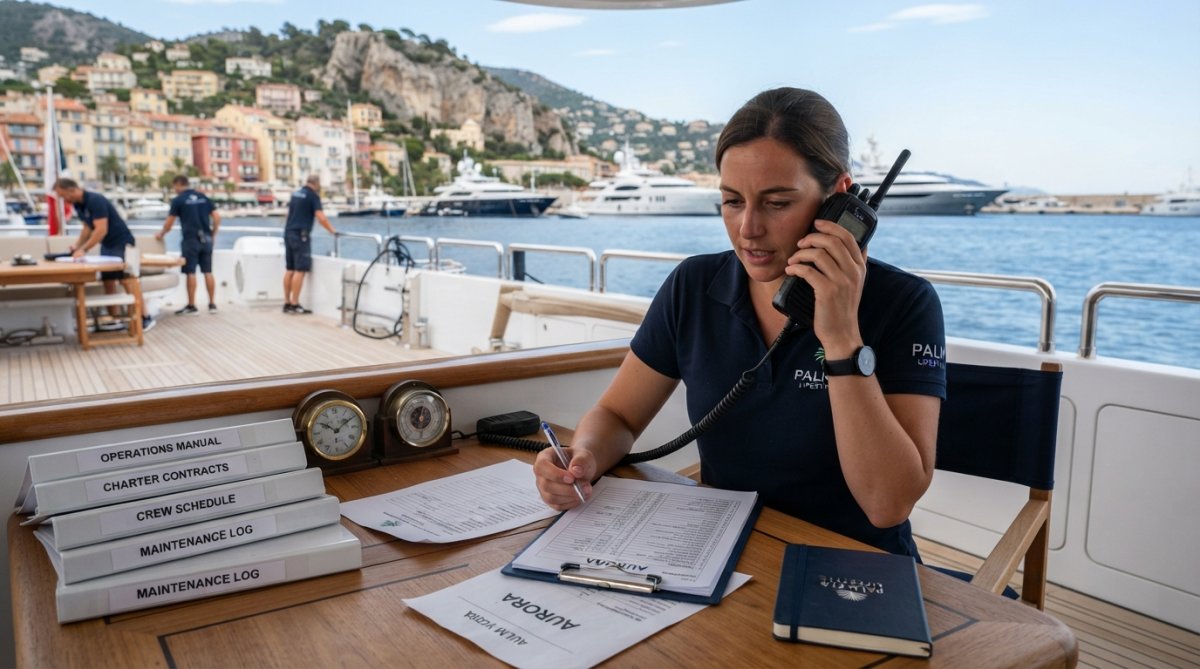
A management company‘s core responsibilities include charter marketing and booking management, crew recruitment and payroll, maintenance scheduling, regulatory compliance, guest services coordination, and financial accounting.
Back-Office Functions and Charter Marketing
Charter marketing begins with professional photography and videography, followed by listing placement across multiple charter broker platforms. A typical booking workflow includes inquiry, proposal negotiation, contract signing, pre-charter coordination, final payment, charter execution, and post-charter settlement. Back-office staff handle vendor management, fuel procurement, provisioning coordination, and scheduling maintenance between charters.
Crew Recruitment and Technical Oversight
The quality of your crew directly impacts guest satisfaction, safety, and operational reliability. Management companies maintain relationships with qualified maritime professionals and conduct recruitment specifically for charter operations. Charter crew must meet higher standards than private crew because they manage unknown guests with varying expectations. Management companies coordinate crew rotations (typically every 3-4 months) to prevent fatigue and maintain service quality.
Yacht Maintenance for Charter UAE: Standards and Costs
Charter yachts experience significantly higher wear and tear than privately used vessels. The combination of frequent guest cycles, multiple crew rotations, and continuous operation means maintenance demands are intense and non-negotiable.
Preventive Maintenance and Vessel Surveys
Preventive maintenance on a charter superyacht is a regulatory requirement and financial necessity. The management company schedules maintenance based on engine hours, seasonal requirements, regulatory inspection cycles, and guest-related wear. A superyacht costing significantly more in maintenance for private use might cost substantially more when operating on a charter schedule.
Vessel surveys are conducted by classification societies (DNV GL, Lloyd’s Register, Bureau Veritas) to certify that the yacht meets international maritime safety standards. Annual surveys are mandatory for charter yachts, with more comprehensive surveys every 5 years.
The single largest cost surprise for new charter yacht owners is unplanned maintenance. Budget for 10-15% of gross charter revenue as a maintenance reserve, above and beyond scheduled preventive maintenance.
Dockage, Insurance, and Operating Expenses
Beyond maintenance, charter yachts incur substantial fixed costs including premium marina dockage, comprehensive insurance coverage, full-time crew salaries and benefits, fuel and provisioning, utilities and services, and regulatory and administrative fees. These fixed costs must be covered whether the yacht is booked or idle. A yacht with only 10-15 weeks of charter activity per year often operates at a loss.
| Expense Category | Monthly Range (AED) | Annual Impact |
|---|---|---|
| Dockage and mooring | 3,000-8,000 | 36,000-96,000 |
| Crew salaries and benefits | 30,000-60,000 | 360,000-720,000 |
| Insurance | 650-1,250 | 8,000-15,000 |
| Fuel and provisioning | 2,000-5,000 | 24,000-60,000 |
| Maintenance (preventive) | 5,000-15,000 | 60,000-180,000 |
| Utilities and services | 1,500-3,000 | 18,000-36,000 |
| Total Fixed Costs | 42,150-92,250 | 506,000-1,107,000 |
Yacht Charter Income Potential UAE: ROI and Financial Planning
The financial viability of charter management depends entirely on booking frequency, charter rates, and the ability to control operating costs.
Realistic Return Expectations and Blackout Dates
Charter rates vary based on yacht size, location, season, and amenities. A realistic booking expectation for a well-managed superyacht is 25-30 weeks per year, accounting for maintenance windows, crew rotation, seasonal demand fluctuations, and owner usage. Many yacht owners view charter management as a way to offset operating costs and generate supplementary income while retaining personal usage, rather than as a primary investment return.
Tax Efficiency and Depreciation Considerations
In the United Arab Emirates, yacht charter income is subject to corporate tax under the new UAE corporate tax regime (effective 2023). The specifics depend on whether the yacht is held in a personal name, a company, or a trust structure.
A qualified tax advisor familiar with maritime operations in the UAE should review your specific situation. Key considerations include entity structure, deductible expenses (crew salaries, maintenance, insurance, dockage, fuel), depreciation deductions, and VAT implications.
Do not assume that charter income is tax-free or that expenses can be deducted without proper documentation. The FTA has increased scrutiny of high-net-worth individuals and their maritime assets. Maintain detailed records of all charter revenue, expenses, crew payments, and maintenance costs.
Yacht Management Services Dubai: Choosing the Right Partner
Selecting a management company is perhaps the most important decision an owner makes. The wrong partner can result in poor bookings, inadequate maintenance, crew instability, and financial losses.
Evaluating Management Agreements and Fee Structures
When evaluating management companies, request detailed information about their fee structure, including revenue share percentage, management fees, additional charges, and expense handling clarification. Request references from at least 3-5 yacht owners currently under management. Ask specifically about booking frequency, revenue accuracy, maintenance responsiveness, communication frequency, and crew quality.
At Palm Lifestyle, we specialize in yacht charter management throughout the Mediterranean and the Middle East. Our approach combines fleet optimization with personalized service, ensuring your yacht is positioned for consistent bookings while maintaining the highest operational standards.
Red Flags and Hidden Costs to Avoid
Warning signs that should disqualify a management company include vague fee structures, pressure to commit long-term, lack of transparency on expenses, poor references from current owners, no documented maintenance schedule, unrealistic revenue projections, and inadequate insurance coverage. Request a detailed estimate of total annual costs before committing. A transparent management company should provide a breakdown showing fixed costs, variable costs, and realistic revenue projections based on comparable yachts.
Exit Strategy and Resale Value: Planning Your Next Move
Entering yacht charter management should not be a permanent commitment. Many owners eventually want to exit, either because financial returns don’t meet expectations or personal circumstances change.
Yacht Depreciation and Market Timing
Yachts depreciate approximately 8-12% annually during the first 5 years of ownership, then more slowly as the vessel ages. Charter operation can accelerate depreciation through mechanical wear, though a well-maintained charter yacht with documented service records can appeal to buyers seeking an income-generating asset. Market timing matters significantly, and owners considering exit should monitor market conditions and plan to transition during periods of strong demand.
Transitioning Out of Charter Management
Exiting a charter management agreement requires reviewing termination clauses, planning the transition timeline to conclude existing charters, addressing crew transitions, updating insurance and registration to reflect private use, and assessing the yacht’s condition through a comprehensive survey. If you’re planning to sell, the transition period is an opportunity to address maintenance issues and prepare the vessel for market presentation.
Common Mistakes in Yacht Charter Management to Avoid
Years of observing yacht owners reveal consistent patterns of avoidable mistakes: underestimating operating costs, choosing the wrong management company based primarily on lowest fees, deferring maintenance to improve short-term profitability, hiring inexperienced crew to save salary costs, failing to properly report charter income or structure ownership for tax efficiency, projecting unrealistic booking potential, using vague charter contracts, and failing to monitor the management company regularly.
Yacht charter management can generate meaningful supplementary income and offset operating costs, but it requires clear-eyed financial planning, careful partner selection, and disciplined operational oversight. The difference between a successful charter operation and a costly mistake often comes down to understanding the true operational demands and financial realities before committing.
At Palm Lifestyle, we guide yacht owners through every stage of charter management, from initial financial modeling through exit planning. Our Mediterranean charter expertise, coupled with deep knowledge of UAE maritime regulations, ensures your yacht is positioned for optimal bookings while maintaining the highest operational standards. Whether you’re evaluating charter management for the first time or seeking to improve an existing arrangement, we can help you navigate the complexities and maximize your yacht’s potential. Get in touch with us to discuss your yachting needs.
Frequently Asked Questions
What services are included in yacht charter management in the UAE?
Yacht charter management in the UAE encompasses crew recruitment and payroll, vessel maintenance and technical oversight, charter marketing and booking coordination, regulatory compliance with flag state requirements, insurance administration, dockage and mooring arrangements, and back-office financial management. Management companies handle the day-to-day operational responsibilities, allowing owners to benefit from charter income while maintaining their usage rights during blackout dates.
How much charter income can I realistically expect from my yacht in Dubai?
Charter income potential depends on vessel size, condition, location, and seasonal demand. Superyachts in high-demand Mediterranean and GCC regions typically generate substantial revenue, but income varies significantly based on charter availability, owner blackout dates, and market conditions. Operating expenses, including crew, maintenance, dockage, and insurance, substantially reduce net ROI. Consult with a specialist in yacht charter income potential UAE to understand realistic projections for your specific vessel.
What are the main legal requirements for yacht charter management in the UAE?
UAE yacht charter operations must comply with flag state requirements, which govern vessel registration and safety standards. Charter contracts must clearly define liability, insurance coverage, and guest responsibilities. Vessel insurance must include comprehensive coverage for charter activities. Crew members require proper maritime certifications and work visas. Management companies must maintain updated yacht surveys and comply with UAE maritime authority regulations. Non-compliance can result in operational shutdowns and financial penalties.
What hidden costs should I expect beyond the management fee?
Beyond the management company's fee, expect crew salaries and benefits, comprehensive vessel insurance, annual yacht surveys and certifications, routine and emergency maintenance, dockage and mooring fees, fuel and utilities, provisioning costs, and regulatory compliance expenses. Many owners underestimate depreciation and the cost of major refits. Request a detailed breakdown of all operating expenses before signing a management agreement, and ask specifically about contingency reserves for unexpected repairs.
