

Table of Contents
- Yacht Market Size and Valuation Heading Into 2026
- CAGR and Growth Drivers Behind the Yachting Industry
- New-Build Pipeline and Order Book Trends to Watch
- Luxury Yacht Segment and Regional Market Share Analysis
- Yacht Brokerage vs Direct Seller: What the 2026 Market Rewards
- Luxury Yacht Valuation Factors That Decide Your Sale Price
- Where Yacht Market Trends 2026 Analysis Points Next
- Frequently Asked Questions
Last Updated: September 20, 2026
Yacht Market Size and Valuation Heading Into 2026
The global yacht market enters 2026 valued in the tens of billions of dollars, with superyachts accounting for most new-build contract value. This yacht market trends 2026 analysis breaks down where the money is moving and what buyers should factor in.
How the Value Splits Across Segments
Valuation is four numbers, and they move at different speeds:
- Superyachts (30 metres and above). Smallest by hull count, largest by contract value. A single 80-metre new build can exceed a dozen 24-metre production yachts combined. Slot availability, not price, decides who buys.
- Large production yachts (18 to 30 metres). The volume engine: semi-custom templates, 12 to 24 month delivery, sold through dealer networks. Most sensitive to financing conditions and first-time buyer confidence.
- Brokerage and pre-owned. Largest by transaction count, and the fastest liquidity signal: when listings sit for over a year, new-build demand usually softens within two seasons.
- Charter. A recurring-revenue segment, and how many first-time buyers test the lifestyle before committing.
What Is Actually Driving Valuation Higher
Three forces drive it:
- Length inflation. The order book’s centre of gravity has shifted upward, with more contracts signed above 50 metres than at any point in the past decade. Value scales faster than length because interior volume, crew needs, and systems complexity grow non-linearly.
- Specification inflation. A 45-metre yacht signed in 2026 carries more installed value than one signed in 2016: hybrid or diesel-electric propulsion, larger beach clubs, stabilisation, and integrated connectivity that were not standard a decade ago.
- Scarcity pricing. With European yard slots committed for years, buyers compete for delivery dates rather than negotiating on price, the main reason contract values have held up as economic conditions tightened.
The Cost Side Nobody Prices In
Valuation headlines describe what buyers pay, not what ownership costs afterwards.
- Crew. Certified officers and engineers are in short supply and wage expectations have risen. Crew is typically the largest line in an annual operating budget above 40 metres.
- Berthing. Prime Mediterranean summer berths are allocated years in advance, and renewal terms reflect that scarcity.
- Insurance and compliance. Classification surveys, emissions documentation, and underwriting now require more evidence than five years ago, each carrying administrative and inspection costs.
- Refit and maintenance. Yards that once took a refit slot at short notice now prioritise new-build and warranty work, pushing scheduling out and raising last-minute costs.
How to Read a Valuation Figure
When you see a market size number quoted, three questions separate a useful figure from a decorative one:
- Does it include brokerage, or only new build? A new-build-only figure can understate the market by a wide margin.
- Is it contract value or delivery value? Contract value is booked when the order is signed; delivery value is recognised when the vessel leaves the yard, up to three years later.
- Does it cover the full length range? Some reports count everything above 24 metres; others start at 30. The difference is substantial.
CAGR and Growth Drivers Behind the Yachting Industry
Industry forecasts place the yachting sector’s compound annual growth rate in the mid-single digits through the early 2030s, with the luxury yacht segment outpacing the broader maritime industry. Growth concentrates in three areas: wealth accumulation among ultra-high-net-worth individuals, demand for experiential luxury over static assets, and the shift toward hybrid propulsion.
Why a Single CAGR Number Misleads
The headline rate averages segments behaving very differently. Read it as four separate curves:
- Superyacht new build. The most supply-constrained segment. Growth is capped by yard capacity and skilled labour, not demand. When order books are full for three years, extra demand cannot convert into output, so reported growth understates appetite.
- Large production yachts. The most cyclical segment, where financing terms, rate expectations, and first-time buyer confidence show up first. It can swing several percentage points in a year while superyachts barely move.
- Brokerage. The most liquid segment and best leading indicator, typically turning six to twelve months before new-build orders do, in both directions.
- Charter. The most resilient segment. Charter demand holds up better than purchase demand during economic uncertainty because it delivers the experience without the capital commitment, precisely why charter is the industry’s main customer acquisition channel.
The Regulatory Mechanism Reshaping the Fleet
Growth in the yachting sector is no longer purely a demand story. Regulation is now a supply-side force most market reports underweight.
- Tiered engine standards. Successive tiers of NOx limits have retired older engine designs from new installations. A yard cannot carry forward a proven engine package; it must certify a compliant one.
- Emission control areas. Designated sea areas impose stricter sulphur and particulate limits. Vessels cruising them regularly need compliant fuel, exhaust gas cleaning systems, or alternative propulsion.
- Documentation and verification. Compliance is ongoing record-keeping, survey, and reporting, which is why it has become a design input at contract stage rather than a retrofit afterthought.
Regional Growth Patterns
Growth rates differ sharply by region, for structural reasons.
Europe remains the centre of both production and cruising. Italy, the Netherlands, and Germany anchor shipbuilding; Greece, Croatia, France, and Spain anchor charter. European growth is capacity-limited rather than demand-limited, so its share of global contract value is more likely to hold steady than expand.
What Would Change the Growth Trajectory
Three developments would move the CAGR materially:
Get in touch with us to discuss your yachting needs. →
- Yard capacity expansion. If European yards add meaningful new-build capacity or skilled labour supply improves, the superyacht segment could convert more latent demand into delivered vessels. Without that, growth stays capped.
- Financing conditions. Easier credit would quickly unlock the large production segment, whose buyers are the most rate-sensitive.
- Regulatory acceleration. If emissions standards tighten faster than the fleet can turn over, older vessels would lose value more quickly, depressing brokerage pricing while boosting new-build demand, an unusual combination that would make headline growth figures harder to interpret.
New-Build Pipeline and Order Book Trends to Watch
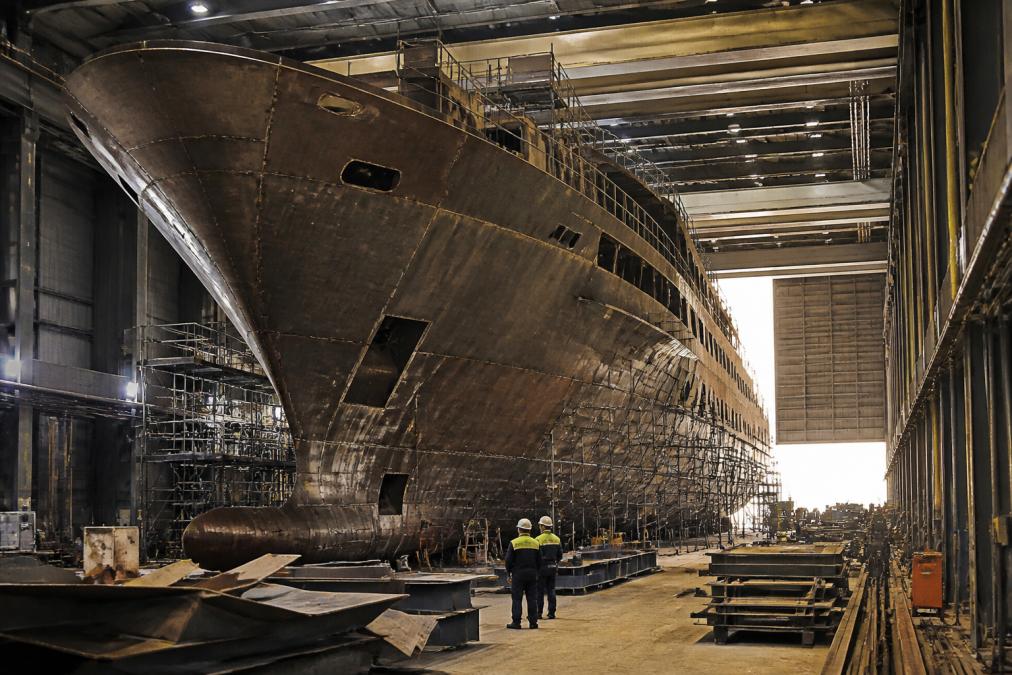
The new-build pipeline is stretched. European yards report order books extending several years out, and slot availability, not price, is the binding constraint for large projects. A buyer wanting a 60-metre vessel delivered before 2030 needs to be talking to a yard now.
Three trends define the pipeline:
- Larger average length. The centre of gravity has shifted upward, with more contracts signed above 50 metres than at any point in the past decade.
- Hybrid and diesel-electric propulsion. International Maritime Organization emissions framework regulations continue to push yards toward lower-emission systems, and buyers increasingly specify them at contract stage rather than retrofitting later.
- Longer build timelines. Customisation depth has increased, and every added specification extends the delivery date.
Luxury Yacht Segment and Regional Market Share Analysis
A gleaming white superyacht moored in a sunlit Mediterranean marina, with crew members in crisp uniforms preparing the deck for guests
Prospective owners must reconcile the prestige of these Mediterranean-moored vessels with the long-term reality of yacht maintenance costs to ensure their investment remains as pristine as the day it was commissioned.
Yacht Brokerage vs Direct Seller: What the 2026 Market Rewards
Factor | Brokerage Sale | Direct Sale |
|---|---|---|
Buyer reach | International pool | Personal network |
Time to sale | Shorter on average | Unpredictable |
Price realised | Usually higher | Often discounted |
Documentation | Handled end to end | Seller’s responsibility |
Buyer confidence | Higher, verified listing | Depends on trust |
Palm Lifestyle handles this end to end, from valuation through to closing, including the financing and legal procedures.
Luxury Yacht Valuation Factors That Decide Your Sale Price
Luxury yacht valuation factors fall into two groups: what the vessel is, and what the market currently wants. The first is objective. The second is where experienced brokers earn their fee.
The objective side:
- Length, gross tonnage, and build pedigree
- Year of build and refit history
- Engine hours and maintenance records
- Naval architecture and interior design reputation
Where Yacht Market Trends 2026 Analysis Points Next
The direction of travel is clear: the market is consolidating around larger vessels, longer build timelines, and stricter environmental requirements. Buyers who plan three to five years ahead find the process manageable; those who decide in a single season pay a premium for whatever is available.
Frequently Asked Questions
What are the primary drivers of the yacht market in 2026?
Wealth accumulation among ultra-high-net-worth individuals remains the strongest driver, particularly across the GCC and Asia. Alongside it, demand for hybrid propulsion systems and lower-emission yachts is reshaping new-build specifications. Brokerage activity for pre-owned vessels is also rising as buyers seek faster delivery than the new-build pipeline allows. Charter demand in the Mediterranean continues to underpin owner revenue expectations.
How does the current market environment influence yacht resale values?
Resale values track the balance between brokerage supply and buyer demand. When new-build wait times stretch, well-maintained pre-owned yachts hold value better because buyers turn to the brokerage market. Condition, service history, and compliance with current environmental standards all affect how quickly a vessel sells. A realistic luxury yacht valuation accounts for these factors rather than relying on original purchase price.
What role does sustainability play in modern yacht design and demand?
Sustainability now influences both design and resale. Hybrid yachts and more efficient propulsion systems attract buyers who face tightening emissions rules in European cruising grounds. Shipyards are responding with lighter materials and alternative power options. For owners, a yacht built to current environmental standards tends to remain more attractive on the brokerage market than one relying on older, less efficient systems.
How should owners interpret market data when planning a sale?
Market data is most useful when read alongside your vessel’s specifics: age, condition, refit history, and cruising range. Broad figures on yacht market size or CAGR set the backdrop, but your sale price depends on luxury yacht valuation factors such as maintenance records and compliance. Working with a brokerage that tracks comparable sales gives a clearer picture than headline statistics alone.
