
Table of Contents
- Understanding Yacht Charter Revenue Potential
- Yacht Charter Management Essentials
- Controlling Yacht Charter Expenses
- Yacht Charter Pricing Strategy for Maximum Returns
- Yacht Charter Marketing Strategies That Drive Bookings
- Tax Benefits and Legal Compliance
- Advanced Tactics to Maximize Yacht Charter Income
- Conclusion
Maximize Yacht Charter Income: A Strategic Guide
Last Updated: July 16, 2026
Understanding Yacht Charter Revenue Potential
The yacht charter market operates differently than most people assume. It’s not simply about owning a beautiful vessel and waiting for bookings to arrive. Research from Statista’s luxury travel market analysis indicates that the global yacht charter industry continues to expand, with discerning travelers increasingly seeking personalized maritime experiences.
Your income potential depends on several interconnected factors: vessel specifications, operational decisions, pricing strategy, and marketing approach. Many owners leave significant revenue on the table simply because they haven’t optimized these levers simultaneously.
The owners generating the highest returns typically focus on three areas simultaneously: reducing operational drag, increasing use rates, and commanding premium pricing through superior service.
Factors That Drive Charter Demand
Seasonality and location create the foundation of demand patterns. Mediterranean charters peak June through September, while Caribbean demand follows different rhythms. Owners who understand these patterns adapt pricing and maintenance windows around them rather than fighting them.
Vessel specifications directly impact your addressable market. Superyachts over 40 meters attract different clientele than smaller vessels. Understanding where your yacht sits in the competitive landscape matters enormously.
Crew quality and service reputation separate vessels commanding top-tier pricing from those competing on price alone. A well-trained crew drives repeat bookings and referrals, directly influencing booking frequency and achievable rates.
Destination appeal fluctuates based on travel trends and geopolitical factors. A yacht positioned in high-demand destinations can achieve 70-80% use during peak season, while the same vessel elsewhere might struggle to reach 40%.
Calculating Your Income Potential
Before implementing any strategy, establish a realistic baseline for what your specific yacht can generate.
Start with daily charter rates. Research comparable vessels in your market segment. A 50-meter superyacht in the Mediterranean operates in a different pricing band than a 35-meter vessel in the Caribbean.
Next, estimate realistic use rates. According to industry data on yacht use patterns, typical owner-operated vessels achieve 40-50% use in their first few years. Professionally managed vessels often reach 60-70%.
Your calculation should look like this:
| Variable | Your Vessel | Calculation |
|---|---|---|
| Daily charter rate | $X per day | Research comparable vessels |
| Annual days available | 365 | Minus scheduled maintenance |
| Realistic use % | 45-60% | Based on management model |
| Annual gross revenue | (Days × Rate × %) | Your baseline income |
| Operating expenses | TBD | See next section |
| Net income potential | Gross – Expenses | Your actual profit |
This framework reveals why use rate matters more than daily rate. A vessel charging $15,000/day at 50% use generates less annual revenue than one charging $12,000/day at 65% use.
The path to maximizing yacht charter income runs through use first, pricing second. A vessel that books consistently at moderate rates outperforms one that books sporadically at premium rates.
Yacht Charter Management Essentials
Deciding between professional management and owner-operator models fundamentally shapes your income potential and operational burden.
Professional Management vs. Owner-Operator Models
Professional yacht charter management companies handle all operational aspects: marketing, crew management, maintenance scheduling, and guest coordination. They typically take 25-35% of gross charter revenue as their management fee.
The professional management model works best when you lack time to oversee operations actively, your yacht requires specialized expertise, or you value predictability over maximum net income.
The owner-operator model works best when you have bandwidth to manage actively, your yacht is smaller or accessible, or you want to maximize net income despite taking on management responsibilities.
Many owners underestimate the complexity of professional yacht management. Coordinating international crew, managing regulatory compliance across jurisdictions, handling guest logistics, and maintaining financial transparency requires specialized knowledge. Attempting this part-time often results in poor decisions that cost far more than management fees would have saved.
Crew Management and Service Excellence
Your crew directly determines whether guests rebook and refer others. Exceptional service creates repeat bookings; poor service creates one-time guests and negative reviews.
Crew costs typically represent 30-40% of operating expenses. This is substantial, but cutting corners here makes no sense. A well-trained, professional crew justifies premium charter rates.
Effective crew management includes recruiting experienced crew, providing ongoing training, establishing clear service standards, gathering guest feedback, and offering competitive compensation to reduce turnover.
Controlling Yacht Charter Expenses
Operating expenses represent the often-overlooked variable in the income equation. Many owners focus entirely on revenue while letting expenses drift upward.
Operating Costs and Maintenance Records
Fuel represents your single largest variable expense, typically consuming 15-25% of gross revenue. A 50-meter yacht burning 150-200 gallons per hour incurs substantial costs during each charter.
Maintenance and repairs consume 10-15% of gross revenue annually for well-maintained vessels. Meticulous maintenance records support higher pricing and reduce emergency repair costs.
Specific maintenance categories to track:
- Engine and mechanical systems
- Hull and structural integrity
- Interior furnishings and equipment
- Navigation and safety systems
- Crew accommodations and amenities
Provisioning costs (food, beverages, supplies) typically run 5-8% of gross revenue. High-end provisioning for luxury charters costs more but supports premium pricing.
Deferred maintenance creates a false short-term profit picture while building hidden liabilities. The math always catches up.
Insurance and Risk Mitigation
Insurance represents a non-negotiable operating expense, typically consuming 3-5% of gross revenue. For charter vessels, additional coverage becomes essential: charter party liability, loss of income protection, and pollution liability.
Beyond insurance, risk mitigation includes maintaining detailed maintenance records, conducting regular safety audits, implementing crew training protocols, establishing clear guest liability waivers, and documenting all incidents.
Yacht Charter Pricing Strategy for Maximum Returns
Pricing strategy determines whether your vessel operates as a profitable business or a marginally viable hobby. Most owners leave substantial revenue on the table through suboptimal pricing approaches.
Dynamic Pricing Models and Seasonality
Static pricing, charging the same daily rate year-round, ignores market realities and leaves money on the table. Dynamic pricing adjusts rates based on demand, seasonality, booking timing, and competitive positioning.
Effective dynamic pricing considers:
- Seasonal demand patterns (peak, shoulder, off-season rates)
- Booking lead time (early bookings vs. last-minute availability)
- Competitive positioning (what comparable vessels charge)
- Special events and holidays (premium pricing during high-demand periods)
- Vessel use goals (lower rates to fill gaps vs. higher rates for selective bookings)
A practical example: A Mediterranean superyacht might charge $25,000/day June-August, $18,000/day April-May and September-October, and $12,000/day November-March.
Research from hospitality pricing strategy analysis demonstrates that dynamic pricing increases revenue 15-25% compared to static pricing when implemented thoughtfully.
Bundled Packages and High-Margin Extras
The highest-margin revenue comes from bundled packages and premium add-ons that guests willingly purchase when positioned correctly.
Bundled packages combine the base charter with curated experiences:
- Culinary charters (chef-led menus, wine pairings, cooking classes)
- Adventure packages (water sports, diving, hiking, exploration)
- Wellness retreats (yoga, meditation, spa services, fitness coaching)
- Family experiences (educational activities, entertainment, kid-friendly itineraries)
- Business packages (meeting facilities, connectivity, productivity-focused itineraries)
These packages command 20-40% premium pricing compared to standard charters. A family willing to pay $15,000/day for a standard charter might pay $22,000/day for a family-focused package.
High-margin extras generate disproportionate profits:
- Onboard spa services
- Water sports equipment and instruction
- Helicopter or submarine experiences
- Specialized crew expertise
- Premium provisioning and beverage packages
- Photography or videography services
These extras typically cost 10-20% of the premium they command, creating 80-90% gross margins.
(/ar/yacht-charter-sindalah-neom-ar/) Pricing Strategy for Maximum Returns]
Yacht Charter Marketing Strategies That Drive Bookings
How to maximize yacht charter income ultimately depends on consistent booking flow. Marketing determines whether your vessel sits idle or operates at high use.
Digital Marketing ROI and Owner-Operator Tactics
Owner-operators often assume they must rely on charter brokers for bookings. Direct bookings through your own marketing channels eliminate broker commissions (typically 10-15% of charter revenue) and create direct guest relationships.
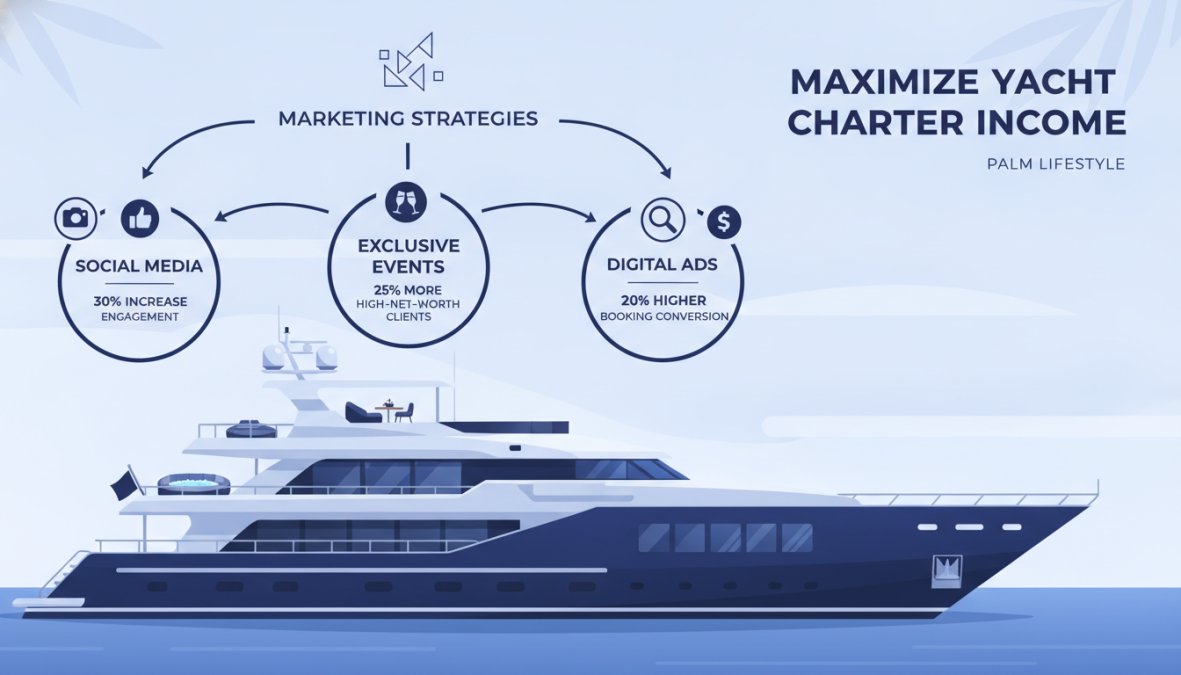
Effective digital marketing includes:
Website optimization: Your site should include detailed vessel specifications, high-quality photography and video, clear pricing, guest testimonials, and a straightforward booking process.
Content marketing: Blog posts about destination guides and charter planning tips drive organic search traffic. Video content showing the vessel, crew expertise, and guest experiences performs exceptionally well on social platforms.
Email marketing: Build a list of past guests and interested prospects. Regular updates about special offers and seasonal availability keep your vessel top-of-mind. Past guests represent your highest-value marketing segment.
Social media presence: Instagram and YouTube perform exceptionally well for luxury yacht marketing. Consistent posting builds audience and drives traffic to your website.
Search engine optimization: Optimize your website for relevant search terms like "luxury yacht charter Mediterranean" and "superyacht rental Caribbean."
Direct marketing channels reduce reliance on brokers and improve net income. A vessel generating 50% of bookings directly versus through brokers improves net income by 5-8% simply through commission savings.
Using Charter Brokers and Distribution Channels
Charter brokers remain essential for most vessels. They maintain relationships with travel agents, corporate clients, and high-net-worth individuals who book charters regularly.
Effective broker relationships include:
Selective partnerships: Partner with 2-4 high-quality brokers who actively market your vessel. Exclusive or semi-exclusive arrangements often generate better results.
Clear communication: Provide brokers with accurate vessel information, high-quality imagery, and clear availability calendars.
Competitive positioning: Work with brokers to position your vessel competitively within your market segment.
Performance monitoring: Track which brokers generate bookings and revenue. Focus energy on relationships that perform well.
Commission structure: Negotiate commission rates based on your vessel’s profile. Standard rates run 10-15%.
The optimal strategy combines direct marketing (for margin and relationship building) with broker partnerships (for reach and market access). Most successful owner-operators target 40-60% direct bookings and 40-60% broker bookings.
Tax Benefits and Legal Compliance
Understanding tax implications and legal requirements prevents costly mistakes and ensures you capture available benefits.
Commercial registration affects tax treatment substantially. Vessels registered for commercial charter may qualify for business expense deductions and depreciation benefits depending on your jurisdiction.
Charter agreement documentation matters for both tax purposes and liability protection. Formal charter agreements establish the commercial nature of the activity and protect you if disputes arise.
Crew taxation requires careful attention. Crew members’ tax status and residency status affect withholding requirements and compliance obligations.
Territorial waters and jurisdiction create additional complexity. Vessels operating in international waters face different regulatory requirements than those in territorial waters.
Working with a maritime tax specialist familiar with yacht charter operations ensures compliance and helps you optimize your tax position.
Advanced Tactics to Maximize Yacht Charter Income
Beyond the fundamentals, several advanced strategies separate top-performing vessels from average ones.
Post-Pandemic Charter Trends and Sustainability
The charter market has shifted significantly. Several trends now influence booking patterns and pricing power:
Wellness and sustainability focus: Guests increasingly seek meaningful experiences aligned with their values. Wellness-focused charters and sustainability-focused charters highlighting environmental practices command premium pricing.
Personalization and customization: Generic charters face increasing competition. Guests expect curated experiences tailored to their specific interests.
Extended stays and off-season charters: Extended stays (10+ days) and shoulder-season availability have grown. Adapting your availability and pricing to capture these opportunities improves use.
Hybrid work and digital nomad charters: Remote work has created a new market segment. Vessels positioned for this market with reliable connectivity and dedicated work spaces tap into growing demand.
Experiential and educational charters: Charters built around specific expertise (marine biology, archaeology, photography, culinary arts) attract passionate travelers willing to pay premium rates.
Common Mistakes to Avoid
Underpricing to fill gaps: Discounting aggressively to achieve high use often backfires. It attracts price-sensitive guests and makes it harder to raise rates later.
Neglecting maintenance: Deferred maintenance creates false short-term profits while building hidden liabilities.
Poor crew management: Treating crew as interchangeable commodities leads to high turnover and service inconsistency.
Ignoring market positioning: Clear positioning (luxury superyacht, family-friendly, adventure-focused, wellness-oriented) attracts the right guests and supports premium pricing.
Passive marketing: Assuming brokers will keep your vessel booked leaves income on the table.
Inadequate documentation: Poor record-keeping creates tax complications and prevents you from learning what works.
The owners maximizing yacht charter income treat the business systematically. They monitor use rates, optimize pricing strategically, control expenses deliberately, and invest consistently in marketing and service excellence.
The path to maximizing yacht charter income requires balancing multiple variables: pricing strategy, use rates, operational efficiency, and consistent marketing. The vessel itself matters less than the business model surrounding it. Palm Lifestyle specializes in helping yacht owners optimize every aspect of their charter operations, from positioning vessels in high-demand markets to implementing dynamic pricing strategies and managing crew excellence. Get in touch with us to discuss your yachting needs and develop a customized strategy for your specific vessel and market positioning.
Frequently Asked Questions
How much can you realistically make from chartering your yacht?
Revenue depends on vessel size, location, seasonality, and charter rates. Factors include territorial waters regulations, vessel utilization rates, and market demand. A well-managed superyacht in high-demand regions can generate substantial net profit after operating expenses and maintenance costs. Consulting with a yacht charter broker helps establish realistic income projections based on comparable vessels and market conditions.
What are the biggest expenses in yacht charter operations?
Major yacht charter expenses include crew salaries, fuel, insurance coverage, maintenance records compliance, and capital expenditure reserves. Operating expenses typically consume 40-60% of gross charter revenue. Proper maintenance records and preventive care reduce unexpected costs. Understanding these expenses is essential for calculating true net profit and optimizing your yacht charter management strategy.
Should I use a professional charter broker or manage bookings myself?
Professional yacht charter brokers provide market expertise, global distribution, and booking management, though they charge management fees. Owner-operators save on fees but invest more time in marketing and customer relations. Many successful owners use hybrid models: brokers for primary bookings and direct digital marketing for additional revenue. Your choice depends on vessel size, available time, and desired net profit margins.
How does dynamic pricing improve yacht charter income?
Dynamic pricing adjusts charter rates based on seasonality, demand, and market conditions. Peak seasons command premium rates while off-season discounts fill calendar gaps and improve vessel utilization. This strategy maximizes revenue across the entire year compared to flat-rate pricing. Implementing dynamic pricing requires monitoring market trends and competitor rates to remain competitive while protecting your profit margins.
This article was written using GrandRanker
