
Table of Contents
- Understanding the Steps to Buying a Luxury Yacht
- Define Your Yachting Vision and Goals
- Partner With a Professional Yacht Broker
- Understanding Luxury Yacht Ownership Costs
- Explore Yacht Financing Options
- Conduct a Marine Survey and Complete Pre-Purchase Inspection
- Make an Offer and Negotiate Terms
- Secure the Purchase and Sale Agreement
Steps to Buying a Luxury Yacht: A Complete Guide
Last Updated: July 17, 2026
Understanding the Steps to Buying a Luxury Yacht
Acquiring a superyacht requires careful planning, expert guidance, and clear understanding of the process ahead. Successful purchases share one trait: buyers who define their vision before entering the market make better decisions and find greater satisfaction with their investment.
The yacht market differs fundamentally from traditional real estate or automotive purchases. It involves marine surveys, sea trials, specialized financing, international maritime law, flag state registration, and ownership structures that vary by jurisdiction. Many buyers underestimate the complexity and timeline required.
Below, we’ll walk you through each critical step, from defining your vision to closing and taking delivery. This isn’t a quick process, but rushing leads to costly mistakes.
Start your yacht buying journey at least 6-12 months before your target delivery date. This timeline allows for thorough market research, proper due diligence, and negotiation without pressure.
Define Your Yachting Vision and Goals
Before contacting a broker or viewing listings, you need clarity on what you’re buying and why. This foundational step determines everything that follows.
Ask yourself: How will you use the yacht? Are you planning extended Mediterranean cruises, Caribbean island hopping, or weekend getaways? Will you charter it for revenue? How many guests will you typically host? Your answers define the yacht’s specifications. A vessel designed for extended ocean passages requires different systems than one optimized for coastal cruising. A charter-focused yacht needs different layouts than a private-use vessel.
Document your priorities in writing. Create a specification sheet listing must-haves (length, cabins, range, speed) separately from nice-to-haves (brand, interior style, amenities). This document keeps you focused when emotions run high and prevents chasing yachts that don’t fit your needs.
The clearest yacht purchases begin [with a](/2026/06/05/risks-of-buying-a-yacht-without-a-broker/) written specification sheet that separates non-negotiable requirements from desirable features.
Partner With a Professional Yacht Broker
A qualified yacht broker serves as your guide, market expert, and negotiator throughout the process.
The right broker brings critical advantages: access to the global yacht market, understanding of yacht valuation and pricing, handling of complex paperwork, and coordination of surveys and sea trials. They also provide protection through liability insurance and industry code compliance.
Find the right broker by asking for referrals and interviewing multiple candidates. Ask about their experience with yachts matching your specifications and which markets they know best. The best brokers ask probing questions about your vision before showing anything, listen more than they talk, and are honest about which yachts fit your needs.
Understand broker compensation. Brokers typically receive 5-10% commission (split between buyer’s and seller’s brokers), paid by the seller, not you. Some brokers also work on hourly or flat-fee bases for specific services.
Avoid brokers who pressure quick decisions or dismiss your concerns about a vessel’s condition. A professional broker respects your timeline and due diligence process.
Understanding Luxury Yacht Ownership Costs
Yacht ownership is expensive beyond the purchase price. Ongoing operational costs continue year-round.
Crew salaries represent the largest ongoing cost. A captain, engineer, chef, and deck crew for a 40-50 meter yacht costs $15,000-$25,000 monthly in salaries alone, plus benefits and provisions.
Docking fees and mooring vary dramatically by location. A 50-meter superyacht in a major yacht hub costs $50,000-$200,000+ annually.
Maintenance and repairs are continuous. Annual maintenance typically runs 5-10% of purchase price. A $10 million yacht should budget $500,000-$1,000,000 annually.
Insurance typically costs 0.5-1.5% of insured value. A $10 million yacht might carry $50,000-$150,000 annual insurance.
Fuel varies significantly. A superyacht burns 50-300 gallons per hour. Monthly cruising might consume $50,000-$200,000 depending on size and patterns.
Yacht management services handle administrative tasks and crew scheduling, typically charging 5-8% of annual operational costs.
VAT and taxes vary by jurisdiction. Some impose 17-20% VAT on purchases, while others exempt yachts registered for charter use.
The total cost of ownership for a 50-meter superyacht typically ranges from $2-4 million annually. Smaller yachts (30-40 meters) might run $1-2 million per year.
| Cost Category | Annual Range (50m Superyacht) | Notes |
|---|---|---|
| Crew Salaries | $180,000-$300,000 | Varies by location and experience level |
| Docking & Mooring | $50,000-$200,000 | Prime locations cost significantly more |
| Maintenance & Repairs | $500,000-$1,000,000 | 5-10% of purchase price annually |
| Insurance | $50,000-$150,000 | 0.5-1.5% of insured value |
| Fuel | $600,000-$2,400,000 | Depends heavily on usage and cruising patterns |
| Management Services | $100,000-$300,000 | If using professional management company |
Create a detailed annual budget for all ownership costs before committing to a purchase. Many buyers focus only on purchase price and financing, then get caught off-guard by operational expenses.
Explore Yacht Financing Options
Most superyacht purchases involve financing. Few buyers pay cash for million-dollar vessels.
Yacht financing differs from traditional mortgage lending. Lenders view superyachts as depreciating assets with limited resale markets, so they’re more conservative. You’ll typically need 20-30% down. Interest rates range from 4-8% depending on credit, yacht age, and market conditions.
Loan terms typically run 10-15 years, though some lenders offer up to 20 years for newer vessels. Shorter terms mean higher monthly payments but less total interest. Longer terms reduce monthly payments but increase total interest cost significantly.
Specialized marine lenders understand yacht valuations and unique risks. Some major banks have marine lending divisions. Your yacht broker often has relationships with preferred lenders and can coordinate financing.
The application requires documentation similar to traditional lending: proof of income, credit history, personal financial statements, and yacht details. The lender will require a professional yacht valuation and proof of adequate insurance.
Understand how flag state and ownership structure affect financing. Some structures (trusts or corporations) are viewed as higher-risk and may result in higher rates. Your maritime legal counsel can advise on the most tax-efficient and lender-friendly structure.
The financing process typically takes 4-8 weeks once you’ve made an offer and submitted all documentation.
Conduct a Marine Survey and Complete Pre-Purchase Inspection
A thorough marine survey and pre-purchase inspection is your single most important protection as a buyer. It can identify problems costing hundreds of thousands to repair, or reveal issues serious enough to walk away from the deal.
(/2026/07/06/pre-owned-luxury-yachts-buyers-guide/)]
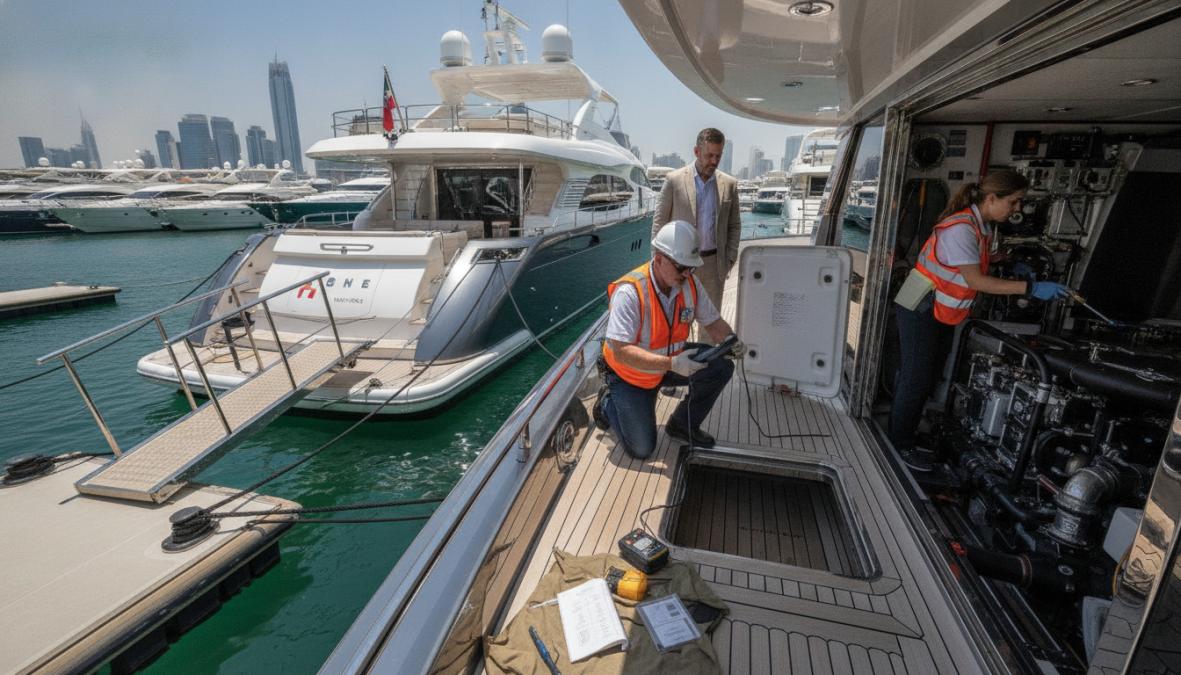
A marine survey is performed by a certified surveyor who examines every system in detail. They inspect the hull for cracks, corrosion, or structural issues. They test all mechanical and electrical systems, review maintenance records, and evaluate engines, generators, air conditioning, plumbing, and navigation equipment. A comprehensive survey takes 2-5 days depending on size and complexity.
The survey report lists every finding: systems in good condition, systems requiring maintenance, and systems with significant problems with estimated repair costs. This report becomes your negotiation tool. If the survey identifies $200,000 in deferred maintenance, you can renegotiate the purchase price or require the seller to complete repairs before closing.
Understanding the Yacht Survey Report
A professional yacht survey report includes sections on hull condition, mechanical systems, electrical systems, plumbing, HVAC, navigation equipment, interior condition, safety equipment, and structural integrity. Each section contains detailed findings with photos and recommendations.
The report uses standardized language categorizing conditions as "good," "fair," "poor," or "not inspected." Items marked "poor" require immediate attention. Pay particular attention to the hull survey section, noting any osmotic blistering, structural cracks, or corrosion. The mechanical section is equally critical, as engine hours and maintenance history determine future repair and maintenance spending.
Sea Trials and Performance Testing
After the initial survey, you’ll participate in a sea trial, a day-long (or multi-day) voyage where you experience the yacht’s performance and systems under operating conditions.
During the sea trial, the crew operates all major systems while you observe. You’ll test engines at various speeds, evaluate handling in different sea conditions, and test stabilizers, air conditioning, water systems, and navigation equipment. You’ll spend time in cabins to experience comfort and noise levels while underway.
Sea trials reveal issues that static inspections cannot. You’ll discover whether the yacht achieves claimed speed and range, experience noise and vibration levels, and learn how it handles in waves.
Bring a qualified captain or yacht delivery expert to the sea trial. They can assess performance issues you might miss and identify subtle problems with engines or navigation equipment.
Document everything during the sea trial. Take photos and videos. Note any systems that don’t operate smoothly. This is your opportunity to experience the yacht before committing to ownership.
A professional marine survey and comprehensive sea trial are non-negotiable. These steps protect your investment and prevent purchasing a yacht with hidden problems costing hundreds of thousands to repair.
Make an Offer and Negotiate Terms
Once you’ve completed your survey and sea trial and confirmed the yacht meets your requirements, it’s time to make an offer.
Your broker will submit a written offer including the proposed purchase price, closing date, and conditions (such as contingency on satisfactory survey results). Most initial offers are below asking price, which is normal and expected.
The seller will respond with a counter-offer, accepting your price, proposing a different price, or modifying terms. Negotiations may go back and forth several times before reaching agreement.
Key negotiation points beyond price include:
Closing date and delivery timeline. When do you want possession? Sellers may need time to move personal items or complete maintenance.
Included equipment and furnishings. Does the sale include tenders, toys, artwork, linens, and provisions? A tender can be worth $100,000+.
Seller financing. In some cases, the seller will finance a portion of the purchase price, particularly if the yacht has been on the market long.
Repairs and maintenance. Will the seller complete survey-identified repairs before closing, or provide credits for you to handle repairs after closing?
Yacht delivery. Who pays for delivery from the current location to your desired location?
The negotiation phase typically lasts 2-4 weeks. Once both parties agree on price and terms, you move to the Purchase and Sale Agreement.
Secure the Purchase and Sale Agreement
The Purchase and Sale Agreement (PSA) is the legal contract governing the yacht sale. This complex document requires careful attention.
The PSA specifies purchase price, payment terms, closing date, and yacht condition. It outlines which systems and equipment are included. It details warranties and specifies current registration and flag state.
Critical clauses include:
Condition of vessel. The PSA should specify the yacht is sold "as-is" following sea trial, or detail specific repairs the seller will complete before closing.
Title and ownership. The PSA should confirm the seller has clear title and the right to sell. It should address any outstanding liens or mortgages that will be paid off at closing.
Closing conditions. The PSA specifies what must be satisfied before closing: satisfactory survey results, successful sea trial, and clear title confirmation.
Payment terms. The PSA details how and when you’ll pay. Typically, you’ll make a deposit (10-20% of purchase price) when the PSA is signed, with the balance due at closing.
Closing costs and expenses. The PSA clarifies who pays for survey fees, title insurance, registration, documentation, legal fees, and other costs. These can total $50,000-$200,000+ depending on yacht value and complexity.
Work with a maritime attorney to review the PSA before signing. Maritime law is specialized, and an experienced attorney can identify problematic clauses and negotiate better terms. This legal review typically costs $5,000-$15,000 but can save hundreds of thousands in disputes.
The PSA negotiation phase typically takes 2-3 weeks. Once both parties sign, you move toward closing.
Buying a luxury yacht represents one of the most significant lifestyle investments you’ll make. The process demands patience, expert guidance, and thorough due diligence, but the reward is access to maritime experiences and freedom few people ever experience.
The steps outlined, defining your vision, partnering with a professional broker, understanding true ownership costs, exploring financing options, conducting comprehensive inspections, negotiating effectively, and securing proper legal documentation, form the foundation of a successful yacht purchase. Whether you’re buying your first superyacht or upgrading to a larger vessel, expert guidance transforms yacht buying from an overwhelming process into an exciting journey.
Frequently Asked Questions
What are the main steps to buying a luxury yacht?
The key steps include defining your yachting vision, working with a yacht broker, setting a realistic budget including hidden costs, searching for the ideal vessel, conducting a marine survey and sea trial, making an offer, signing a Purchase and Sale Agreement, and handling registration and insurance. Each step requires careful attention to ensure a smooth acquisition process and proper ownership structure.
Why is a yacht survey so important before purchase?
A yacht survey importance cannot be overstated, it protects your investment by identifying structural issues, mechanical problems, and safety concerns. A comprehensive marine survey examines the hull, engines, systems, and interior condition. The yacht survey report provides critical documentation that influences your final offer price and reveals maintenance needs. Professional surveyors also recommend necessary repairs or upgrades.
What are typical luxury yacht ownership costs beyond the purchase price?
Luxury yacht ownership costs extend far beyond the initial purchase. Key expenses include docking fees at marinas, crew salaries, insurance premiums, maintenance and repairs, fuel, and yacht management services. Seasonal storage, refits, and upgrades add significant costs. Many owners use a Total Cost of Ownership calculator to forecast annual expenses, which typically range from 5-10% of the yacht's purchase price annually, depending on size and usage.
What financing options are available for buying a luxury yacht?
Yacht financing options include traditional marine mortgages, which typically offer terms of 10-20 years with competitive interest rates. Many financial institutions specialize in yacht loans and understand the unique aspects of marine asset financing. Some buyers explore structured ownership arrangements or partnership models. A yacht broker can connect you with lenders experienced in luxury vessel financing and help you understand the terms, down payment requirements, and documentation needed to secure favorable financing.
This article was written using GrandRanker
