
Table of Contents
- Understanding the True Costs of Maintaining a Private Yacht
- The 10-15% Annual Maintenance Rule and Operating Budget Framework
- Yacht Maintenance Budget Breakdown by Category
- Cost of Yacht Ownership by Size: What Different Vessel Classes Require
- Dockage, Mooring Fees, and Berthing Expenses
- Yacht Insurance Premiums and Coverage Considerations
- Crew Salaries, Benefits, and Payroll Management
- Fuel Consumption, Bunkering, and Engine Servicing
Costs of Maintaining a Private Yacht: Complete Guide
Last Updated: July 18, 2026
Understanding the true costs of maintaining a private yacht goes far beyond the purchase price. The costs of maintaining a private yacht typically consume 10-15% of the vessel’s value annually. Most prospective owners underestimate these ongoing expenses by 30-50%, focusing on acquisition costs while overlooking the operational reality: a yacht demands constant attention, professional servicing, insurance coverage, and skilled personnel.
The 10-15% annual maintenance rule is your starting point. A $10 million yacht should budget $1-1.5 million per year in operating expenses. This percentage increases for older vessels and decreases slightly for newer, well-maintained superyachts.
The 10-15% Annual Maintenance Rule and Operating Budget Framework
The 10-15% annual maintenance rule serves as the industry baseline for calculating total operating costs. This percentage applies to the yacht’s current market value, not its original purchase price. For a $20 million vessel, you’re looking at $2-3 million annually in combined operating, maintenance, insurance, and crew expenses.
Yachts are complex marine environments where hull integrity, mechanical systems, electronics, and safety equipment all degrade with use and time. Neglect any system, and you risk catastrophic repair costs that dwarf regular maintenance spending.
The percentage breaks down roughly as follows: crew payroll typically consumes 35-40% of the annual budget, fuel and bunkering another 15-20%, insurance 10-12%, dockage and mooring fees 8-12%, and routine servicing and parts 20-25%. The remaining 5-10% covers miscellaneous expenses like provisioning, electronics upgrades, and contingency reserves.
How the percentage rule applies to different vessel sizes
Smaller yachts under 50 feet often run at the higher end of the 10-15% range because fixed costs like insurance and mooring don’t scale down proportionally. A $2 million 45-foot yacht might spend $300,000+ annually, while a $100 million superyacht might operate at 10-12% due to economies of scale.
Mid-range vessels between 50-100 feet typically land at 12-14% annually. Superyachts over 100 feet can operate at 10-12% with professional management, though scheduled refits every 5-7 years spike costs dramatically. A $200 million superyacht undergoing a comprehensive refit might spend $30-50 million over 12-18 months, temporarily pushing annual costs to 15-25% of value.
The 10-15% rule assumes the yacht is actively maintained. Vessels left idle or poorly maintained often face emergency repairs exceeding 20-30% of annual value within 2-3 years. Preventative maintenance always costs less than reactive repairs.
Yacht Maintenance Budget Breakdown by Category
Understanding where your maintenance dollar goes is essential for realistic budgeting. The costs divide into essential recurring expenses and capital expenditures on longer cycles.
Essential recurring expenses
Crew payroll dominates recurring expenses for any professionally managed yacht. A captain, first officer, chief engineer, and deck crew for a 100+ foot vessel typically costs $400,000-$800,000 annually in salary, benefits, and payroll taxes. Larger superyachts with full hotel services easily exceed $1.5 million annually.
Fuel consumption varies by vessel type and cruising patterns. A 100-foot motor yacht might burn 50-100 gallons per hour at cruise speed, translating to $15,000-$30,000 monthly in fuel. Sailing yachts eliminate fuel costs but require rigorous sail maintenance; new sails for a 100-foot yacht cost $150,000-$300,000.
Insurance premiums for yachts follow a complex formula based on vessel age, condition, claims history, and captain experience. A $20 million yacht typically carries marine insurance costing $80,000-$150,000 annually. Older vessels or those with previous damage claims face significantly higher premiums.
Dockage and mooring fees vary by location. Mediterranean marinas charge $800-$2,000 per foot annually. A 100-foot yacht in Monaco might occupy a $100,000-$200,000 slip annually. Caribbean locations run $400-$800 per foot.
Routine engine servicing and mechanical repairs consume 15-20% of the annual budget. A comprehensive annual engine survey by a certified marine surveyor costs $5,000-$15,000 but prevents catastrophic failures.
Schedule engine servicing on a strict calendar basis. Marine engines operate in corrosive saltwater environments. Regular fluid analysis and preventative replacement of gaskets, seals, and hoses costs far less than emergency engine work while underway.
Capital expenditures and planned replacements
Hull maintenance and bottom painting occur annually or every 18-24 months. Hauling the yacht costs $30,000-$80,000 depending on size and location. Anti-fouling paint application adds another $40,000-$120,000.
Teak maintenance for teak-decked vessels requires annual sanding, oiling, or sealing at $20,000-$40,000 annually. Replacement of degraded teak costs $100,000-$300,000.
Electronics upgrades happen every 5-7 years. A complete electronics refresh for a mid-size yacht runs $80,000-$200,000. Superyachts can exceed $500,000.
Refit cycles represent the largest capital expenditure. A comprehensive refit every 5-7 years typically costs 15-25% of the yacht’s value. A $50 million superyacht might spend $7.5-12.5 million over 12-18 months.
| Expense Category | Annual Cost Range (100-ft vessel) | Frequency | Notes |
|---|---|---|---|
| Crew payroll & benefits | $400,000-$800,000 | Annual | Includes captain, officers, deckhands |
| Fuel & bunkering | $180,000-$360,000 | Annual | 50-100 gal/hr at cruise, varies by location |
| Marine insurance | $80,000-$150,000 | Annual | Increases with age and claims history |
| Dockage & mooring | $80,000-$200,000 | Annual | Mediterranean premium; varies by location |
| Engine servicing & repairs | $40,000-$80,000 | Annual | Preventative maintenance essential |
| Hull maintenance & painting | $40,000-$120,000 | Annual/24 months | Bottom paint every 18-24 months |
| Teak maintenance | $20,000-$40,000 | Annual | For teak-decked vessels only |
| Provisioning & supplies | $30,000-$60,000 | Annual | Food, cleaning, operational supplies |
| Typical Total (recurring) | $870,000-$1,810,000 | Annual | Represents 8.7-18.1% of $10M vessel value |
Cost of Yacht Ownership by Size: What Different Vessel Classes Require
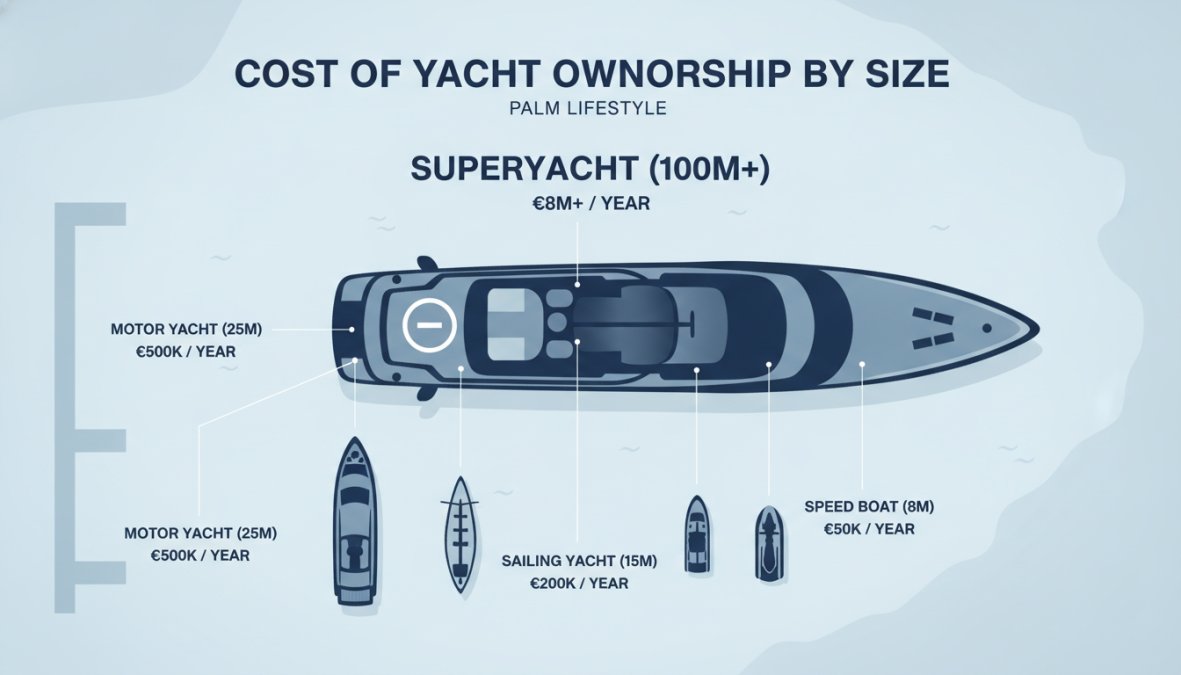
The costs of maintaining a private yacht scale nonlinearly with vessel size. A 50-foot yacht often costs 60-70% as much as a 100-foot yacht because certain expenses don’t shrink proportionally.
Comparison across yacht categories
Under 50 feet: Annual maintenance budgets range from $50,000-$150,000. No full-time captain needed, but professional servicing is essential. Dockage runs $15,000-$40,000 annually. Insurance costs $8,000-$20,000.
50-100 feet: Entry point for professional crew requirements. A captain and deckhand cost $200,000-$400,000 annually. Total operating budgets range from $300,000-$800,000 per year.
100-150 feet: Full hotel services become standard. Crew expands to 6-8 people costing $600,000-$1.2 million annually. Total budgets reach $1.2-2.5 million per year.
150+ feet (superyachts): Professional management becomes mandatory. Crew often exceeds 12-15 people. Annual budgets easily exceed $3-5 million for vessels in the $100-200 million range. Charter management can generate $500,000-$2 million annually, offsetting costs.
(/2026/06/16/luxury-yacht-sales-market-trends/) by Size: What Different Vessel Classes Require]
Doubling vessel length increases annual costs by 2.5-3x, not 2x. A 200-foot superyacht costs roughly 8-10 times what a 100-foot yacht costs to operate.
Dockage, Mooring Fees, and Berthing Expenses
Dockage and mooring fees vary dramatically by location. Mediterranean marinas command premium rates. Monaco’s Port Hercules charges $1,500-$2,500 per meter annually; a 50-meter yacht occupies a $75,000-$125,000 slip. The French Riviera runs $1,000-$1,800 per meter. Spanish and Italian marinas offer better value at $600-$1,200 per meter.
Caribbean locations typically run $400-$800 per foot annually. United States East Coast marinas range from $500-$1,200 per foot depending on location.
Mooring balls and anchoring fields cost significantly less, often $100-$300 monthly, but eliminate access to shore power, water, and security. Most serious yacht owners maintain a primary berth in a full-service marina and use moorings for seasonal cruising.
Seasonal repositioning creates additional costs. Many owners maintain a Mediterranean berth for summer and a Caribbean berth for winter, paying for both locations despite using only one at a time. This flexibility costs $100,000-$300,000 annually but allows optimal cruising conditions year-round.
Yacht Insurance Premiums and Coverage Considerations
Marine insurance for yachts reflects not just vessel value but age, condition, claims history, crew experience, and intended use.
Factors affecting marine insurance rates
Vessel age and condition: New yachts typically pay 0.5-0.8% of hull value annually. A $20 million new yacht pays $100,000-$160,000. Vessels over 15 years old face premiums of 1.0-1.5% of value.
Captain and crew experience: Insurers require captains to hold appropriate licenses and demonstrate experience with the specific yacht class. A captain with 20+ years of superyacht experience commands lower premiums.
Navigation equipment and safety systems: Yachts equipped with redundant navigation systems and comprehensive safety equipment receive insurance discounts of 5-10%.
Claims history: One significant claim can increase premiums by 25-50% for 3-5 years.
Marine insurance policies contain exclusions for mechanical breakdown and operator negligence. Understand your policy’s coverage limits for crew injury liability, pollution, and salvage costs. Underinsurance is a common mistake; many owners insure only hull value while ignoring liability exposure that could exceed the vessel’s value.
Crew Salaries, Benefits, and Payroll Management
Crew represents the largest controllable expense in yacht operating budgets. Professional yacht crew typically work on contract basis: 4-6 weeks on duty followed by 2-4 weeks off-duty.
A captain on a 100-foot yacht earns $60,000-$120,000 annually, plus benefits. First officers earn $40,000-$80,000. Chief engineers command $50,000-$100,000. Deckhands start at $30,000-$50,000. Stewards and chefs earn $35,000-$75,000.
Superyachts employ larger crews at higher wages. A captain on a 200-foot superyacht might earn $150,000-$250,000 annually. Chef positions reach $100,000-$150,000. Aggregate crew costs for a 10-person team easily exceed $1.5-2.5 million annually.
Beyond salary, owners must provide health insurance, life insurance, and accommodations. Payroll taxes typically add 15-25% to gross wages. Professional yacht management companies charge 5-8% of crew costs for payroll processing, tax compliance, and recruitment.
Training and certification represent ongoing expenses. Crew must maintain STCW certifications, medical certifications, and safety training. Annual training costs per crew member run $2,000-$5,000.
Fuel Consumption, Bunkering, and Engine Servicing
Fuel represents the second-largest controllable operating expense after crew.
Routine engine maintenance and mechanical repairs
Motor yachts consume fuel at rates proportional to speed and engine load. A 100-foot displacement hull motor yacht cruising at 10 knots burns 30-50 gallons per hour. At full speed, it burns 80-120 gallons per hour. Over a year of moderate cruising (500 hours), fuel costs range from $90,000-$180,000.
Fuel prices vary by bunkering location. Mediterranean ports charge $600-$900 per metric ton. Caribbean locations run $500-$700 per ton.
Diesel fuel degradation in storage tanks requires active management. Fuel polishing costs $3,000-$8,000 annually and prevents engine damage from contaminated fuel.
Oil analysis identifies mechanical wear before catastrophic failure. This preventative measure costs $500-$1,000 per analysis but often prevents engine failure costing $300,000-$800,000 to repair.
Impeller servicing occurs annually or every 100 operating hours. Replacement costs $1,000-$3,000 but prevents engine overheating.
Through-hull fittings require annual inspection and maintenance. Professional servicing costs $5,000-$15,000 annually.
Haul-out for bottom work occurs every 18-24 months, costing $30,000-$80,000 depending on vessel size and location.
Maintain a detailed maintenance log for every service performed. This documentation proves to [future buyers](/2026/07/08/what-to-look-for-when-buying-used-yacht/) that the yacht has been professionally maintained, directly supporting resale value. Yachts with complete service records command 10-15% premiums over comparable vessels with incomplete documentation.
Charter management offers a partial offset to fuel and crew costs for superyachts. A well-positioned superyacht can generate $150,000-$300,000 monthly through managed charter programs, significantly reducing the owner’s net expense.
Understanding Tax Implications by Jurisdiction
The costs of maintaining a private yacht extend beyond direct operating expenses into tax and regulatory territory. Flag state selection, beneficial ownership structures, and crew employment jurisdiction all influence total cost of ownership.
Different flag states impose different annual registration fees and survey requirements. Panama-flagged yachts pay lower registration fees but require more frequent surveys. Malta-flagged vessels cost more to register but benefit from EU regulatory alignment. These choices affect insurance costs and compliance expenses by $5,000-$30,000 annually.
Beneficial ownership structures affect tax liability and asset protection. Consulting with international tax specialists and maritime lawyers costs $10,000-$30,000 but prevents far more expensive tax complications.
DIY vs. Professional Maintenance Breakdown
Owner-managed yachts save 8-12% on operating costs by eliminating professional management fees. However, this savings comes with significant risks: missed maintenance schedules, inexperienced crew decision-making, and potential liability exposure.
Professional yacht management companies charge 5-8% of total operating costs but provide comprehensive oversight: crew management, maintenance scheduling, regulatory compliance, vendor coordination, and emergency response. For superyachts, professional management is virtually mandatory.
Mid-size yacht owners often find a hybrid approach works best: owner involvement in strategic decisions combined with professional crew and maintenance contractors for day-to-day operations.
The costs of maintaining a private yacht demand serious financial planning and realistic budgeting. The 10-15% annual rule provides a starting framework, but individual circumstances, vessel age, size, location, and intended use, create variation around this baseline. At Palm Lifestyle, we specialize in helping owners understand these cost structures through comprehensive yacht purchase consulting, professional management referrals, and strategic charter optimization. Whether you’re evaluating yacht ownership or seeking to optimize an existing vessel’s operating budget, our team brings decades of maritime experience to every engagement. Get in touch with us to discuss your yachting needs and develop a realistic ownership strategy aligned with your financial and lifestyle goals.
Frequently Asked Questions
What is the 10-15% rule for yacht maintenance costs?
The 10-15% annual maintenance rule suggests that owners should budget 10-15% of a yacht's purchase value each year for operating and maintenance expenses. This industry guideline helps owners understand baseline costs of maintaining a private yacht and plan accordingly. However, actual costs vary significantly based on vessel age, size, usage patterns, and regional factors. Older yachts or those requiring major refits may exceed this percentage substantially.
How much does yacht insurance cost annually?
Yacht insurance premiums vary widely based on vessel value, age, type, navigation area, and claims history. Insurance typically represents 1-3% of a yacht's insured value annually. Factors affecting rates include the yacht's construction materials, safety systems, crew experience, and whether it's used for chartering. Working with a specialized marine broker ensures comprehensive coverage and competitive yacht insurance premiums for your specific vessel and circumstances.
What are the hidden costs of yacht ownership I should plan for?
Beyond routine expenses, hidden costs include dry docking (every 2-5 years), major refits, electronics upgrades, bottom painting, teak maintenance, and emergency repairs. Winterization, surveyor fees, and vessel registration renewal add up quickly. Many owners underestimate contingency needs; financial advisors recommend maintaining an emergency fund of 20-30% of annual operating costs. Preventative maintenance reduces surprise expenses, but unexpected mechanical failures or weather damage can strain budgets significantly.
Can chartering my yacht offset maintenance costs?
Yes, chartering can significantly reduce net ownership costs. Many superyacht owners use professional charter management companies to generate revenue during periods when the vessel isn't in personal use. Charter income can offset 30-50% of annual operating expenses for well-maintained, desirable yachts. However, chartering requires additional insurance, crew training, provisioning, and management overhead. Working with experienced charter specialists helps maximize revenue while maintaining your yacht's condition and ensuring guest satisfaction.
This article was written using GrandRanker
