
Table of Contents
- Superyacht Purchase vs Charter: Understanding Your Options
- Superyacht Ownership Costs: A Complete Breakdown
- Superyacht Charter Costs: What to Expect
- The Usage Frequency Threshold: When Ownership Makes Sense
- Benefits of Superyacht Ownership: Beyond Economics
- Fractional Yacht Ownership: A Middle Ground
- Ownership Exit Strategies and Liquidity Planning
- Making Your Decision: Key Factors to Evaluate
Superyacht Purchase vs Charter: A 2026 Comparison
Last Updated: July 19, 2026
Deciding between superyacht purchase and charter requires understanding how each path serves different lifestyles and financial situations. The choice hinges on control, flexibility, commitment, and how you want to experience life on the water. Ownership locks capital into an illiquid asset; charter is temporary but constrains customization and availability.
Superyacht Purchase vs Charter: Understanding Your Options
Ownership means you own the vessel outright, assume all operational responsibilities, and control every aspect of use. Charter means you rent a yacht for a defined period, managed by professionals, with predetermined terms and limited customization.
Ownership carries hidden complexity: you’re acquiring a floating business with staff, insurance, maintenance contracts, regulatory compliance, and depreciation. Charter offers simplicity and flexibility but at a premium cost and with constraints on spontaneity.
The decision hinges on three variables: how much you’ll actually use the yacht, how much control you need, and whether you view the asset as a lifestyle purchase or investment. Most high-net-worth individuals never honestly assess usage frequency before committing to ownership, a costly oversight.
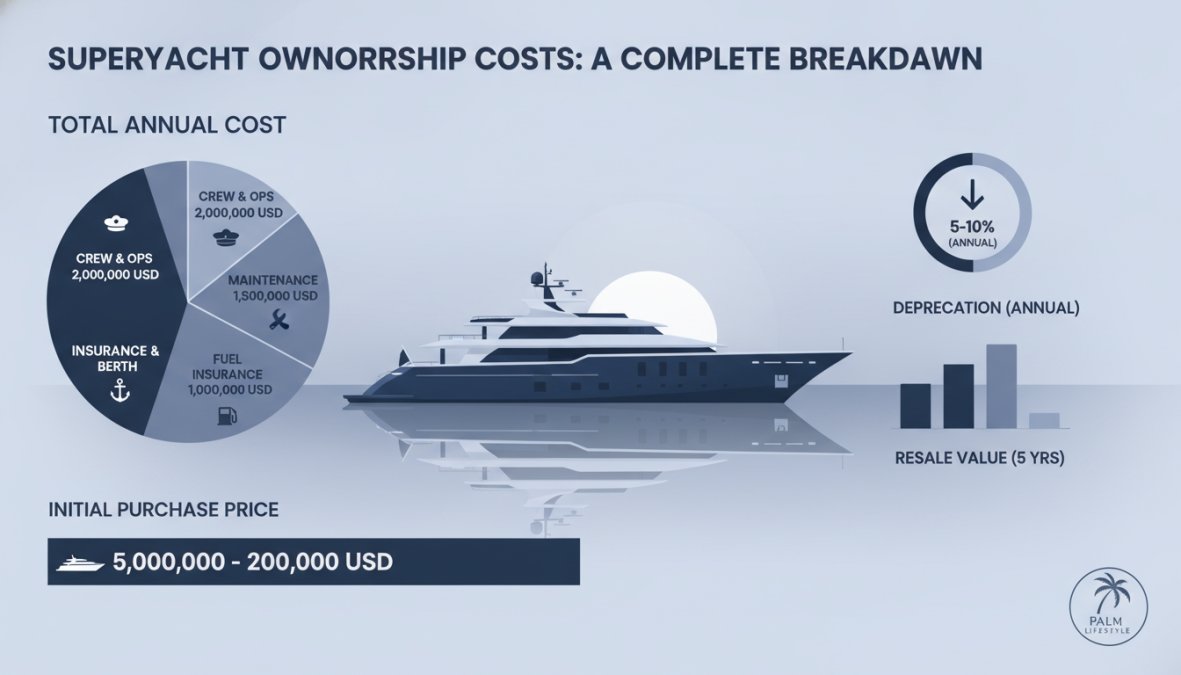
Superyacht Ownership Costs: A Complete Breakdown
Ownership costs fall into three categories: fixed annual expenses regardless of usage, variable costs that scale with use, and capital expenditure for purchase and major upgrades.
Fixed Annual Operating Expenses
Fixed costs occur whether your superyacht sits idle or runs at full capacity.
Crew salaries represent the largest fixed expense. A superyacht requires permanent crew even during idle periods: captain, chief engineer, chef, stewardess, and additional staff depending on size. Crew costs for a 50-meter superyacht easily reach six figures annually.
Insurance premiums are substantial and non-negotiable. Comprehensive superyacht insurance covers hull damage, liability, loss of use, and crew coverage. Annual premiums typically run 0.5-1.5% of the yacht’s insured value. For a $50 million vessel, that’s $250,000-$750,000 per year.
Berthing and mooring fees vary dramatically by location. Mediterranean marinas charge $1,000-$3,000 per meter annually in sought-after ports.
Technical management and administrative services handle regulatory compliance, crew management, and maintenance coordination, costing $50,000-$150,000 annually.
Flag state registry and documentation require annual renewal fees, typically $5,000-$20,000.
Combined, fixed annual costs for a mid-size superyacht often reach $500,000-$1.2 million before the yacht moves.
Variable Costs and Hidden Expenses
Variable costs scale with usage and often surprise owners.
Fuel consumption is the most obvious variable. A 50-meter superyacht burns 200-400 gallons of marine diesel per hour at cruising speed. A week-long Mediterranean cruise can consume $50,000-$100,000 in fuel alone.
Provisioning and catering for crew and guests range from $10,000-$30,000 weekly.
Port fees and transit costs include harbor dues, canal passage fees, and pilot services, totaling $20,000-$50,000 annually for actively cruising yachts.
Maintenance and repairs reveal ownership’s true hidden costs. Even well-maintained superyachts require regular haul-outs for hull inspection and anti-fouling. A major engine overhaul costs $500,000; hull refits run into millions. Most owners budget 5-10% of yacht value annually for maintenance, though actual costs often exceed projections.
Crew training and certifications require ongoing investment, costing $20,000-$50,000 annually.
Entertainment systems, water toys, and equipment upgrades add $50,000-$200,000+ annually.
The critical insight: variable costs make ownership financially unpredictable. A yacht cruising 10 weeks annually costs dramatically more than one used 4 weeks.
Capital Expenditure and Depreciation
The purchase price is only the beginning. Superyachts depreciate steeply: typically 10-15% in the first year, then 5-8% annually thereafter. A $50 million new build is worth approximately $42.5 million after year one. After five years, expect 60-70% of purchase price.
Refits and major upgrades can offset some depreciation by modernizing systems, occurring every 5-10 years at 10-20% of yacht value.
Many owners purchase pre-owned superyachts to avoid the steepest depreciation. A 10-year-old superyacht has already absorbed most value loss, making it a more stable asset, though it may require significant capital investment to modernize systems.
Superyacht Charter Costs: What to Expect
Charter costs operate on a completely different structure. You pay for access during a defined period, and the charter company assumes all operational responsibility.
Base Charter Rates and Seasonal Variations
Base charter rates are quoted per week and vary dramatically by vessel size, location, and season. A 40-meter superyacht in the Mediterranean during peak summer (July-August) might command $150,000-$250,000 per week. Shoulder season (May-June, September) costs 20-30% less. Winter rates drop another 30-40%.
Larger vessels (60+ meters) command proportionally higher rates. Ultra-luxury flagship yachts exceed $500,000 per week. Smaller yachts (35-40 meters) start around $80,000-$120,000 weekly.
Charter rates are negotiable, especially for longer commitments. A three-week charter typically receives 10-15% discount. Multi-month charters yield 20-30% reductions.
Additional Charges Beyond the Base Rate
The base charter rate covers the yacht, crew, and basic operational costs. Everything else is additional.
Fuel surcharge typically runs $20,000-$50,000 per week or 10-15% markup on base rate. Provisioning and catering add $10,000-$30,000 weekly. Crew gratuity is customary at 10-15% of base charter rate. Port fees and transit costs are charged at cost. Insurance and damage deposits vary by charter company, with some requiring 10-25% security deposit.
A realistic total cost for a Mediterranean charter is typically 20-30% higher than the advertised base rate.
The Usage Frequency Threshold: When Ownership Makes Sense
Ownership makes financial sense only if you use the yacht enough to justify fixed costs.
Breaking Even on Annual Costs
Consider a 50-meter superyacht with fixed annual costs of $750,000 and variable costs of $75,000 per week of cruising. Charter equivalent is $200,000 per week (base rate plus fuel, provisions, crew gratuity).
If you charter for four weeks annually, your cost is approximately $800,000-$900,000. Your fixed ownership costs alone are $750,000. You’d break even on pure cost comparison at 3-4 weeks annually.
However, ownership fixes your costs while charter rates fluctuate. The conventional wisdom suggests ownership makes sense if you’ll use the yacht 8+ weeks annually. Below that threshold, charter is typically more economical.
Flexibility vs. Asset Control
Ownership provides control that charter cannot match. As an owner, you decide when the yacht operates, where it goes, what crew manages it, and what guests are invited. You can make spontaneous decisions and multi-month expeditions.
Charter restricts these freedoms. You book specific dates, accept the assigned crew, work within the charter company’s parameters, and follow predetermined itineraries. Last-minute changes incur penalties.
Benefits of Superyacht Ownership: Beyond Economics
Ownership delivers non-financial benefits that pure cost analysis misses.
Privacy, Exclusivity, and Lifestyle Control
Ownership provides absolute privacy. Your superyacht is your private floating residence with only your hired crew. For high-net-worth individuals and public figures requiring discretion, this is invaluable.
Exclusivity extends to customization. You design interior spaces, select artwork and furnishings, and create an environment reflecting your taste. Ownership enables multi-generational family experiences without charter schedule constraints.
Customization and Personalization
As an owner, you commission upgrades and modifications, controlling the aesthetic entirely and establishing operational preferences. Over time, your crew becomes expert in your preferences. Charter yachts, while excellent, offer standardized service and design.
Building Wealth Through Asset Appreciation
While superyachts typically depreciate, some owners charter their yacht when not using it, generating revenue that offsets operating costs. A well-maintained superyacht can generate $1-2 million in annual charter revenue, significantly reducing net ownership costs.
Fractional Yacht Ownership: A Middle Ground
Between full ownership and charter lies fractional ownership, a model gaining traction among discerning clients.
How Fractional Models Work
Fractional ownership allows multiple owners to share a single superyacht. Each shareholder has guaranteed access for a set number of weeks annually, plus voting rights on major decisions.
You might own 1/8th of a superyacht, guaranteeing 6-7 weeks of access annually. You pay a proportional share of fixed costs plus variable costs for weeks you use the yacht. Fractional ownership costs typically run 40-60% of full ownership costs for equivalent access. Management is handled by a professional operator.
Pros and Cons vs. Full Ownership and Charter
Advantages: Lower capital commitment than full ownership; guaranteed access (unlike charter); professional management removes operational headaches; shared fixed costs reduce individual burden; potential for charter revenue if scheduled weeks aren’t used.
Disadvantages: Scheduling constraints; limited customization; governance complexity; resale liquidity challenges; shared responsibility if other owners neglect obligations.
Fractional ownership appeals to those wanting more control than charter but less operational burden than full ownership. It’s ideal for first-time superyacht users or those with variable usage patterns.
Ownership Exit Strategies and Liquidity Planning
Understanding exit strategies before purchase is critical.
Resale Considerations and Market Timing
Superyacht resale markets are cyclical and illiquid. A vessel that appreciated during a bull market can depreciate sharply during downturns. The global superyacht market is relatively small, perhaps 5,000-6,000 active vessels. Finding a buyer at your desired price can take months or years. Brokers typically work on 5-10% commission, further reducing net proceeds.
The strategic insight: Purchase a superyacht only if you’re comfortable holding it for 5-10 years minimum. Short-term ownership (1-3 years) almost always results in losses exceeding charter costs.
Charter Income as a Revenue Offset
Many owners mitigate holding costs by chartering their yacht when not using it. A 50-meter superyacht chartering for $150,000-$200,000 per week can generate $1.5-2 million annually if booked 10 weeks per year. After charter company fees (typically 20-30%), the owner nets $1-1.4 million, substantially offsetting $750,000-$1 million in fixed annual costs.
Charter income works best for owners using their yacht 4-6 weeks annually and comfortable with professional management during charter periods.
Making Your Decision: Key Factors to Evaluate
The purchase vs. charter decision hinges on five critical variables.
Financial Capacity and Long-Term Planning
Assess your actual financial capacity. Ownership requires not just the purchase price but sustained annual cash flow for operating costs. A $50 million yacht purchase requires comfortably affording $750,000-$1.5 million annually for 10+ years.
Consider your time horizon. Are you planning to own for 20+ years, or might circumstances change in 5-10 years? Ownership makes sense for long-term commitment.
Usage Patterns and Lifestyle Requirements
Honestly assess how much you’ll use the yacht. Track your actual vacation patterns from the past five years. How many weeks did you spend away from home? How many would have been spent on a superyacht? This historical data is far more reliable than aspirational projections.
If honest assessment suggests 4-6 weeks annually, charter is more economical. If you’re confident in 8+ weeks annually and value control highly, ownership becomes justified.
Tax Efficiency and Regulatory Considerations
Superyacht taxation is complex and jurisdiction-dependent. Ownership structure (personal, corporate, trust) affects tax treatment. Charter income is taxable. Depreciation offers some tax benefits. VAT and import duties vary by flag state.
High-net-worth individuals should consult specialized maritime tax advisors before committing to ownership. Charter eliminates these complexities.
Decision Factor | Favors Ownership | Favors Charter |
|---|---|---|
Annual usage | 8+ weeks | 4-6 weeks or less |
Need for control | High | Low |
Desired customization | Extensive | Standard acceptable |
Time horizon | 10+ years | 5 years or less |
Liquidity needs | Low | High |
Tax complexity tolerance | High | Low |
Operational involvement | High | Minimal |
Flexibility preference | Predictable routes | Variety and options |
Conclusion
The superyacht purchase vs charter comparison ultimately reflects your values, lifestyle, and financial priorities. Ownership delivers control, privacy, and the ability to create a personalized floating residence. Charter offers simplicity, flexibility, and access without long-term commitment.
Most high-net-worth individuals benefit from starting with charter. It allows you to experience superyacht lifestyle, understand your actual usage patterns, and test your preferences before committing capital to ownership. After 2-3 years of charter experience, you’ll have clarity on whether ownership is truly aligned with your needs.
For those ready to commit to ownership, fractional models provide a pragmatic middle ground, combining guaranteed access with professional management and reduced financial burden.
At Palm Lifestyle, we specialize in helping clients navigate this decision with clarity and confidence. Whether you’re exploring charter options for the first time or planning a sophisticated ownership strategy with integrated charter revenue, our team provides comprehensive guidance on yacht purchase, charter arrangements, and hybrid models.
Get in touch with us to discuss your yachting needs and explore the option that best aligns with your lifestyle and financial goals.
Frequently Asked Questions
Is it cheaper to charter or buy a superyacht?
The answer depends on your usage frequency. Charter costs vary by vessel size, season, and destination, while superyacht ownership involves substantial fixed annual operating expenses including crew salaries, berthing fees, insurance, and maintenance. For occasional users (under 6-8 weeks annually), chartering typically proves more economical. However, frequent users may find ownership justifiable when amortized over multiple years. A detailed financial analysis comparing your anticipated usage against ownership costs is essential to determine which path suits your situation.
What are the main benefits of superyacht ownership?
Superyacht ownership offers unparalleled privacy, exclusivity, and lifestyle control that chartering cannot replicate. Owners enjoy complete customization of their vessel, guaranteed availability without booking constraints, and the ability to establish a permanent floating residence or business asset. Additionally, a well-maintained superyacht can serve as a tangible asset class that may appreciate over time, and owners can offset costs by chartering the yacht out when not in personal use. The lifestyle benefits—privacy for family gatherings, business entertaining, and personalized itineraries—appeal strongly to high-net-worth individuals seeking total autonomy.
What is fractional superyacht ownership, and how does it compare?
Fractional yacht ownership allows multiple investors to share ownership of a single vessel, typically dividing usage rights and costs proportionally. This model provides a middle ground between full ownership and charter, offering greater control than chartering while reducing the capital expenditure and management burden of sole ownership. Fractional owners enjoy guaranteed access during allocated periods and share operating expenses, insurance, and crew salaries. However, you sacrifice exclusivity and flexibility compared to full ownership, and availability is limited to your designated weeks. This option suits those wanting ownership benefits without the complete financial or operational commitment.
Can I offset superyacht ownership costs by chartering it out?
Yes, many superyacht owners generate significant charter income when their vessel is not in personal use. Professional yacht management companies can market your yacht for charter, arrange crew, and handle all logistics, typically taking a commission. Charter income can substantially offset annual operating expenses, depreciation, and financing costs. However, chartering your own yacht requires careful planning around your usage schedule, compliance with maritime regulations, insurance considerations, and tax implications. Working with experienced yacht brokers familiar with charter agreements and MYBA terms ensures your vessel is properly marketed and legally protected during charter periods.