
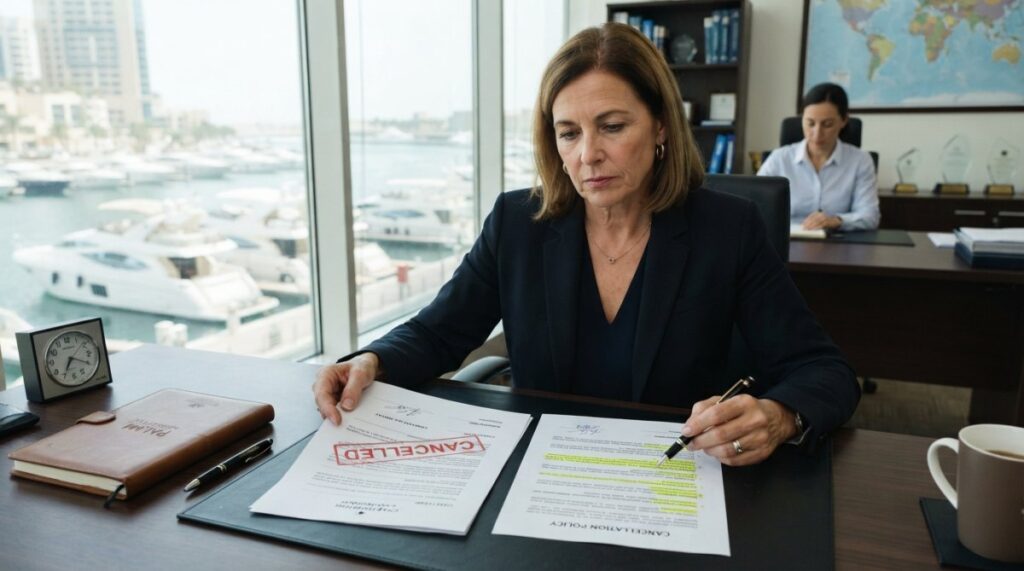
What Happens if You Cancel a Luxury Yacht Charter Under a MYBA Charter Contract
Booking a luxury yacht charter is, for most people, the easy part. The hard part — the part almost nobody thinks about until it’s too late — is what happens when plans change. A guest falls ill. A business deal collapses and the trip no longer makes sense. A hurricane forms in the wrong place at the wrong time. Whatever the reason, the moment a charterer decides to walk away from a signed agreement, one document determines exactly what happens next: the MYBA Charter Agreement.
Understanding this contract before you sign it — not after you need to cancel — is the single most valuable piece of preparation any prospective charterer can do. This article walks through what the MYBA agreement actually says about cancellation, how the financial consequences are calculated, what rights and obligations survive for both the charterer and the owner, and how the process typically plays out in practice.
What the MYBA Charter Agreement Is, and Why It Matters
MYBA — originally the Mediterranean Yacht Brokers Association, now trading as “The Worldwide Yachting Association” — publishes the standard-form contract used for the overwhelming majority of crewed superyacht charters worldwide. In the Caribbean and Bahamas, brokers sometimes use the CYBA Crewed Yacht Charter Agreement instead, but for the Mediterranean, and for most yachts above roughly 24 metres wherever they cruise, the MYBA form is the default.
The agreement’s popularity is not an accident. It is a carefully balanced document, refined over decades of industry practice and periodically updated — most recently with a 2025 revision that layered in modern compliance requirements around Know Your Client (KYC) checks, data protection, confidentiality, and sanctions screening, while preserving the core structure that brokers, owners, and charterers have relied on since the 2001 and 2017 editions. It governs the charter fee and what it covers, the Advance Provisioning Allowance (APA), delivery and redelivery of the vessel, insurance, liability, and — critically for this discussion — what happens if either party cancels.
Because the MYBA agreement is a genuine legal contract, not a booking confirmation or a set of loosely worded terms and conditions, it is enforceable in court, and in practice most disputes arising from it are resolved through arbitration under English law, typically under the rules of the London Maritime Arbitrators Association (LMAA). That single detail — that this is a binding instrument governed by English law and headed toward arbitration if things go wrong — should already reframe how a prospective charterer thinks about the word “cancel.”
The Payment Structure You’re Cancelling Against
To understand the consequences of cancellation, you first need to understand the payment schedule the cancellation clause is measured against, because the financial exposure at any given moment is a direct function of how much money has already changed hands and how close the charter start date is.
The standard MYBA payment structure is a two-instalment model:
- First instalment (deposit): typically 50% of the charter fee, due at the time of signing the agreement.
- Second instalment (balance): the remaining 50%, together with the APA and any VAT due, typically payable four to six weeks — commonly 30 days — before the charter begins.
Some brokers and owners negotiate a different split for early bookings made many months or a year in advance, sometimes breaking the deposit into smaller tranches. But the two-instalment structure above remains the market default, and it is the one the cancellation clause is built around. This matters because the two moments — signing and final balance payment — create two distinct “zones” of financial exposure for a charterer who is thinking about cancelling.
The Cancellation Clause: How It Actually Works
The cancellation provisions sit within the body of the MYBA agreement (numbered as Clause 9 in the core agreement text covering owner and charterer default, with some broker-facing summaries referring to the practical cancellation mechanics loosely as “Clause 11” — the exact numbering has shifted slightly across the 2001, 2017, and 2025 editions, so always check the clause numbers on the specific agreement you are signing). What matters far more than the clause number is the underlying logic, which is consistent across editions.
Cancellation by the Charterer
If you, as the charterer, decide to cancel, the financial consequence depends on timing:
Before the deposit is due, or immediately upon signing. In practice this window barely exists — signing the agreement and paying the first instalment tend to happen together, so once you have a signed MYBA agreement in hand, you generally also have money on the table.
After the deposit has been paid, but before the final balance is due. This is the most common scenario. If you cancel during this period, the owner is entitled to retain the deposit already paid — typically the full 50% first instalment — as compensation. You are not usually obligated to pay the remaining balance, because the charter has not yet reached the point where that money was due. The yacht, however, has been held off the market for your dates, and the deposit compensates the owner for that lost opportunity.
After the final balance has been paid. This is where cancellation becomes financially serious. Once the full charter fee has been transferred, the position shifts from “the owner keeps the deposit” to “the charterer’s exposure depends heavily on whether the yacht can be re-chartered.” If the broker and owner succeed in re-booking the yacht for the same dates — even at a different rate — the original charterer is typically entitled to a partial refund of monies paid, net of the owner’s reasonable costs and, in many cases, a cancellation fee calibrated to how late the cancellation occurred. If no replacement charter can be found, the charterer generally forfeits the funds paid, because the owner has now lost the entire charter period with certainty.
The escalating logic — the closer to embarkation, the higher the forfeiture — is deliberate. A cancellation six months out gives the owner and the yacht’s management company time to remarket the dates; a cancellation two weeks out gives them almost none. In some published examples of how these clauses are applied, a charterer cancelling at least 30 days before the charter start might still recover the equivalent of roughly 25% of the charter fee as liquidated damages if the owner is deemed responsible for a corresponding cancellation, while charterer-initiated cancellations close to the start date can, in the worst case, result in forfeiture of the full amount paid. These figures move depending on the specific negotiated terms of each agreement, so treat them as illustrative of the mechanism rather than as fixed industry percentages.
Cancellation by the Owner
The MYBA agreement is explicit that owner-initiated cancellation is treated more strictly than charterer-initiated cancellation, and rightly so — the charterer has planned around a specific vessel and specific dates, often booking flights, coordinating a group of guests, and arranging shoreside logistics.
If the owner cancels for any reason other than force majeure, the charterer is entitled to:
- Immediate repayment, in full and without deduction, of every payment already made; and
- Liquidated damages calculated as a percentage of the charter fee, with the percentage increasing the closer the cancellation falls to the intended start date of the charter.
Illustrative structures published by maritime law commentators describe tiers along these lines: an owner cancellation well in advance of the charter might trigger damages equivalent to a modest percentage of the charter fee, rising as the notice period shortens, and reaching a significantly higher percentage — sometimes cited as being in the region of 50% of the charter fee — where the owner cancels with only a couple of weeks’ notice or less. Again, the exact bands are set out in the specific agreement and can be negotiated, so a charterer or their broker should always confirm the precise figures in the document being signed rather than relying on industry rules of thumb.
There is one more detail that surprises many first-time charterers: even when the owner cancels, the broker’s commission is typically still fully payable by the owner. The MYBA agreement treats the broker’s commission as earned upon signature of the agreement and payment of the deposit — the broker has done the work of matching owner and charterer and administering the transaction, and that work isn’t undone by a subsequent cancellation, whichever side causes it. In an owner-cancellation scenario, the standard language requires the broker and stakeholder to be paid the full commission due, generally within a short fixed window (commonly 72 hours) of the formal cancellation. This is worth knowing because it shapes incentives on all sides of the transaction.
Force Majeure: A Different Set of Rules Entirely
Not every cancellation is a matter of choice. The MYBA agreement carves out a separate, more limited remedy for cancellations caused by force majeure — defined broadly to include acts of God, strikes, civil commotion, war, terrorism, fire, explosion, government action, contaminated fuel, and major mechanical or electrical breakdown that is beyond the crew’s control and not the result of poor maintenance or negligence.
The key practical distinction is this: if the owner cancels because of a genuine force majeure event, the charterer’s only remedy is a full, prompt refund of monies already paid, without interest — there are no additional liquidated damages. This is a meaningfully worse outcome for the charterer than an ordinary owner-initiated cancellation, precisely because force majeure removes fault from the equation. A hurricane, a war outbreak, or a genuine engine casualty is nobody’s doing, so the contract doesn’t ask the owner to compensate the charterer beyond returning their money.
This distinction has become sharper in the most recent (2025) revision of the agreement, which tightened the documentary requirements around invoking force majeure. Under the newer language, a party seeking to rely on force majeure typically has a short window — commonly described as 48 hours — to notify the other side, followed by a further period, often around seven days, to submit documentary proof supporting the claim. Miss that window, and the force majeure protection can be lost, exposing the cancelling party to the ordinary (and less forgiving) cancellation consequences instead. This is a meaningful trap for charterers and owners alike: a genuine emergency, poorly documented or reported late, can end up costing far more than it should have.
Whether a specific event actually qualifies as force majeure is, in the words of maritime lawyers who work with this contract regularly, always a question of fact. Two things generally have to be true: the cause of cancellation must be directly attributable to the qualifying event, and that event must be genuinely beyond the reasonable control of the party invoking it. A charterer who simply changes their mind cannot dress the decision up as force majeure, and an owner whose yacht breaks down because of deferred maintenance cannot either — the clause exists for genuine, uncontrollable disruption, not for convenient exits.
The Re-Charter Clause: Everyone’s Best Outcome
Buried within the cancellation mechanics is a provision that, in practice, resolves a large share of real-world cancellations far more amicably than the headline percentages suggest: the re-charter (or “buyer takeover”) clause. If a charterer needs to cancel but can find another party willing to take over the booking on the same terms and conditions, the original charterer generally avoids any cancellation penalty. The replacement charterer simply steps into the original charterer’s shoes, the owner suffers no loss of revenue, and the broker’s commission structure continues to apply on the substituted booking.
This is precisely why an experienced charter broker earns their fee in a cancellation scenario. Before assuming the worst-case forfeiture applies, a good broker will actively work the phones — checking whether the same dates on the same yacht can be resold, whether a comparable vessel in the fleet can absorb the booking, or whether a private buyer or referral can step in. The contractual worst case exists to allocate risk clearly if nothing can be salvaged; it is not usually the first move.
Technical Breakdown: A Related but Separate Scenario
Charterers sometimes conflate cancellation with what happens when the yacht itself becomes unavailable due to a mechanical or technical problem — a separate clause in the MYBA agreement, generally addressed after the cancellation provisions. If a genuine technical breakdown disrupts or prevents the charter, the contract typically gives the owner the option to substitute a similar or better vessel; if no suitable substitute is available, the charterer is entitled to a full refund. This is a related but distinct pathway from cancellation, because it is triggered by the vessel’s condition rather than either party’s decision to walk away from the agreement, and it carries its own compensation logic tied to time lost on board rather than liquidated damages calculated against the full charter fee.
KYC, Sanctions, and Compliance-Driven Cancellations
The 2025 revision of the MYBA agreement introduced a cluster of new clauses — commonly numbered in the high 20s — covering Know Your Client procedures, data protection, confidentiality, and sanctions compliance. These aren’t cosmetic additions. Both the owner and the charterer are now contractually required to provide identity documentation before funds move, and if a third party is settling the charter fee on the charterer’s behalf, that third party is pulled into the same KYC process.
This matters for cancellation because the contract now explicitly contemplates cancellation on compliance grounds: if KYC verification fails, or a sanctions screening flags a party involved in the transaction, the agreement can be cancelled without either side being able to characterise the other’s compliance block as a breach of contract. In other words, a cancellation triggered by a legitimate regulatory or compliance issue is treated as its own category, sitting outside the ordinary fault-based cancellation framework. For high-net-worth charterers structuring payment through corporate entities, trusts, or third-party payers, this is an area worth clarifying with the broker well before signing, since a compliance-driven cancellation late in the process can otherwise create confusion about which cancellation regime applies.
What a Charterer Should Actually Do Before Signing
Given everything above, a few practical habits separate charterers who navigate a cancellation smoothly from those who are blindsided by it.
Read the actual cancellation clause in the specific agreement, not a summary of it. Percentages, notice periods, and even clause numbers vary between the 2001, 2017, and 2025 versions of the MYBA form, and owners occasionally negotiate bespoke variations. The only reliable source is the document you are about to sign.
Understand exactly where you sit on the payment timeline before making any decision to cancel. Whether you are pre-deposit, post-deposit, or post-final-balance changes your exposure dramatically, and it is worth confirming the exact dates the second instalment falls due at the moment you book.
Ask your broker, early, what re-charter prospects look like for your dates. A broker who knows the yacht’s calendar and the wider market can often give a realistic read on whether a cancellation is likely to be absorbed cheaply through a resale or whether it is likely to be a costly, unrecoverable loss — and that assessment should inform how aggressively you negotiate cancellation terms before signing, not after.
Seriously consider charter cancellation insurance. Given how rigid and formulaic the MYBA cancellation language is by design — it exists precisely to avoid case-by-case negotiation under pressure — a dedicated cancellation and interruption insurance policy is, for most charterers booking a significant charter fee months in advance, a proportionate and inexpensive way to transfer the risk that this article has just walked through. Reputable brokers routinely offer a quote for this alongside the charter agreement itself, and it is worth taking seriously rather than treating as an upsell.
If you are the one considering cancellation, document your reasoning and act promptly. Particularly where force majeure might apply, the tightened notification windows in the current agreement mean that delay itself can be the difference between a full refund and a forfeited deposit. Notify your broker immediately, in writing, and follow up with whatever documentary evidence supports your position within the window the contract specifies.
The Bigger Picture
None of this is designed to make cancellation sound like a trap. The MYBA agreement’s cancellation architecture exists precisely because yacht charter is a high-value, low-volume business built around scarce, perishable inventory — a yacht’s calendar for a specific week in August cannot be resold once that week has passed, unlike almost any other luxury purchase. The contract’s job is to allocate that risk predictably between owner and charterer, rather than leaving it to an ad hoc negotiation at the worst possible moment, under time pressure, with money already on the table.
Charterers who understand the mechanics — the two-instalment payment structure, the escalating forfeiture logic tied to how close cancellation falls to embarkation, the sharper line between fault-based and force majeure cancellation, and the practical value of the re-charter clause — are simply better placed to make good decisions, whether that means negotiating better terms before signing, buying appropriate insurance, or knowing exactly what to expect if circumstances genuinely force a change of plan. In a transaction of this size, that clarity is worth as much as any clause in the contract itself.vFrequently Asked Questions
What are the typical cancellation fees under a MYBA charter agreement?
MYBA agreements typically structure cancellation fees as a percentage of the charter fee, scaled by how close you are to the scheduled charter date. Early cancellations (60+ days before) often allow full refunds minus the booking deposit. Mid-window cancellations (30-60 days) may result in 50% loss of the charter fee, while cancellations within 30 days can forfeit 75-100% of the charter fee. The exact percentages depend on your specific charter contract terms and the operator’s policy.
Can I recover my Advance Provisioning Allowance if I cancel my yacht charter?
Yes, the Advance Provisioning Allowance (APA) refund depends on cancellation timing and what expenses have already been incurred. If you cancel early, before the charter operator has purchased provisions and supplies, you may recover most or all of the APA. However, if cancellation occurs close to the charter date or after provisioning has begun, deductions for crew salaries, fuel, and supplies already purchased will reduce your refund. Request an itemized accounting from the charter operator to understand what portions are refundable.
What is force majeure in a yacht charter contract, and does it protect me from cancellation fees?
Force majeure refers to unforeseen, uncontrollable events, such as severe weather, natural disasters, or government-imposed travel restrictions, that make charter performance impossible or illegal. Under MYBA agreements, force majeure typically releases both parties from liability, meaning you may avoid cancellation fees if a genuine force majeure event prevents the charter. However, the event must be documented and meet the contract’s specific definition. Weather disruptions alone may not qualify unless they render the charter genuinely unsafe or impossible.
Should I purchase yacht charter insurance in the UAE, and what does it cover?
Yes, travel insurance for yacht charters is strongly recommended in the UAE. Comprehensive policies typically cover cancellation due to illness, injury, family emergencies, and sometimes force majeure events. Coverage often reimburses your charter fee, booking deposit, and related travel costs if you cancel for a covered reason. Policies vary widely, so review exclusions carefully, some may not cover cancellations due to weather or pre-existing conditions. Obtain a quote from your insurance provider before booking to ensure adequate protection for your charter investment.
Frequently Asked Questions
What are the typical cancellation fees under a MYBA charter agreement?
MYBA agreements typically structure cancellation fees as a percentage of the charter fee, scaled by how close you are to the scheduled charter date. Early cancellations (60+ days before) often allow full refunds minus the booking deposit. Mid-window cancellations (30–60 days) may result in 50% loss of the charter fee, while cancellations within 30 days can forfeit 75–100% of the charter fee. The exact percentages depend on your specific charter contract terms and the operator's policy.
Can I recover my Advance Provisioning Allowance if I cancel my yacht charter?
Yes, the Advance Provisioning Allowance (APA) refund depends on cancellation timing and what expenses have already been incurred. If you cancel early, before the charter operator has purchased provisions and supplies, you may recover most or all of the APA. However, if cancellation occurs close to the charter date or after provisioning has begun, deductions for crew salaries, fuel, and supplies already purchased will reduce your refund. Request an itemized accounting from the charter operator to understand what portions are refundable.
What is force majeure in a yacht charter contract, and does it protect me from cancellation fees?
Force majeure refers to unforeseen, uncontrollable events—such as severe weather, natural disasters, or government-imposed travel restrictions—that make charter performance impossible or illegal. Under MYBA agreements, force majeure typically releases both parties from liability, meaning you may avoid cancellation fees if a genuine force majeure event prevents the charter. However, the event must be documented and meet the contract's specific definition. Weather disruptions alone may not qualify unless they render the charter genuinely unsafe or impossible.
Should I purchase yacht charter insurance in the UAE, and what does it cover?
Yes, travel insurance for yacht charters is strongly recommended in the UAE. Comprehensive policies typically cover cancellation due to illness, injury, family emergencies, and sometimes force majeure events. Coverage often reimburses your charter fee, booking deposit, and related travel costs if you cancel for a covered reason. Policies vary widely, so review exclusions carefully—some may not cover cancellations due to weather or pre-existing conditions. Obtain a quote from your insurance provider before booking to ensure adequate protection for your charter investment.
