
Table of Contents
- Custom Mediterranean Yacht Charter Itinerary: How the Process Works
- Bespoke Yacht Charter Planning: What to Decide Before the Route
- Translating Yacht Charter Guest Preferences Into a Route
- Choosing Yacht Charter Duration and Departure Ports
- Yacht Charter Itinerary Examples by Trip Length
- Step-by-Step: Building the Sailing Route and Daily Schedule
- Season, Weather, and Contingency Planning for a Mediterranean Yacht Charter
- Finalising and Booking Your Itinerary
- Frequently Asked Questions
Last Updated: October 8, 2026
Custom Mediterranean Yacht Charter Itinerary: How the Process Works
A custom Mediterranean yacht charter itinerary is a route built around your group, your dates and your pace, not pulled from a brochure.
Below, we break down the full process, from the first conversation to the signed charter agreement. You will see what to decide before the route, how many days you actually need, and what a realistic day on board looks like.
Bespoke Yacht Charter Planning: What to Decide Before the Route
Bespoke yacht charter planning starts with decisions, not destinations. Most first-time charterers do this backwards. They pick a famous island, then try to force everything else around it.
That is how you end up with long, uncomfortable crossings.
Before we draw a single line on a chart, we want answers to a short list of questions.
What a Charter Broker Needs From You First
- Guest list and ages. Young children, elderly guests and non-swimmers all change the plan.
- Trip dates and flexibility. A two-day window can change which regions are viable.
- Preferred pace. Some groups want a new bay every day. Others want two anchorages all week.
- Must-do experiences. A specific restaurant, a diving site, a beach club.
- Onboard style. Formal dining, casual lunches, or a mix.
- Privacy requirements. Who should know where you are, and who should not.
Get these on paper early. Every later decision, from departure port to daily schedule, flows from them.
How the Plan Changes by Traveler Type
The same coastline produces a very different week depending on who is on board.
Couples. Longer, quieter anchorages and fewer harbour nights.
Groups of friends. More harbour towns, later starts, and a tender that can move people in two or three waves.
Corporate and client hosting. Fewer stops, longer stays, and a schedule built around a single focal event.
First-time charterers. Build in more anchor time and fewer moves.
Translating Yacht Charter Guest Preferences Into a Route
Yacht charter guest preferences are the raw material of the itinerary. The skill is in the translation.
A group that says “we want nightlife” is not asking for the same week as a group that says “we want quiet”.
Here is how we read the common requests:
Guest Preference | What It Usually Means | Route Implication |
|---|---|---|
“Somewhere quiet” | Anchorages, few other yachts | Smaller islands, off-peak timing |
“Good food and wine” | Long lunches ashore | Short hops between harbour towns |
“Water sports” | Tenders, toys, swimming | Sheltered bays, calm mornings |
“Culture and history” | Old towns, ruins, walks | Ports with walkable centres |
“Entertaining clients” | Space, service, timing | Fewer stops, longer stays |
The last row matters most for corporate groups. Hosting twenty business guests on board is a logistics exercise, not a sightseeing one.
Choosing Yacht Charter Duration and Departure Ports
Yacht charter duration and your departure port are the two decisions that constrain everything else. Get them wrong and the rest of the plan fights itself.
A seven-day charter in the western Mediterranean gives you one region, done properly. A ten-day charter opens up a second. Trying to cover three regions in a week means spending your holiday at sea, watching coastlines go past.
How Many Days You Actually Need
- 5 days: One compact area. Ideal for a short break or a first charter.
- 7 days: One region with depth. The classic charter length.
- 10 days: Two connected regions, with a relaxed pace.
- 14 days: A full crossing or two distinct areas, island by island.
On departure ports, the rule is simple. Start where the flights land, and finish somewhere with an easy departure. One-way charters usually carry a repositioning cost, so factor that in early rather than at contract stage.
Yacht Charter Itinerary Examples by Trip Length
Yacht charter itinerary examples are useful because they show what is realistic. Ours are built around sailing hours, not wish lists.
A comfortable day involves two to four hours of cruising. Anything beyond five hours starts to feel like a ferry crossing, especially in the afternoon heat.
Get in touch with us to discuss your yachting needs. →
Below are three templates by trip length. Treat them as shapes, not scripts. The captain will adjust for wind, swell and harbour availability.
Three Days: One Anchorage Cluster
Best for a short break or a first taste of charter life. Stay within a 15 to 20 nautical mile radius so you never spend more than two hours under way.
- Day 1: Board late morning, short cruise of 8 to 10 nautical miles to a sheltered first anchorage. Swim, dinner on board.
- Day 2: Morning at anchor, then a 12 to 15 nautical mile hop to a harbour town for lunch ashore and an afternoon walk. Return to anchor nearby.
- Day 3: Short 6 to 8 nautical mile cruise to a final swim stop, then back to the arrival port by early afternoon.
Seven Days: One Region, Done Properly
A typical seven-day plan in a single region looks like this, using a notional island group as the example:
- Day 1: Board mid-afternoon, settle in, short 5 to 8 nautical mile cruise to a nearby anchorage.
- Day 2: Morning swim stop, then a 12 to 15 nautical mile hop to a harbour town for lunch and a walk. Overnight at anchor or in the harbour.
- Day 3: A quieter island, 15 to 20 nautical miles away. Anchorage, water sports, dinner on board.
- Day 4: Longer hop of 25 to 30 nautical miles to the next group of islands, arriving by early afternoon.
- Day 5: Beach club or a coastal village, depending on the group. Keep the leg under 10 nautical miles.
- Day 6: Final full day. A highlight stop, kept flexible for weather.
- Day 7: Short 8 to 10 nautical mile cruise to the arrival port, disembark after breakfast.
Notice how little ground that covers. That is the point. The best weeks are the ones where nobody feels rushed.
Ten Days: Two Connected Regions
Ten days lets you link two areas without long crossings. Keep every leg under 35 nautical miles and give yourself one full day at anchor with no cruising at all.
- Days 1 to 4: First region, following the seven-day shape above but with an extra anchorage day.
- Day 5: Repositioning day of 30 to 35 nautical miles between the two regions, timed for the morning when seas are usually calmer.
- Days 6 to 9: Second region, with two harbour stops and two anchorages.
- Day 10: Short cruise to the arrival port and disembarkation.
Alternatives and Swaps
Every stop should have a Plan B within 10 nautical miles. Common swaps include:
- Wind from the wrong direction: move to the leeward side of the same island rather than changing islands.
- Harbour full in peak season: anchor outside and tender in for dinner.
- Guests want a slower day: drop the longest leg and add an anchorage.
- Guests want more activity: add a second harbour town instead of a second anchorage.
Step-by-Step: Building the Sailing Route and Daily Schedule
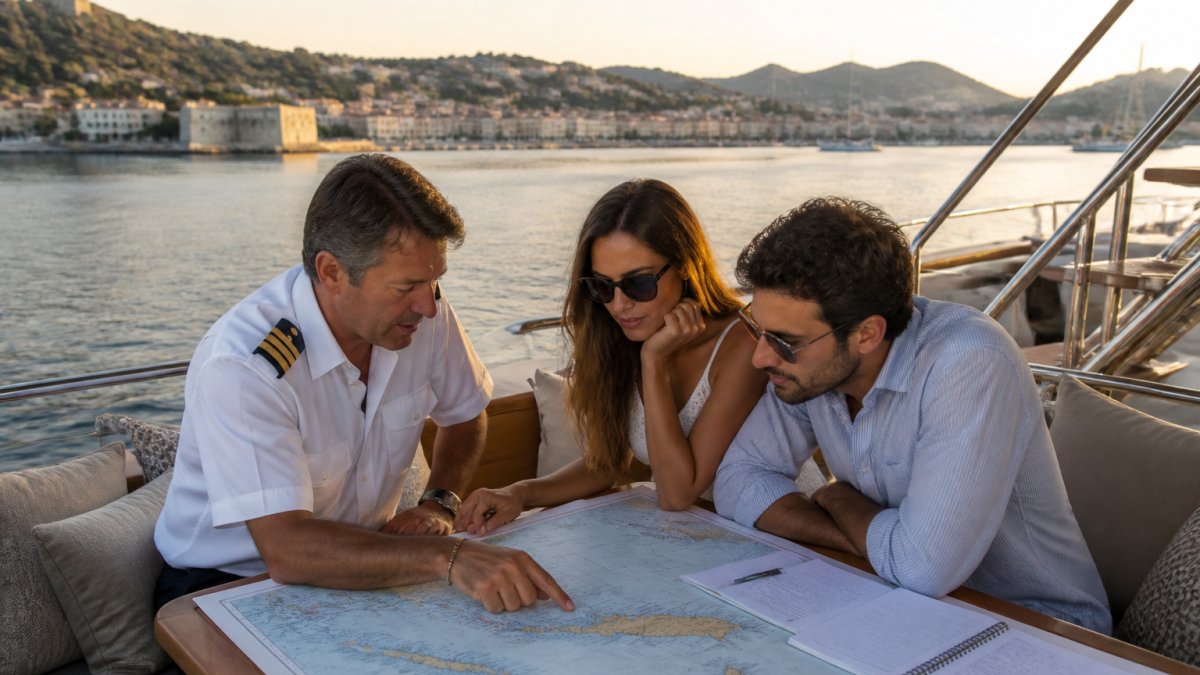
Building the sailing route is a sequence, and skipping a step costs you later. Here is the process we follow.
- Set the fixed points. Arrival port, departure port, and any non-negotiable date.
- Block the sailing days. Two to four hours of cruising per day, maximum.
- Place the anchorages first. Quiet nights are the hardest thing to find late.
- Add harbour stops. One every two or three days for dining and provisioning.
- Layer in shore time. Lunches, walks, and excursions, timed around the heat.
- Build in a spare day. Weather moves. Plans should too.
- Confirm with the captain. Local knowledge beats any plan made on land.
Step seven is the one most people skip. A captain who knows the area will tell you which bay is exposed, which harbour is full in August, and where the wind funnels in the afternoon. That advice is worth more than any guidebook.
Season, Weather, and Contingency Planning for a Mediterranean Yacht Charter
Weather decides more of your week than any other factor. The Mediterranean summer is reliable, but it is not uniform.
July and August bring heat, calm mornings and busy harbours. June and September are cooler, quieter and often the better choice for groups who value privacy.
Contingency planning is straightforward:
- Keep one spare day in any charter of a week or more.
- Have a Plan B anchorage for every overnight stop.
- Watch the afternoon wind. It builds in many areas and drops by evening.
- Book the popular restaurants ahead. The good tables go early.
- Brief the crew on priorities. If you must lose a stop, they should know which one.
For official marine weather and safety guidance in the region, consult the relevant national maritime authority before departure.
Finalising and Booking Your Itinerary
Booking is the easy part once the plan is right. The sequence matters more than the speed.
- Confirm the yacht and dates in writing before anything else.
- Agree the itinerary outline with the captain and broker.
- Review the contract, including what is and is not included.
- Check the cancellation terms carefully.
- Confirm guest details and preferences with the crew.
- Arrange transfers and any shore bookings.
Start this process early. The best yachts and the best crews are committed well ahead of the season, particularly for peak weeks.
Frequently Asked Questions
How do you plan a custom Mediterranean yacht charter itinerary?
Start with your guest list, travel dates, and the experience you want, then work with a broker to match those to a region and a yacht. Your captain then sequences ports, anchorages, and shore time around realistic sailing distances. Build the route in this order: preferences, duration, region, then daily schedule. A good plan keeps one long passage day per week and leaves the rest flexible, because weather and guest mood will shift the plan once you are aboard.
How many days do you need for a Mediterranean yacht charter?
Seven days suits a single region well, such as the Balearics or the Greek Cyclades, because you spend your time exploring rather than repositioning. Ten to fourteen days lets you combine two regions or add a longer stretch of coast. Anything under five days works only if you stay close to your departure port. As a rule, keep daily cruising to two to four hours so guests have full afternoons for swimming, dining, and shore excursions.
What should you tell a charter broker before planning an itinerary?
Give your broker the guest count and ages, preferred dates, must-see places, dietary and cultural requirements, and how much time you want on shore versus on the water. Mention any events you plan to host, such as a business dinner or a celebration, since these shape the yacht choice and the daily schedule. The more precise your brief, the fewer revisions the itinerary needs later, and the faster suitable yachts can be shortlisted.
How do season and weather affect a Mediterranean yacht charter route?
July and August bring the warmest sea and liveliest coastal towns, along with the busiest marinas, so book early. May, June, September, and October offer quieter anchorages and comfortable temperatures, though some island businesses close late in the season. Meltemi winds in the Aegean can build through July and August, which is why captains plan flexible schedules with alternative anchorages. Your captain will adjust the route day by day based on the forecast, so treat any itinerary as a strong plan rather than a fixed contract.
A custom itinerary only works when the plan, the yacht and the crew pull in the same direction. That is where most charterers lose time: chasing availability across agents instead of building one coherent plan. Palm Lifestyle handles the whole process, from matching your group to the right yacht through our worldwide charter fleet, to briefing the captain on your route and preferences before you step aboard. Get in touch with us to discuss your yachting needs.