
Table of Contents
- 1. Why a Crewed Luxury Yacht Charter Beats Every Other Mediterranean Holiday
- 2. The 2027 Luxury Yacht Charter Booking Checklist
- 3. What Is Included in a Crewed Yacht Charter
- 4. Choosing Your Yacht: Size, Style and Guest Capacity
- 5. Building a Mediterranean Yacht Charter Itinerary
- 6. Mediterranean Yacht Charter Duration: How Long to Book
- 7. Reading the Contract and Avoiding Hidden Costs
- Frequently Asked Questions
Last Updated: October 20, 2026
1. Why a Crewed Luxury Yacht Charter Beats Every Other Mediterranean Holiday
A luxury yacht charter mediterranean booking is the one Mediterranean holiday where the vessel, the crew and the itinerary are chosen around you rather than the other way round. At Palm Lifestyle, we arrange these trips for families and executives who have already tried the alternative: five-star hotels, private villas, chartered flights between islands. Each works. None of them moves with you.
That is the core argument of this guide, and it is worth stating plainly. A hotel fixes you to one coastline. A crewed yacht gives you a new anchorage each morning without a single packing case. The crew handles navigation, provisioning, service and the tender runs ashore. You handle nothing.
Below, we walk through the full booking process, the cost structure, the yacht types, and the contract clauses that separate a smooth charter from an expensive argument. The seven sections follow the order in which a serious booking actually happens.
2. The 2027 Luxury Yacht Charter Booking Checklist
Start twelve months ahead if you want first choice of yacht in July or August. The best crewed vessels in the western Mediterranean are committed early, and a late enquiry means accepting whatever remains.
Here is the sequence we use with clients:
- Fix your dates and guest numbers before anything else
- Decide crewed yacht only, and rule out bareboat entirely
- Set a total budget, not just a weekly rate ceiling
- Shortlist three to five yachts with recent photographs and crew profiles
- Request a written availability confirmation, not a verbal one
- Review the charter agreement and the expense allowance terms
- Confirm the crew’s language skills and dietary capability
- Arrange travel to the embarkation port with a buffer day
- Pay the deposit and diarise the balance date
- Send preference sheets six weeks before boarding
3. What Is Included in a Crewed Yacht Charter
A crewed yacht charter includes the vessel, the crew, insurance for the hull and crew, and standard onboard equipment. It does not include fuel, food, drinks, port fees, or gratuities. Those sit in a separate expense fund, usually called the advance provisioning allowance.
The distinction matters because first-time charterers compare a weekly rate against a hotel bill and draw the wrong conclusion. The weekly rate is the starting point, not the total.
What the crew delivers is the part that justifies the format. A captain plans the route around weather and berth availability. A chef provisions against your preference sheet. Stewardesses keep the interior running while you are ashore. On a sailing yacht, the deckhands do the work that would otherwise be yours.
4. Choosing Your Yacht: Size, Style and Guest Capacity
Yacht selection comes down to three variables: length, hull type, and how many cabins you actually need. Length drives cost and comfort. Hull type drives the experience. Cabin count drives whether your group fits.
Guest capacity on a crewed yacht is governed by the number of guest cabins, not by deck space. A 30-metre motor yacht typically carries eight to ten guests in four or five cabins. A sailing yacht of similar length carries fewer, because interior volume goes to rigging and crew quarters.
Yacht type | Typical length | Guest capacity | Best for |
|---|---|---|---|
Sailing yacht | 20-30 m | 6-8 guests | Quiet anchorages, genuine sailing |
Motor yacht | 24-40 m | 8-12 guests | Speed between islands, deck space |
Superyacht | 40 m+ | 10-12 guests | Formal entertaining, full crew |
Catamaran | 15-20 m | 6-10 guests | Families, shallow water, stability |
Motor yachts suit groups that want to cover distance. Sailing yachts suit groups that want the passage itself to be the point. Catamarans win with young children because the platform is stable and the layout is flat.
5. Building a Mediterranean Yacht Charter Itinerary
An itinerary is a draft, not a schedule. Weather, berth availability and your own mood will reshape it, and a good captain builds in that flexibility from day one.
The classic western route runs from the South of France into the Italian coast, then across to the Balearics. The eastern route covers the Greek islands and the Adriatic, with Croatia offering short hops between sheltered anchorages. Both work. They suit different travellers.
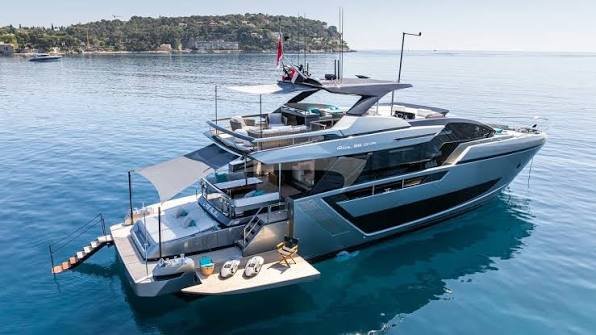
A large white crewed motor yacht anchored in a turquoise Mediterranean cove near rocky cliffs, with guests relaxing on the aft deck and a tender moored alongside in late afternoon light
Families with small children tend to prefer short passages and anchorages with a beach. Groups hosting business guests want marinas with restaurants and reliable connectivity. Groups that want seclusion accept longer passages in exchange for empty water.
Get in touch with us to discuss your yachting needs. →
6. Mediterranean Yacht Charter Duration: How Long to Book
One week is the standard minimum, and it is genuinely the shortest period that feels unhurried. Two weeks is where the format opens up, because you stop repositioning and start settling.
For a first charter, book seven days and treat it as a trial. You will learn how you actually use the yacht: whether you want long passages, whether the chef’s style suits you, whether the crew rhythm matches your own. That knowledge makes the second booking far sharper.
Ten days suits a mixed group of family and business guests, since you can split the trip into two distinct halves. Anything shorter than a week tends to collapse into transfers.
7. Reading the Contract and Avoiding Hidden Costs
Read the expense allowance clause first. Everything else in the agreement is standard; this clause is where disputes begin. It should state the amount, how it is replenished, and what happens to any unspent balance at the end of the charter.
Then check four more items: the cancellation terms, the delivery and redelivery ports, the security deposit, and the gratuity expectation. Each is normal. Each is also where a poorly drafted agreement leaves room for interpretation.
We insist on this because the industry has a habit of quoting a headline weekly rate and letting the extras surface later. A reputable provider will give you the complete picture up front. If a quote arrives without a cost schedule attached, ask for one.
Booking a crewed yacht in the Mediterranean is straightforward once you know the sequence: dates, budget, yacht, contract, expense fund. The difficulty is access. The best vessels are held by a small number of people, and availability moves quickly in peak season.
Palm Lifestyle holds direct access to a worldwide fleet of charter yachts and manages the entire process, from yacht selection and itinerary design through to the contract review and crew briefing. We work with clients across the Gulf and internationally, and we handle the details that make a charter feel effortless rather than merely expensive.
Get in touch with us to discuss your yachting needs and start your 2026 booking.
Frequently Asked Questions
How far in advance should I book a luxury yacht charter in the Mediterranean?
For peak July and August weeks, start the conversation six to twelve months ahead. The best-known crewed yachts in the French Riviera, Greece and Croatia are usually committed by early spring, and late enquiries leave you choosing from what remains rather than from the full fleet. Shoulder-season weeks in May, June, September and October are more forgiving, but a three to four month lead time still gives you room to compare yachts and negotiate terms. If your dates are fixed around a corporate event or family gathering, treat the booking as a project with a timeline rather than a single transaction.
What is included in a crewed yacht charter and what costs extra?
The weekly charter rate covers the yacht, the crew, insurance for the vessel and standard onboard equipment. Running expenses are usually handled through an advance provisioning allowance, which covers fuel, food, drinks, berthing fees and any shore costs the crew incurs on your behalf. Spa treatments, some water toys, private guides and transport to and from the yacht are typically outside both. Ask for the allowance to be explained in writing before you sign, and confirm how any unspent balance is returned at the end of the trip.
Can I customise the itinerary on a crewed yacht charter?
Yes, and on a private crewed yacht the itinerary is built around you rather than shared with other guests. A good broker will ask what you want from the week, whether that is quiet anchorages, restaurant reservations ashore, water sports or hosting business guests, and then propose a route that fits the distances involved. Once on board, the captain can adjust for weather and your mood. Some destinations have restrictions on where a yacht of a given size can anchor or berth, so the plan is always shaped around the vessel as well as your wish list.
How long should a Mediterranean yacht charter last?
One week is the standard unit and works well for a single region such as the Greek islands or the Croatian coast. Ten days to two weeks suits anyone crossing between regions, for example from the French Riviera into Italy, because you spend less of the trip repositioning. Shorter three and four night breaks are possible in some locations but limit how far you can travel. For a first charter, a week in one cruising area gives you a realistic feel for the pace of life on board before committing to a longer booking.
How do I choose the right yacht for a Mediterranean charter?
Start with guest capacity and cabin configuration, then match the yacht to the itinerary rather than the other way round. A sailing yacht suits a relaxed island-hopping week, while a motor yacht covers longer distances and holds more guests comfortably for entertaining. Check the age and refit history of the vessel, the crew profile and the water toys on board. Ask your broker for the yacht’s recent guest feedback and confirm the crew has cruised your chosen region before, since local knowledge shapes everything from anchorage choice to restaurant bookings.