

Table of Contents
Why the Benefits of Hiring a Yacht Broker Go Beyond Convenience
Yacht Marketing Expertise, Listing Agreements, and Pre-Screening
Negotiation Strategy, Closing Assistance, and Legal Protection
Yacht Broker Commission Fees: What to Expect and Why It’s Worth It
Yacht Survey and Sea Trial Checklist: How Your Broker Guides the Process
Post-Sale Support and Vessel Documentation: A Benefit Most Buyers Overlook
Questions to Ask a Yacht Broker Before Signing a Listing Agreement
Last Updated: June 16, 2026
The yacht market is more complex than most buyers and sellers expect. Pricing fluctuates with season, vessel condition, and regional demand, and the paperwork alone can derail a transaction if handled incorrectly. Understanding the benefits of hiring yacht broker professionals is not just about convenience; it is about protecting your financial and legal interests at every stage of the deal. This guide from Palm Lifestyle breaks down exactly what a qualified broker brings to the table, and why attempting to navigate a yacht transaction without one is a risk most buyers and sellers cannot afford.
A skilled yacht broker is the single most important factor in whether a transaction closes smoothly, at the right price, with clean documentation. Below, we cover every dimension of broker value, from network access and negotiation strategy to post-sale vessel documentation, areas where the real financial stakes live.
Why the Benefits of Hiring a Yacht Broker Go Beyond Convenience
A yacht broker is a licensed marine industry professional who manages the purchase or sale of a vessel, handling everything from market valuation and listing agreements to sea trials, yachting contracts, and closing assistance.
The benefits of hiring yacht broker professionals extend into territory most private buyers and sellers never anticipate: lien clearance, title search complications, survey disputes, and post-sale documentation. These are not edge cases, they are routine parts of yachting transactions, each carrying financial or legal exposure for an unrepresented party.
A common mistake is assuming yacht sales work like residential real estate. Yacht transactions involve marine surveys, sea trials, flag state registration, vessel documentation with national maritime authorities, and often cross-border ownership structures. The margin for error is high, and the cost of mistakes is higher.
According to the Yacht Brokers Association of America’s professional standards guidelines, certified brokers are held to defined ethical and procedural standards that protect both buyers and sellers throughout the transaction.
Industry Connections, Network Access, and Market Valuation
Professional yacht brokers maintain relationships built over years of transactions, and those relationships directly affect outcomes for their clients.
Access to Yachting Professionals and Global Listings
Brokers operate within a tightly connected network that includes surveyors, maritime lawyers, insurance specialists, flag state registrars, and other brokers with active buyer pools. A well-connected broker does not just post a listing, they activate their network directly, reaching qualified buyers already in the market. For buyers, a broker’s network surfaces off-market vessels that never appear on public platforms, where some of the best value in yacht sales lives.
Palm Lifestyle operates with a direct global fleet network and deep GCC-region connections, giving clients access to both Mediterranean-focused listings and Middle East buyer pools that most brokers cannot match simultaneously.
Accurate Market Data and Pricing Strategy
Pricing a yacht incorrectly is one of the most expensive mistakes a seller can make. Price too high and the vessel sits, accumulating maintenance costs and losing perceived value. Price too low and you leave significant money behind.
Experienced brokers use current market data, comparable sales, and vessel condition assessments to arrive at a defensible asking price based on actual transaction history, not listing prices. For buyers, the same data works in reverse: a broker can tell you whether an asking price reflects genuine market value or wishful thinking.
Yacht Marketing Expertise, Listing Agreements, and Pre-Screening
Getting a yacht sold requires more than photographs and a price tag. Professional yacht marketing involves high-quality visual production, strategic placement across yachting platforms, targeted outreach to broker networks, and a listing agreement that clearly defines terms, commission structure, and exclusivity.
The listing agreement is where many sellers make their first mistake. A poorly drafted agreement can lock you into an arrangement that limits flexibility, creates disputes over commission on self-sourced buyers, or fails to define what happens if the vessel does not sell within a specified timeframe. A qualified broker will walk you through every clause before you sign.
Pre-screening is equally undervalued. Brokers filter time-wasters, verify financial capability, and ensure that anyone who boards your vessel for a sea trial is a genuine prospect.
According to the National Marine Manufacturers Association’s annual industry overview, the yacht sales market involves significant regional variation in demand and pricing, reinforcing why local market expertise is not interchangeable with generic listing exposure.
Negotiation Strategy, Closing Assistance, and Legal Protection
Negotiation is where the benefits of hiring yacht broker professionals become most tangible in dollar terms. Experienced brokers know where sellers have flexibility, which survey findings are legitimate grounds for price adjustment, and how to structure counter-offers that keep deals alive without giving away value unnecessarily.
Closing assistance covers the final phase: coordinating the survey and sea trial, managing escrow funds, preparing closing documents, and ensuring title transfers cleanly. This phase has more moving parts than most buyers anticipate, and delays here are expensive.
Buyer vs. Seller Representation: Understanding the Difference
A selling broker represents the vessel owner, working to achieve the best possible price and terms. A buying broker represents the purchaser, identifying suitable vessels, negotiating favorable terms, and protecting the buyer’s interests throughout due diligence.
In some transactions, a single broker may represent both parties, dual agency, which requires full disclosure and informed consent from both sides. Many experienced yachting professionals recommend independent representation for significant transactions, precisely because the interests of the two parties are not always aligned.
Yachting Contracts, Title Search, and Lien Clearance
Yachting contracts must address deposit terms, survey contingencies, sea trial provisions, and closing conditions. A missing clause or ambiguous language can create disputes that delay or kill a transaction.
Title search and lien clearance are non-negotiable. A vessel may carry outstanding loans, unpaid marina fees, or tax liens that transfer with ownership if not identified and resolved before closing. Brokers coordinate with maritime lawyers and vessel documentation services to ensure the title is clean before funds change hands. A buyer who skips this step can inherit financial liabilities they had no knowledge of at purchase.
Yacht Broker Commission Fees: What to Expect and Why It’s Worth It
Yacht broker commission fees are typically a percentage of the final sale price, paid at closing. The standard rate generally falls around 10% for smaller vessels, with variation for larger yachts.
A broker who achieves a better sale price through professional marketing and skilled negotiation often more than offsets their commission. A vessel that sits on the market for six additional months while accumulating storage, insurance, and maintenance costs erodes seller returns far more than a professional commission does. For buyers, the commission structure is equally worth understanding: in most yacht sales, the seller pays the commission, meaning the buyer receives professional representation at no direct cost.
Representation Type | Who Pays Commission | Primary Benefit |
|---|---|---|
Seller’s Broker | Seller (from sale proceeds) | Market exposure, price optimization |
Buyer’s Broker | Seller (split with selling broker) | Deal sourcing, negotiation protection |
Dual Agency | Seller | Single-point coordination |
Yacht Survey and Sea Trial Checklist: How Your Broker Guides the Process
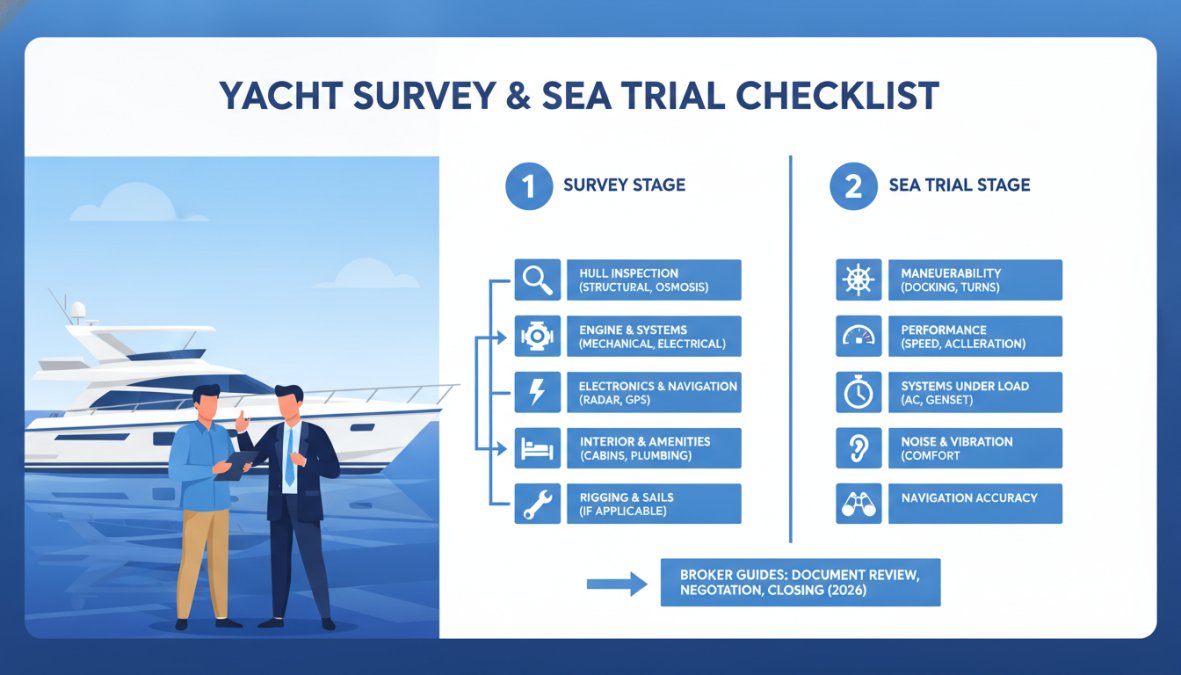
The yacht survey and sea trial are the buyer’s primary due diligence tools, and a broker’s role in managing this phase is one of the most practical benefits of hiring yacht broker professionals.
A marine survey is a professional inspection of the vessel’s structural integrity, mechanical systems, electrical systems, and overall condition. The sea trial tests the vessel under power, verifying that the engine, steering, navigation systems, and onboard equipment perform as represented.
Your broker should coordinate the following steps:
Selecting a qualified, independent marine surveyor with no financial interest in the transaction
Scheduling the haul-out if a below-waterline inspection is required
Ensuring the sea trial covers sufficient time and conditions to assess the vessel properly
Reviewing the survey report and identifying findings that warrant price renegotiation
Coordinating with the seller’s broker to resolve survey-flagged issues before closing
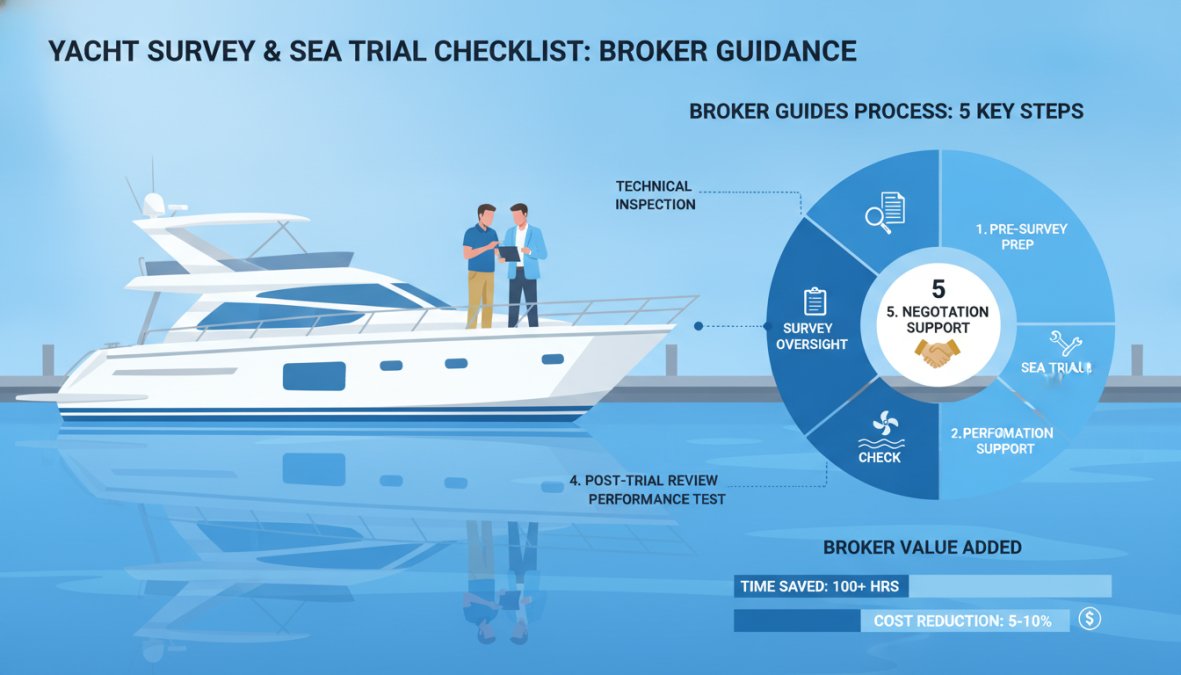
What most guides miss is that the survey report is a negotiation tool, not just an inspection record. A skilled broker uses survey findings to renegotiate price or require remediation before closing. According to the American Bureau of Shipping’s vessel survey standards, a thorough marine survey covers structural, mechanical, and safety systems in detail, and findings can materially affect vessel value.
Post-Sale Support and Vessel Documentation: A Benefit Most Buyers Overlook
The transaction does not end at closing. Vessel documentation, flag state registration, and yachting insurance arrangements all require attention after the sale completes, and this is where many new owners find themselves unexpectedly adrift.
Vessel documentation is the process of registering ownership with the relevant maritime authority, whether the US Coast Guard, a flag state registry, or a national authority in the buyer’s home country. This documentation is required for legal operation of the vessel and for obtaining marine financing in the future.
A broker who provides genuine post-sale support will assist with documentation filing, connect the buyer with appropriate yachting insurance providers, and facilitate introductions to crew placement services if needed. Palm Lifestyle provides comprehensive end-to-end service including legal procedures and financing coordination, which is particularly valuable for first-time yacht owners in the GCC region unfamiliar with international vessel registration requirements.
Post-sale support also extends to sellers: confirming that all liens have been discharged, that the vessel has been formally de-registered from the seller’s name, and that insurance coverage has been properly transferred are all steps a thorough broker manages through to completion.
Questions to Ask a Yacht Broker Before Signing a Listing Agreement
Choosing the right broker is as important as deciding to use one. The questions to ask a yacht broker before signing a listing agreement fall into three categories: credentials, process, and transparency.
On credentials and experience:
How many yacht sales have you closed in the past 12 months?
Do you hold a certified sales professional designation or equivalent yachting credentials?
Are you a member of a recognized industry association?
On process and marketing:
Where will my vessel be listed, and what marketing materials will you produce?
How will you pre-screen prospective buyers?
What is your process for managing the survey and sea trial phase?
On transparency:
What is your commission structure, and how is it split if another broker introduces the buyer?
What are the terms for terminating the listing agreement if I am not satisfied?
Will you represent both buyer and seller, or exclusively one party?
Evaluating Yachting Credentials and Certified Sales Professional Status
The yachting industry has formal credentialing pathways that distinguish trained professionals from unlicensed intermediaries. The Certified Professional Yacht Broker (CPYB) designation, administered by the Yacht Brokers Association of America, is one of the most recognized markers of professional competency in the marine industry.
According to the CPYB certification program overview, certified brokers must demonstrate knowledge across vessel documentation, yachting contracts, escrow procedures, and ethical standards. This matters for a practical reason: the marine industry is not uniformly regulated across jurisdictions, and in some markets anyone can call themselves a yacht broker without formal training. Checking for verifiable credentials is the most direct way to separate professional brokers from opportunistic intermediaries.
The benefits of hiring yacht broker professionals are most fully realized when the broker you choose has demonstrable expertise, transparent business practices, and a track record of closed transactions in your vessel category and price range. Ask for references, review their listings, and verify their credentials. The due diligence you apply to choosing a broker is a direct investment in the quality of the transaction that follows.
Yacht transactions carry significant financial and legal complexity that most buyers and sellers underestimate until they are already in the middle of one. Palm Lifestyle offers comprehensive end-to-end brokerage services covering professional market valuation, strategic marketing, legal procedure management, and financing coordination, specifically designed for clients in the Middle East and beyond. Whether you are acquiring a vessel or maximizing returns on a sale, get in touch with Palm Lifestyle to discuss your yachting needs and put the right expertise behind your next transaction.
Frequently Asked Questions
Do I really need a broker to buy a yacht?
While it is technically possible to purchase a yacht privately, the benefits of hiring a yacht broker are substantial. A broker provides access to verified listings, handles yachting contracts, conducts pre-screening, and manages the entire closing process. For buyers unfamiliar with vessel documentation, lien searches, or sea trial protocols, a broker significantly reduces financial and legal risk — making the investment in professional representation well worthwhile.
How do yacht brokers get paid, and what are typical commission fees?
Yacht broker commission fees are typically charged as a percentage of the final sale price, commonly ranging from 8% to 10% for vessels under a certain value, with rates sometimes negotiated on higher-value yachts. In most yachting transactions, the seller pays the commission, meaning buyers often receive professional representation at no direct cost. Always clarify the commission structure and what services are included before signing a listing agreement.
Do yacht brokers help with surveys and sea trials?
Yes — coordinating the yacht survey and sea trial is one of the most practical benefits of hiring a yacht broker. An experienced broker will recommend qualified marine surveyors, help prepare a sea trial checklist, interpret survey findings, and use the results as leverage in price negotiations. This guidance protects buyers from costly hidden defects and ensures sellers present their vessel in the best possible condition before closing.
What should I look for when choosing a yacht broker?
When evaluating a yacht broker, ask about their yachting credentials, including whether they hold a Certified Sales Professional designation from a recognized marine industry body. Assess their knowledge of current yachting market data, their network within yachting professionals and marinas, and their experience handling vessel documentation and closing procedures. Also ask how they handle buyer vs. seller representation and whether they offer post-sale support services.
Is it better to buy a yacht through a broker or a private seller?
Buying through a broker generally offers stronger legal and financial protection than purchasing from a private seller. A broker facilitates a yachting title search, checks for liens, manages escrow, and ensures all yachting contracts comply with maritime regulations. Private sales may appear cheaper upfront, but without professional oversight, buyers risk inheriting undisclosed debts, documentation errors, or vessels with unresolved legal issues — costs that far exceed any savings.