
Table of Contents
Understanding Private Yacht Rental Cost and What You Actually Pay
Crewed Yacht Rental: What to Expect from Your Captain and Crew
Legal, Insurance, and VAT Requirements for International Waters
Yacht Booking Tips: How to Choose a Broker and Secure the Right Vessel
Conclusion: Making Your Private Yacht Rental Seamless and Unforgettable
Last Updated: June 15, 2026
Booking a private yacht rental is one of the most complex luxury purchases most people will ever make, and the process is far less transparent than it should be. Palm Lifestyle has guided hundreds of clients through this process, and the single biggest source of confusion is not the yacht itself, it is everything that comes after the base charter rate. Below, we show you exactly how private yacht pricing works, what a crewed charter delivers, and how to build an itinerary that makes the most of every nautical mile. But first: the listed charter fee is rarely the final number you pay.
What Is a Private Yacht Rental and How Does It Work?
A private yacht rental is the exclusive use of a yacht, typically from a single day to several weeks, where the vessel, captain, and crew are dedicated entirely to your group. The charter market divides into two models: bareboat and crewed. Understanding which suits your needs is the first decision every first-time charterer should make.
According to the International Yacht Brokers Association industry overview, crewed charters represent the dominant segment among first-time and luxury clients.
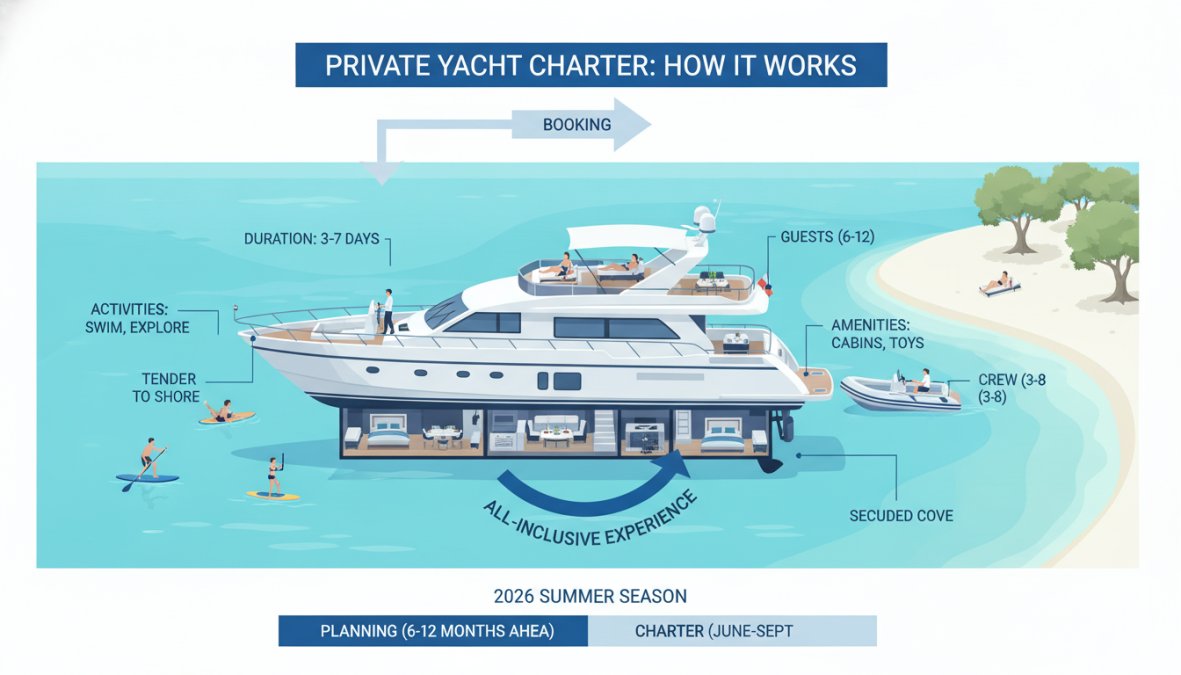
Bareboat vs. Crewed Charter: Key Differences
Bareboat charter is the rental of a yacht without crew. The charterer assumes full responsibility for navigation, safety, and provisioning, and most companies require proof of sailing qualifications (typically RYA or ASA certification).
Crewed charter includes a professional captain and, depending on vessel size, a full crew covering navigation, cooking, housekeeping, and water sports instruction. For most luxury clients, crewed is the only sensible option.
Feature | Bareboat | Crewed (Skippered) | Full Crewed |
|---|---|---|---|
Crew included | None | Captain only | Captain + full crew |
Qualifications needed | Yes (sailing cert) | No | No |
Provisioning | Self-managed | Self-managed | Onboard chef |
Best for | Experienced sailors | Small groups | Luxury/corporate |
Typical vessel size | 30-50ft | 40-65ft | 65ft+ |
Types of Yachts Available: Sailing, Motor, Catamaran, and Superyacht
Sailing yachts deliver the most authentic nautical experience, quieter, fuel-efficient, and well-suited to destinations with reliable wind like the Greek islands or the BVI.
Motor yachts prioritize speed and range, covering more ground per day. A motor yacht in the 60-80ft range typically accommodates 8-10 guests across four to five cabins.
Catamarans offer exceptional stability and deck space relative to their price point, making them popular for families and groups who value social space over sailing performance.
Superyachts and megayachts (above 24 metres) carry larger crews and amenities rivalling five-star hotels: on-deck jacuzzis, gyms, cinema rooms, and multiple tenders.
Understanding Private Yacht Rental Cost and What You Actually Pay
The base charter rate is only part of the total cost, and treating it as the final number is the most expensive mistake first-timers make. A typical crewed charter in the Mediterranean during peak season (July-August) carries a base vessel rate, plus fuel, marina fees, provisioning, crew gratuities, and often VAT. These extras commonly add 30-40% to the base rate.
The APA (Advanced Provisioning Allowance) Explained
The Advanced Provisioning Allowance (APA) is a pre-paid fund, typically 25-35% of the base charter fee, used to cover running expenses including fuel, port fees, water, and provisioning. At the end of the charter, the captain provides a full accounting. Surplus funds are refunded; shortfalls are topped up by the client. The APA is not a fee paid to the owner; it is your operational budget for the trip.
Tipping Etiquette and Hidden Costs First-Timers Miss
Crew gratuity is not included in the charter fee or APA. Industry convention suggests 10-20% of the base charter rate, distributed among the crew at the captain’s discretion.
Beyond gratuities, costs that most frequently surprise first-timers include:
VAT: Applicable in EU waters; rate varies by country and charter structure.
Cruising permits: Croatia and certain Caribbean islands charge per-vessel entry fees.
Communication charges: Satellite internet can carry per-megabyte costs unless a flat-rate package is arranged in advance.
Port dues: High-season berths in Monaco, Portofino, and Mykonos carry significant nightly costs.
The MYBA Charter Agreement standard terms sets the industry benchmark for transparent cost disclosure. Any reputable broker will use this agreement or a close derivative.
Crewed Yacht Rental: What to Expect from Your Captain and Crew
A crewed charter delivers personalised service no land-based resort can replicate. The captain handles navigation, safety, and itinerary execution; on larger vessels, the crew adds a first mate, chef, steward, and deckhand doubling as water sports instructor.
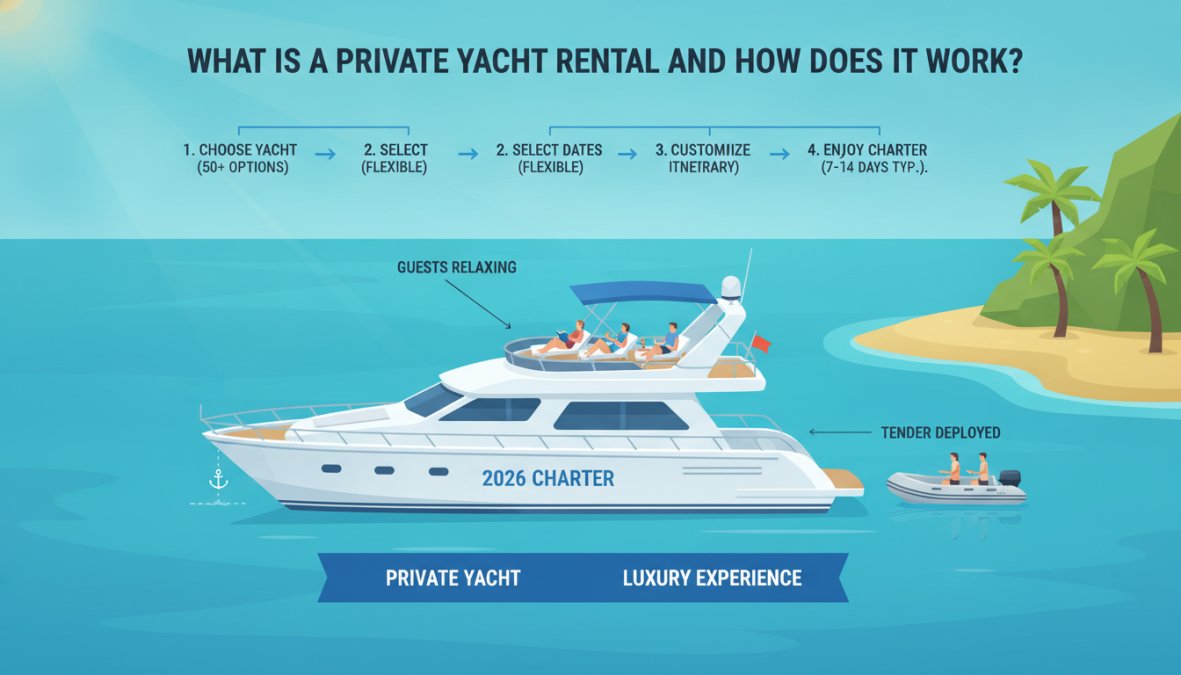
The onboard chef is, for many clients, the defining element. A good chef meets guests before departure to discuss dietary preferences and cuisine styles, then prepares fresh meals daily using local produce sourced at port. What most guides miss is that the crew’s local knowledge is equally valuable, a captain who has sailed the same grounds for years knows which anchorages are sheltered from afternoon wind, which tavernas are worth the dinghy ride, and which ports are overcrowded on any given week.
How to Build a Bespoke Yacht Charter Itinerary
A bespoke itinerary is what separates a private charter from any other form of travel. The charter party sets the pace: anchor in a secluded cove, spend a morning diving, motor to a new port for dinner, or simply stay put because the swimming is too good to leave. The most common mistake is planning too many ports of call, covering 100 miles per day means motoring through the most scenic parts of your destination. The best itineraries build in slack time.
Top Cruising Grounds: Mediterranean, Caribbean, and the Middle East
The Mediterranean remains the world’s most popular charter destination. The Greek islands offer unmatched density of anchorages and local cuisine within a compact sailing area; Croatia’s Dalmatian coast combines medieval walled towns with crystalline Adriatic water; the French Riviera and Amalfi Coast trade on glamour and gastronomy, though marina costs reflect that reputation.
The Caribbean operates on a different rhythm. Trade winds make sailing predictable, and the BVI, St. Barts, and the Grenadines each offer distinct character within a day’s sail. The season runs November through April, inverse to the Mediterranean.
The Middle East is an emerging destination with genuine advantages: warm water year-round, uncrowded anchorages, and extraordinary UAE and Saudi Arabian coastal landscapes. Palm Lifestyle operates extensively in this region with direct fleet access and local expertise that aggregator platforms cannot match.
Chartering for Special Life Events and Corporate Occasions
A private charter scales elegantly from intimate to grand. Proposals, milestone birthdays, and anniversaries benefit from complete privacy and spectacular scenery; the crew can be briefed in advance to manage timing, decoration, and catering around the occasion. Corporate charters serve team retreats, client entertainment, and incentive travel, the confined, luxurious setting accelerates relationship-building in ways a restaurant dinner cannot.
According to [Yacht Charter(/women-only-yacht-charter/) Guide’s event chartering overview | yachtcharterfleet.com], life event charters have grown significantly as clients seek personalised alternatives to traditional venue-based celebrations.
Legal, Insurance, and VAT Requirements for International Waters
Every commercially operating yacht must carry valid commercial insurance. Confirm that the vessel’s policy covers third-party liability and passengers during water sports activities, some policies exclude jet ski use or diving without an additional rider.
Maritime law jurisdiction follows the flag state of the vessel and the location of the incident, managed in practice by the yacht’s management company. The charter agreement specifies governing law and dispute resolution jurisdiction, read it carefully.
VAT within EU waters depends on where the charter commences, time spent in EU territorial waters, and the vessel’s flag state. Some charter structures are designed to minimise VAT exposure legally, and a reputable broker will advise on this. Attempting to navigate it without professional guidance reliably produces unexpected tax bills.
The European Commission guidelines on VAT for passenger transport provides the regulatory framework, though application to charter agreements requires specialist interpretation.
Eco-Friendly and Sustainable Private Yacht Charter Options
The yacht charter industry’s environmental footprint is a legitimate concern, and the sector is responding with genuine substance. Hybrid and fully electric motor yachts are now available for charter in several major markets, they operate silently at anchor, produce zero emissions during electric cruising, and suit protected marine areas where diesel engines are restricted. The trade-off is range, requiring more frequent recharging stops.
Solar panel arrays are now standard on many new builds, reducing generator use at anchor. Some expedition yachts carry watermakers, waste management systems, and hull coatings designed to minimise antifouling chemical release.
Charterers who prioritize sustainability should ask their broker about:
Hybrid or electric propulsion options
Solar capacity and battery storage
Waste management and grey water treatment systems
Crew training in marine conservation practices
Compliance with protected area regulations in the chosen destination
The Blue Flag sustainable marina certification program provides a useful framework for identifying marinas and destinations that meet environmental standards.
Yacht Booking Tips: How to Choose a Broker and Secure the Right Vessel
Most people book their first charter through a broker, and the quality of that relationship determines almost everything that follows. A good broker knows specific vessels, captains, and cruising grounds from direct experience, not just a database search. The practical difference shows at the point of conflict: when weather forces an itinerary change or a mechanical issue requires a vessel swap, the broker’s network determines how quickly the problem is resolved.
Palm Lifestyle provides end-to-end charter management, from vessel matching through itinerary design, legal documentation, and onboard coordination, giving clients in the GCC region and Mediterranean a single point of contact with direct fleet access rather than a commission-driven aggregator.
When evaluating any broker, ask directly:
Have you personally been aboard the vessels you are recommending?
What is your process if the vessel is unavailable at the last minute?
Can you provide references from clients who chartered in the same destination?
Do you use the MYBA standard charter agreement?
What to Look for in a Charter Agreement
The charter agreement is the governing document for the entire experience. Several clauses deserve close attention before signing.
Cancellation policy: Most agreements use a sliding scale with penalties increasing as departure approaches. Confirm whether your deposit is refundable and whether travel insurance covers charter cancellations specifically.
Force majeure: Covers cancellations due to weather, government restrictions, or mechanical failure. Understand whether the remedy is a refund, credit, or rescheduled charter.
Yacht substitution: Some agreements permit the owner to substitute a comparable vessel without consent. If the specific vessel matters, negotiate this clause explicitly.
Guest capacity and berth allocation: The agreement should specify maximum guest capacity and berth configuration.
The MYBA standard yacht charter agreement documentation is the industry reference document that reputable brokers use as the basis for all charter contracts.
Booking a private yacht rental involves more moving parts than most luxury travel, and the gap between a seamless experience and a frustrating one comes down to preparation and broker quality. Palm Lifestyle specializes in matching clients with the right vessel from a worldwide fleet, managing all legal and documentation requirements, and designing bespoke itineraries backed by genuine destination expertise. Get in touch with Palm Lifestyle to discuss your charter requirements and let our team handle the complexity while you focus on the experience.
Frequently Asked Questions
How much does a private yacht rental cost per day?
Private yacht rental cost varies widely depending on yacht size, type, and destination. A day charter on a smaller sailing or motor yacht can start from a few hundred dollars, while a crewed superyacht in the Mediterranean may range from tens of thousands to over a hundred thousand dollars per week. Beyond the base charter fee, budget for the APA (Advanced Provisioning Allowance), VAT, crew gratuity, and fuel, which can add 30–40% to your total yacht rental cost.
What is the difference between a bareboat and a crewed yacht charter?
A bareboat charter means you rent the yacht without a captain or crew — you are responsible for sailing and managing the vessel yourself, and typically need a valid maritime licence. A crewed yacht rental includes a professional captain, onboard chef, and additional crew who handle navigation, meals, and service. For most luxury private yacht rental clients, a crewed charter delivers a fully managed, all-inclusive experience without any operational responsibilities.
Do you need a licence to rent a private yacht?
For a bareboat charter, most charter companies and flag-state regulations require a recognised sailing or powerboat licence, such as an RYA or IYT qualification, along with relevant sea miles. For a crewed yacht rental, no personal licence is required — the captain holds all necessary maritime certifications. Always verify licence requirements with your charter broker before booking, as rules differ by destination and yacht specifications.
What should I look for in a yacht charter itinerary?
A well-planned yacht charter itinerary should balance sailing time with time spent exploring ports of call, secluded coves, and local attractions. Discuss your priorities — island hopping, water toys, fine dining ashore, or cultural visits — with your charter broker before departure. A bespoke itinerary built around your preferences, weather patterns, and cruising grounds ensures you maximise every day. Build in flexibility so your captain can adapt to conditions and unexpected discoveries.
Can you charter a private yacht for a party or corporate event?
Yes. Private yacht rental is an excellent choice for milestone celebrations, corporate retreats, product launches, and incentive events. Many superyachts and motor yachts are configured to host larger guest capacities for day charters, with catering by an onboard chef, water toys, and entertainment systems. Inform your charter broker about the event type early so the vessel, crew, and bespoke itinerary can be tailored accordingly. Always confirm guest capacity limits in the charter agreement.
What hidden costs should I be aware of when booking a private yacht rental?
Beyond the headline charter fee, common additional costs include the APA (Advanced Provisioning Allowance, typically 25–35% of the base fee), VAT or local taxes, fuel surcharges, marina and port fees, crew gratuity (standard is 10–20% of the charter fee), and any premium water toys or excursions. A transparent charter broker will itemise all of these upfront. Always review the charter agreement carefully before signing to avoid unexpected charges.
