
Table of Contents
- Yacht Lifestyle vs Waterfront Home: The Core Difference
- Cost of Yacht Ownership in Europe vs Waterfront Property Investment
- Capital Appreciation and Return on Lifestyle
- Waterfront Property Investment Trends and Market Performance
- Flexibility and Portability: Static Ownership vs Active Cruising
- Privacy, Exclusivity, and Lifestyle Integration
- Marina Infrastructure, Berthing, and Waterfront Access
- Exit Strategy and Liquidity Comparison
- Which Asset Class Suits Your Goals?
- Conclusion
Last Updated: August 5, 2026
Yacht Lifestyle vs Waterfront Home: The Core Difference
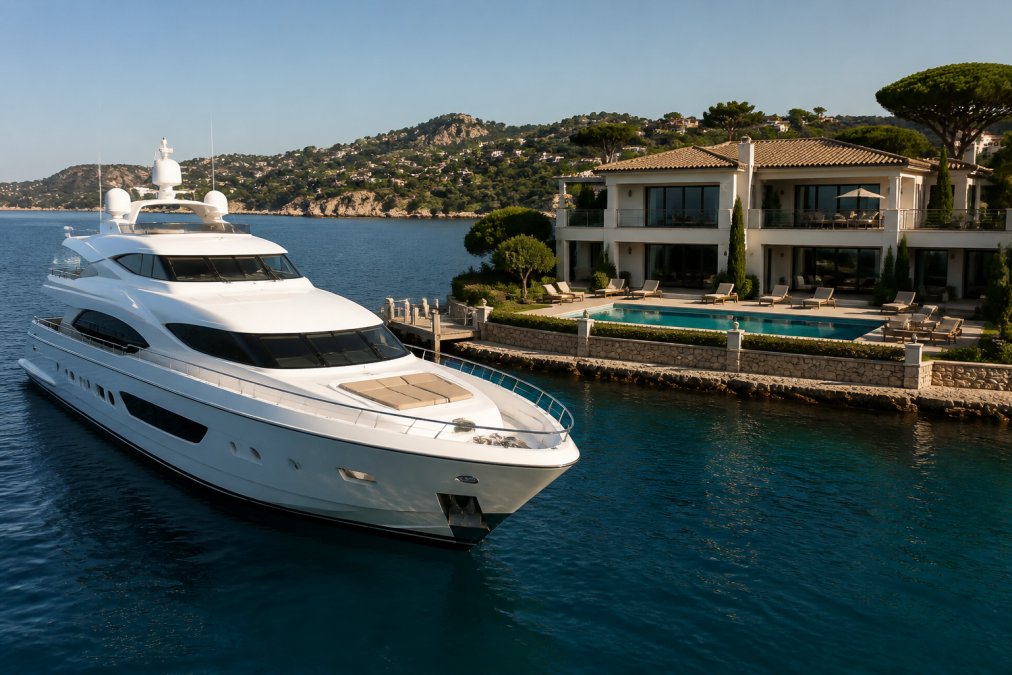
Choosing between a luxury yacht and a waterfront property represents one of the most significant lifestyle and financial decisions a high-net-worth individual can make. Both offer coastal living, but they deliver fundamentally different experiences, financial structures, and long-term value propositions. A luxury yacht lifestyle vs waterfront home ownership comparison reveals these aren’t simply two versions of the same asset, they’re distinct asset classes with opposing characteristics in liquidity, flexibility, appreciation potential, and daily usability.
The core distinction lies in portability versus permanence. A yacht gives you the Mediterranean and beyond on your terms; you move the asset to where you want to be. A waterfront property anchors you to a specific location but provides stability, real estate appreciation, and rental income potential. One is active and mobile; the other is static and rooted. Understanding which aligns with your actual lifestyle is where most buyers go wrong.
At Palm Lifestyle, we’ve guided ultra-high-net-worth clients through this exact decision. The choice isn’t about which is objectively “better”, it’s about which fits your wealth strategy, time availability, and how you actually spend leisure hours. This comparison breaks down the financial realities, lifestyle implications, and exit strategies so you can make an informed decision based on data, not aspiration.
Cost of Yacht Ownership in Europe vs Waterfront Property Investment
Acquisition and Financing
A 40-meter motor yacht typically costs €10-€20 million; a 60-meter superyacht ranges from €20-€70 million. Prime European waterfront properties occupy a similarly wide price band, but entry points often start lower than equivalent yachts.
Yacht financing differs fundamentally from real estate. Maritime lenders offer 50-70% loan-to-value ratios, whereas European waterfront property financing typically allows 70-80% LTV. Yacht loans carry higher interest rates (6-9%) compared to European mortgage rates (2.5-4% for prime borrowers in 2026).
Yacht purchases involve import duties, flag registration, VAT considerations (varying by EU residency), and marine survey costs (€8,000-€20,000). Waterfront property acquisition involves traditional closing costs, legal fees, and transfer taxes varying by country (Spain: 6-10%, France: 7-8%, Italy: 9-10%).
Total Cost of Ownership: 10-Year Comparative Framework
Most luxury buyers compare only acquisition price, missing the compounding effect of annual operating costs. A structured 10-year TCO analysis reveals the true financial burden:
Superyacht (60-meter motor yacht, €20 million purchase price):
- Annual operating costs (crew, fuel, insurance, maintenance, berthing): €2-€2.6 million (9-12% of vessel value)
- 10-year cumulative operating cost: €20-€26 million
- Depreciation: vessel worth €15-€17 million after 10 years (20% loss)
- Total 10-year cost: €35-€42 million
Waterfront Property (€5 million villa, Mediterranean coast):
- Annual operating costs (property tax, maintenance, utilities, staff): €75,000-€125,000 (1.5-2.5% of property value)
- 10-year cumulative operating cost: €750,000-€1.25 million
- Appreciation: property worth €6.5-€7 million after 10 years (30-40% gain)
- Rental income potential (20 weeks/year at €8,000/week): €160,000/year × 10 years = €1.6 million
- Total 10-year net cost: €350,000-€1.1 million
A superyacht costs 40-50 times more annually to operate than a comparable waterfront property.
Tax and Legal Implications Across European Jurisdictions
Ownership structure, personal name, corporate entity, trust, or flag jurisdiction, creates vastly different tax outcomes.
Yacht Ownership Tax Considerations:
Yacht taxation depends on flag state and beneficial owner residency. EU residency matters significantly:
- French resident ownership: Yachts are subject to wealth tax (impôt de solidarité sur la fortune) if valued above €1.3 million, triggering 0.55% annual wealth tax on excess value. VAT reclamation is complex; most EU residents cannot reclaim VAT, making effective cost 20% higher than quoted price.
- Spanish resident ownership: Yachts are taxed as personal property under the Impuesto sobre Bienes Inmuebles (IBI) if permanently moored in Spanish waters, typically 0.4-1.1% of cadastral value annually. Vessels actively cruising may avoid this tax if properly documented as mobile assets.
- Italian resident ownership: Italy taxes yachts based on length and engine power under the Imposta di Registro, approximately €15,000-€25,000 annually for a 60-meter vessel. Italian wealth tax applies to yachts valued above €500,000 at 0.76% annually.
- Greek resident ownership: Greece offers favorable treatment for non-resident yacht owners. Vessels flagged under the Greek flag and not permanently berthed in Greek waters avoid many local taxes.
Waterfront Property Tax Considerations:
- French Riviera property: Annual property tax (taxe foncière) ranges 0.5-1.2% of cadastral value. Capital gains tax on sale is 36% (including social charges) for residents; non-residents face 33.3%.
- Spanish Mediterranean property: Annual property tax (IBI) is typically 0.4-1.1% of cadastral value. Capital gains tax is 19-23% depending on holding period and residency status.
- Italian Amalfi Coast property: Annual property tax is 0.76% of cadastral value. Capital gains tax is 26% for residents. Italy offers a primary residence exemption; if the property qualifies, capital gains tax is eliminated entirely.
Depreciation and Asset Structuring:
Yachts depreciate predictably, creating tax deductions in some jurisdictions if owned through a business entity. A corporate-owned yacht can depreciate 5-8% annually, generating tax deductions that offset other income.
Waterfront properties appreciate, creating capital gains tax liability on sale. However, many European jurisdictions offer primary residence exemptions or stepped-up basis rules for inherited properties, making property ownership more tax-efficient across generations.
Consult with a tax advisor specializing in cross-border European wealth before committing to either asset class. The tax structure you choose at acquisition can save or cost hundreds of thousands of euros over a 10-year holding period.
Capital Appreciation and Return on Lifestyle
Waterfront property in prime European locations has historically appreciated 3-5% annually, with exceptional markets like the Côte d’Azur seeing 4-6% appreciation during strong cycles. A €5 million property purchased in 2016 is worth approximately €6.5-€7 million in 2026.
Yachts depreciate. A new superyacht loses 15-20% of value in the first year, then depreciates 5-8% annually. A €20 million yacht purchased new is worth approximately €10-€12 million after 10 years.
The concept of “Return on Lifestyle” (ROL) complicates this comparison. A yacht generates intangible returns: unparalleled privacy, mobility, and experiences unavailable through property ownership. Waterfront property generates financial returns through appreciation and rental income potential. Many European waterfront properties achieve 4-6% annual rental yields, meaning a €5 million property rents for €200,000-€300,000 annually.
The financial verdict: waterfront property is a wealth-building asset. Yachts are a lifestyle expense with negative cash flow.
Waterfront Property Investment Trends and Market Performance
European waterfront real estate markets have demonstrated resilience and growth despite economic cycles. The Mediterranean coast, particularly Spain, France, Italy, and Greece, attracts international capital seeking both lifestyle and diversification. Prime coastal markets show distinct performance patterns. The French Riviera experiences steady appreciation driven by limited supply and consistent international demand. Spanish Mediterranean properties, particularly in Barcelona and the Costa Brava, have seen accelerated appreciation as investors recognize value relative to comparable French properties. Italian Amalfi Coast and Lake Como properties attract wealthy European buyers seeking cultural richness alongside investment returns.
Market dynamics favor waterfront property for several reasons. Supply is fixed; you cannot create new beachfront. Demand from high-net-worth individuals continues rising as coastal living becomes increasingly desirable. Currency diversification appeals to international investors seeking European real estate as a hedge against home-country currency risk.
Rental income potential has strengthened post-2024. Luxury holiday rental platforms and private management companies have professionalized short-term waterfront property rentals, allowing owners to generate 5-7% annual yields while maintaining personal use flexibility. The trend toward “work-from-anywhere” among entrepreneurs and executives has accelerated waterfront property demand, as a Mediterranean villa with reliable internet becomes a functional office, vacation home, and investment simultaneously.
Flexibility and Portability: Static Ownership vs Active Cruising
The defining advantage of yacht ownership is absolute geographical flexibility. You are not constrained by property location, seasonal weather, or fixed residence. If Mediterranean weather deteriorates in November, you relocate to the Caribbean.
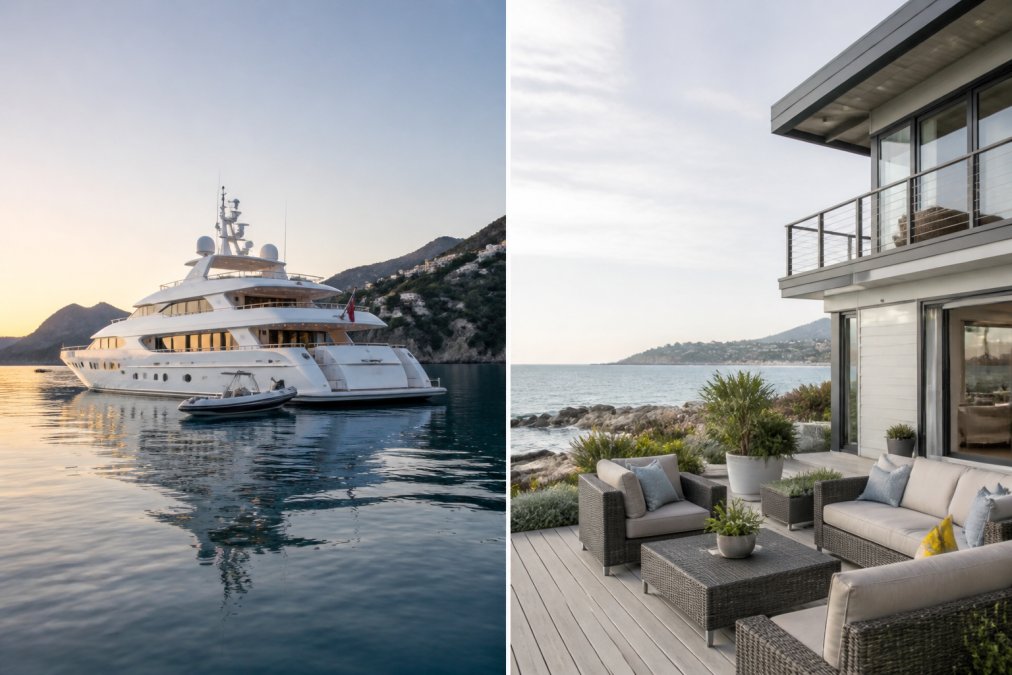
This mobility comes with operational complexity. Repositioning a superyacht internationally requires crew coordination, fuel logistics, customs clearance, and maritime regulations across multiple jurisdictions. What sounds spontaneous requires weeks of planning.
Waterfront property offers zero geographical flexibility but maximum lifestyle flexibility within that location. You cannot move a villa, but you can modify it extensively, develop deep community connections, and benefit from local knowledge. Active cruising requires significant time commitment; a meaningful Mediterranean cruise demands 3-4 weeks minimum away from business and personal responsibilities. Many yacht owners find actual usage limited to 4-6 weeks annually.
Waterfront property usage is frictionless. You arrive, settle in, and your property is immediately functional. There’s no crew to brief, no weather windows to monitor, no fuel logistics to coordinate.
Get in touch with us to discuss your yachting needs. →
The portability advantage appeals primarily to individuals with genuinely flexible schedules, entrepreneurs who can work from anywhere, or retirees without location constraints. For executives bound to specific locations for business, waterfront property offers superior practical flexibility.
Privacy, Exclusivity, and Lifestyle Integration
A yacht at sea provides absolute privacy, no paparazzi, no unexpected visitors, no shared walls. You control your environment completely. This appeals intensely to high-profile individuals and those requiring discretion.
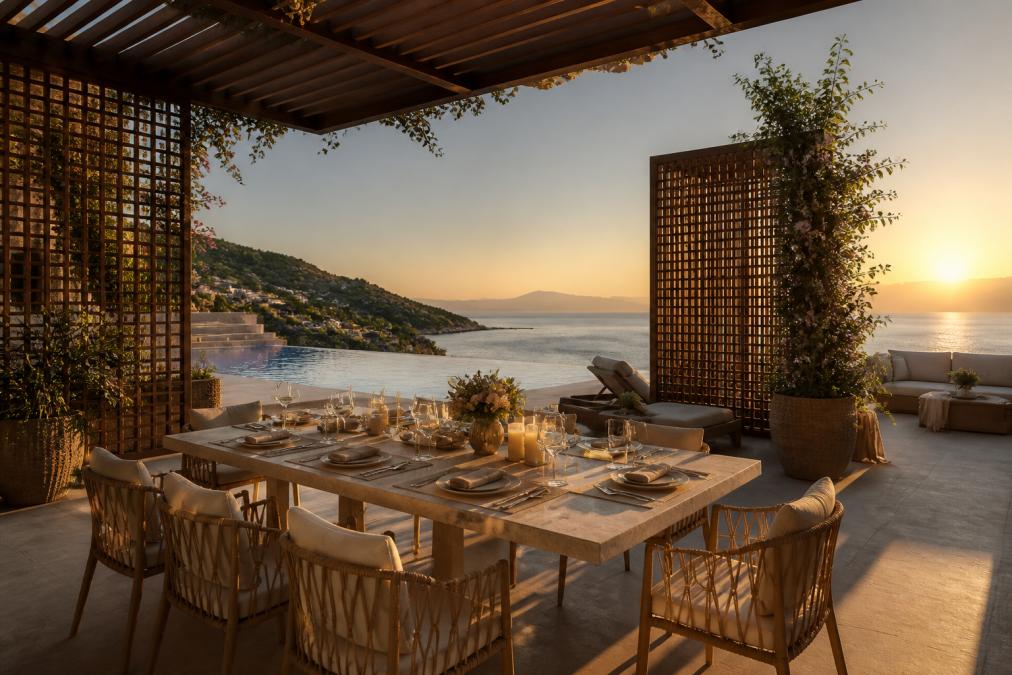
Waterfront properties in gated communities or private enclaves offer privacy through location and security infrastructure. You gain privacy alongside community, access to exclusive beach clubs, private marinas, and social networks of similarly situated individuals.
Exclusivity operates differently in each model. A superyacht is inherently exclusive; ownership is limited to those with €10 million+ capital and tolerance for ongoing operational costs. However, this network is transient; relationships form and dissolve as yachts move between regions.
Waterfront property exclusivity is rooted in location. Owning on the Côte d’Azur or Amalfi Coast places you in a stable community of established wealth, creating lasting social and business relationships. These communities have history, reputation, and social infrastructure that transcends individual transactions.
For individuals requiring absolute discretion, yacht ownership has distinct advantages. A vessel under private flag provides unparalleled privacy for family activities and business meetings. Waterfront property in Mediterranean communities is increasingly cosmopolitan, but it remains geographically rooted.
Marina Infrastructure, Berthing, and Waterfront Access
Yacht ownership depends entirely on marina infrastructure, creating operational friction that the lifestyle narrative rarely acknowledges. Berthing availability, quality, and cost vary dramatically across European regions and directly limit the freedom that yacht ownership promises.
Berthing Costs and Seasonal Constraints
Prime Mediterranean berths command premium prices: €1,500-€3,000 monthly for a 50-meter vessel in Monaco, Antibes, or Barcelona. Secondary ports (Croatia, Greece, Portugal) offer berths at €600-€1,200 monthly. These are fixed costs regardless of whether you use the yacht.
During peak season (June-September), premium marinas fill completely. Yacht owners often maintain waiting lists or rotate between multiple marinas, creating operational complexity. If you want to be in Monaco in August, you need a confirmed berth months in advance.
Seasonal closures compound this friction. Many Mediterranean marinas close or reduce services November-March due to weather. A yacht owner planning winter Mediterranean cruising must secure berths in open facilities, often at premium rates or in less desirable locations.
Marina Quality and Maintenance Infrastructure Variability
Berthing cost doesn’t correlate with facility quality. A €2,000/month berth in Monaco may offer world-class security and maintenance facilities. A €800/month berth in a secondary Greek port may offer basic infrastructure with limited maintenance capacity.
If your yacht requires major repairs, you need access to a facility with specialized marine engineers, dry-dock capacity, and parts availability. Top-tier facilities in Monaco, Antibes, Barcelona, and Venice have waiting lists for major work; scheduling a 3-month refit may require booking 12 months in advance.
Secondary ports often lack adequate maintenance infrastructure. A yacht owner facing an unexpected engine failure may need to relocate the vessel to a major port for repairs, incurring repositioning costs that can exceed €50,000-€100,000 for a 60-meter vessel.
Waterfront property owners face none of this friction. Your villa has permanent access to local contractors and no seasonal availability constraints.
Crew Logistics and Infrastructure Dependency
A superyacht requires a professional crew (captain, engineers, deck crew, stewards, chef for vessels over 50 meters). This crew must be housed, fed, and managed. Crew retention is a persistent challenge; experienced maritime professionals command high salaries and have multiple employment options. Many yacht owners maintain crew through the off-season even when the yacht is inactive, simply to preserve continuity.
Waterfront property ownership requires occasional contractors and household staff, but no permanent crew.
Berthing as a Lifestyle Constraint
The practical reality: your yacht is only as mobile as berthing availability allows. The fantasy of “wake up in Monaco, sail to Corsica by evening, reach the Greek islands within days” requires confirmed berths at each destination. In practice, you’re working backward from berth availability, not forward from your desired itinerary.
Many yacht owners solve this by chartering their vessel when not using it, generating income to offset operating costs. However, chartering introduces operational complexity: managing guest safety, crew coordination, insurance liability, and scheduling conflicts between personal use and charter bookings.
Waterfront Property Integration into Coastal Infrastructure
Waterfront property ownership integrates you directly into established coastal infrastructure. You have immediate, permanent access to beaches, water sports, restaurants, marinas, and community amenities. Your property is permanently positioned in a developed coastal ecosystem.
A Mediterranean villa provides permanent beach access, established contractor networks, community integration, flexibility in usage, and rental income potential. You can occupy the property for 2 weeks or 6 months without logistical coordination.
The Infrastructure Verdict
Yacht ownership creates dependency on external infrastructure (marinas, berthing, crew facilities) that you don’t control and that constrains your actual mobility. Waterfront property ownership provides integrated access to coastal infrastructure without dependency on availability or seasonal constraints.
Exit Strategy and Liquidity Comparison
Selling a waterfront property in prime European locations is straightforward. The market is liquid, buyer pools are deep, and transaction timelines are predictable (typically 2-4 months from listing to closing). You can list a property and expect reasonable market-rate offers within weeks.
Selling a superyacht is more complex. The market is smaller, buyers are fewer, and transactions take longer (typically 6-12 months for premium vessels). A yacht’s depreciation compounds the exit challenge. A vessel purchased for €20 million may sell for €10-€12 million after 10 years, representing a 50% loss in capital. A waterfront property purchased for €5 million may appreciate to €6.5-€7 million, representing a 30-40% gain.
Liquidity timing matters significantly. If you need to liquidate a yacht quickly (within 3-6 months), expect to accept 10-15% below market value. Waterfront property, even in a rushed sale, typically achieves 95-98% of market value.
The exit strategy verdict strongly favors waterfront property. You’re purchasing a liquid asset with predictable appreciation and straightforward sale mechanics.
Which Asset Class Suits Your Goals?
Choose a superyacht if: you have genuine time flexibility (3+ months annually for extended cruising), value absolute privacy and isolation above financial returns, derive pleasure from active voyaging and maritime experiences, and can comfortably absorb annual operating costs without impacting wealth strategy.
Choose waterfront property if: you prioritize capital appreciation and wealth building, want to generate rental income offsetting ownership costs, value community integration and lasting relationships, require a functional residence for business and personal use, and prefer predictable, lower ongoing costs.
Many ultra-high-net-worth individuals optimize by owning both. A waterfront property provides stable, appreciating wealth; a yacht (or yacht charter access through services like Palm Lifestyle’s Mediterranean fleet) provides mobility and lifestyle flexibility without permanent capital commitment or ongoing operating costs.
The hybrid approach, owning a waterfront property while chartering yachts for extended voyages, delivers the financial benefits of real estate ownership with the lifestyle flexibility of yachting, without the burden of year-round yacht operating costs. This strategy appeals particularly to busy executives who want Mediterranean access without operational complexity.
The choice between a luxury yacht and waterfront property ultimately reflects your definition of wealth. If you’re building long-term capital and seeking stable returns, waterfront property in prime European locations delivers measurable appreciation, rental income potential, and community integration. If you’re optimizing for lifestyle flexibility and privacy, a superyacht provides unmatched experiences, but at a significant financial cost.
Palm Lifestyle specializes in helping discerning clients navigate this decision through transparent valuation, market analysis, and access to both asset classes. Whether you’re acquiring a Mediterranean villa, purchasing a superyacht, or exploring charter options that preserve capital while delivering yacht lifestyle experiences, our team provides the expertise and global network to match your specific goals. Get in touch with us to discuss your maritime and coastal lifestyle strategy.
Frequently Asked Questions
What are the hidden costs associated with long-term yacht ownership in European waters?
Beyond the purchase price, yacht ownership in Europe involves berthing fees at marinas (varying by location and season), crew wages, insurance, fuel, maintenance, and regulatory compliance. Mediterranean ports charge premium dockage fees during peak season. Annual maintenance typically runs 5-10% of the vessel's value. Haul-out for hull inspections, engine servicing, and antifouling treatments add thousands annually. You'll also encounter VAT implications, registration costs, and potential environmental compliance fees. Many owners underestimate these cumulative expenses, which can exceed the vessel's depreciation, making the true cost of ownership substantially higher than initial projections.
How does the depreciation of a luxury yacht compare to the appreciation of prime waterfront real estate?
Luxury yachts typically depreciate 8-12% annually during their first five years, then stabilize at 3-5% yearly. Well-maintained superyachts may hold value better, but depreciation remains consistent. Waterfront properties, especially in prime European locations like the Côte d'Azur or Croatian coast, appreciate 3-7% annually and often outpace inflation. Real estate offers equity building through mortgage leverage, while yachts are depreciating assets. Properties generate rental income through holiday lets or long-term tenancy, whereas yachts require charter management to offset costs. Over 10-20 years, waterfront real estate typically builds substantially more wealth, though yacht lifestyle flexibility has intrinsic value.
Which lifestyle offers more flexibility for high-net-worth individuals?
Yachts provide unmatched geographic flexibility—you can relocate to different cruising grounds seasonally, explore multiple Mediterranean destinations, and adjust your base without selling assets. However, this requires active engagement with crew, itinerary planning, and regulatory navigation across jurisdictions. Waterfront properties offer lifestyle stability and passive income through rentals, but lock you into a single location. For entrepreneurs requiring mobility across business hubs, yachts excel. For those seeking a stable, income-generating asset with minimal operational involvement, waterfront homes win. Many ultra-high-net-worth individuals own both: a yacht for seasonal cruising and a waterfront villa as a permanent base and investment anchor.
Are luxury yachts a good investment compared to waterfront property?
Yachts are primarily lifestyle purchases with poor investment returns due to depreciation and high operating costs. Waterfront real estate, conversely, appreciates over time and generates rental income, making it a stronger financial investment. However, yachts offer intangible returns—exclusive experiences, privacy, and business entertainment value that can justify ownership for high-net-worth individuals. If your primary goal is wealth preservation and growth, waterfront property is superior. If you value the nautical lifestyle, business flexibility, and the ability to access exclusive coastal communities globally, a yacht's lifestyle return may outweigh its financial drawbacks. The decision hinges on whether you prioritize financial ROI or return on lifestyle.
What are the primary maintenance differences between a luxury yacht and a waterfront villa?
Yachts require constant attention: engines, propulsion systems, electrical networks, plumbing, and hull integrity demand regular professional servicing. Saltwater exposure accelerates corrosion, necessitating frequent inspections and antifouling treatments. Crew management, provisioning, and regulatory compliance add operational complexity. Waterfront villas face weather exposure and moisture challenges, but maintenance is predictable: HVAC systems, pool equipment, structural inspections, and landscaping. Villa maintenance is typically less urgent and can be scheduled flexibly. Yachts cannot be neglected—deferred maintenance creates safety hazards and compounds costs. Villas allow owner-managed maintenance or simple contractor scheduling. For those avoiding hands-on oversight, waterfront properties demand significantly less active management.