
Table of Contents
- What to Consider When Buying a Superyacht: Key Priorities
- Defining Your Requirements and Lifestyle Needs
- Understanding Ownership Structures and Legal Entities
- The True Cost of Ownership: OPEX vs CAPEX
- New-Build vs Brokerage Yacht: Making the Right Choice
- Yacht Survey and Inspection Checklist for Pre-Owned Vessels
- Crew Recruitment and Management in the Middle East
- Tax Implications, VAT Status, and Financial Planning
What to Consider When Buying a Superyacht: A 2026 Guide
Last Updated: August 3, 2026
Understanding what to consider when buying a superyacht requires navigating a complex intersection of personal lifestyle, legal structures, financial commitments, and operational realities. The superyacht market in the Middle East has grown substantially, with discerning buyers increasingly seeking vessels that match both their aspirational vision and practical needs. At Palm Lifestyle, we’ve guided numerous ultra-high-net-worth individuals through this journey, and the difference between a successful acquisition and a costly misstep often comes down to preparation.
What to Consider When Buying a Superyacht: Key Priorities
Buying a superyacht isn’t simply about selecting the largest or most luxurious vessel available. The decision hinges on understanding your actual usage patterns, financial capacity for ongoing expenses, and personal requirements for crew, itineraries, and regulatory compliance. Annual operating expenses typically range from 8-12% of the vessel’s acquisition cost, a figure that catches unprepared owners off guard.
The most successful superyacht purchases begin with brutal honesty about three foundational questions: How many weeks per year will you actually use this vessel? What geographic regions will you visit? And are you willing to charter the yacht commercially to offset costs?
Before viewing a single vessel, define your “must-haves” versus “nice-to-haves.” A 50-meter yacht that matches your actual needs beats a 70-meter vessel that sits idle nine months per year.
Defining Your Requirements and Lifestyle Needs
Your superyacht should serve a clearly defined purpose. Document how you envision using the vessel: a floating residence for extended Mediterranean cruises, a platform for entertaining business clients, or a base for water sports in the Caribbean. Each use case demands different design priorities, crew expertise, and technical specifications.
Consider the practical realities of superyacht ownership. Berthing a 60-meter vessel in Monaco or the Greek Islands requires advance booking and significant daily fees. Fuel consumption for larger yachts can exceed 500 liters per hour at cruising speed. Crew accommodations must meet international maritime labor standards. If you’re accustomed to land-based luxury, a superyacht offers comparable comfort only when staffed by highly trained professionals.
The geographic scope of your intended voyages matters enormously. Mediterranean cruising differs fundamentally from tropical waters. Vessels operating in the Caribbean require hurricane-resistant design and seasonal positioning. Middle Eastern yacht owners often prioritize privacy and discretion, which influences berthing choices and crew selection.
Define your usage pattern with specificity: “Charter 12 weeks annually in the Mediterranean, owner use 6 weeks, positioned in the Gulf during summer months.” This clarity guides every subsequent purchasing decision.
Understanding Ownership Structures and Legal Entities
How you own a superyacht carries profound tax, legal, and operational implications. The three primary ownership structures, direct personal ownership, corporate ownership through a limited liability company, and bareboat charter arrangements, each present distinct advantages and liabilities.
Direct personal ownership offers simplicity but exposes your personal assets to maritime liability claims. A corporation or limited liability entity provides liability protection and may offer tax advantages, particularly for non-UAE residents. Some buyers establish ownership through entities registered in flag states known for favorable tax treatment, such as the Cayman Islands or British Virgin Islands, while operating the vessel under a UAE flag.
If you plan to charter your yacht commercially, a strategy many owners use to offset operating costs, your ownership structure must comply with maritime commercial regulations. Professional maritime legal counsel familiar with both UAE regulations and international maritime law is essential.
Flag State Registration and UAE Vessel Registration Process
Your superyacht’s flag state determines regulatory oversight, taxation, crew employment standards, and international recognition. The UAE allows vessel registration under the UAE flag through the General Authority of Islamic Affairs and Endowments (GAIAE) and the Department of Ports and Customs. UAE-flagged vessels benefit from proximity to local maritime authorities and alignment with GCC maritime standards.
Alternatively, many superyacht owners register under flags of convenience such as the Cayman Islands, Malta, or Liberia, which offer favorable tax treatment and less stringent regulatory oversight. The UAE vessel registration process requires submission of technical specifications, proof of ownership, crew certifications, and maritime insurance documentation. Processing typically takes 4-8 weeks.
Changing a vessel’s flag state after purchase is time-consuming and expensive. Confirm the intended flag state and associated regulatory requirements before finalizing your purchase agreement.
The True Cost of Ownership: OPEX vs CAPEX
The purchase price of a superyacht represents only the beginning of your financial commitment. Capital expenditure (CAPEX), the initial acquisition cost, is dwarfed by operating expenses (OPEX) that accumulate year after year.
Operating expenses include crew salaries and benefits, fuel, insurance, maintenance and repairs, berthing and mooring fees, provisioning and supplies, and regulatory compliance. Many buyers underestimate crew costs. A fully staffed superyacht requires a captain, first officer, chief engineer, second engineer, bosun, deckhands, chief steward, stewardesses, and chef. International maritime labor standards mandate specific crew-to-guest ratios and minimum wage requirements.
Fuel consumption scales dramatically with vessel size and speed. A 50-meter yacht cruising at 12 knots consumes approximately 200 liters per hour; a 100-meter vessel may consume 400+ liters per hour. A two-week Mediterranean cruise burns 50,000-100,000 liters depending on the vessel’s size and routing.
Insurance for superyachts is substantial, covering hull insurance, liability coverage, crew coverage, and protection against piracy.
Understanding Superyacht Maintenance Costs in the UAE
Superyacht maintenance divides into routine upkeep and major refits. Routine maintenance occurs continuously, while major refits occur every 5-10 years and address structural integrity, system upgrades, and regulatory compliance.
The UAE has limited superyacht maintenance facilities, which means many owners send vessels to European shipyards for major work. Alternatively, some owners contract with specialized yacht management companies that coordinate maintenance schedules and negotiate favorable rates with international service providers.

Haul-outs and underwater hull inspections, required annually for compliance, are essential for identifying corrosion and structural issues. Budget conservatively for routine maintenance, inspections, and refit reserves to maintain vessel integrity.
New-Build vs Brokerage Yacht: Making the Right Choice
The decision between commissioning a new-build superyacht and purchasing a pre-owned vessel involves fundamental trade-offs between customization, cost, timeline, and risk.
New-build superyachts offer complete customization. You collaborate with naval architects and interior designers to create a vessel precisely aligned with your vision. However, construction timelines range from 3-5 years for custom vessels, and costs typically exceed initial quotes due to design changes and material inflation.
Brokerage yachts (pre-owned vessels) offer immediate availability and price transparency. You can view the vessel, conduct thorough inspections, and take possession within weeks or months. However, you inherit the previous owner’s design choices and maintenance history.
For most buyers, the optimal approach combines elements of both: purchase a relatively recent pre-owned superyacht (5-10 years old) that’s already proven seaworthy, then commission a selective refit to customize systems and technology to your specifications. This approach reduces timeline risk, provides known costs, and allows meaningful customization without the extended wait and cost overruns of a full new-build.
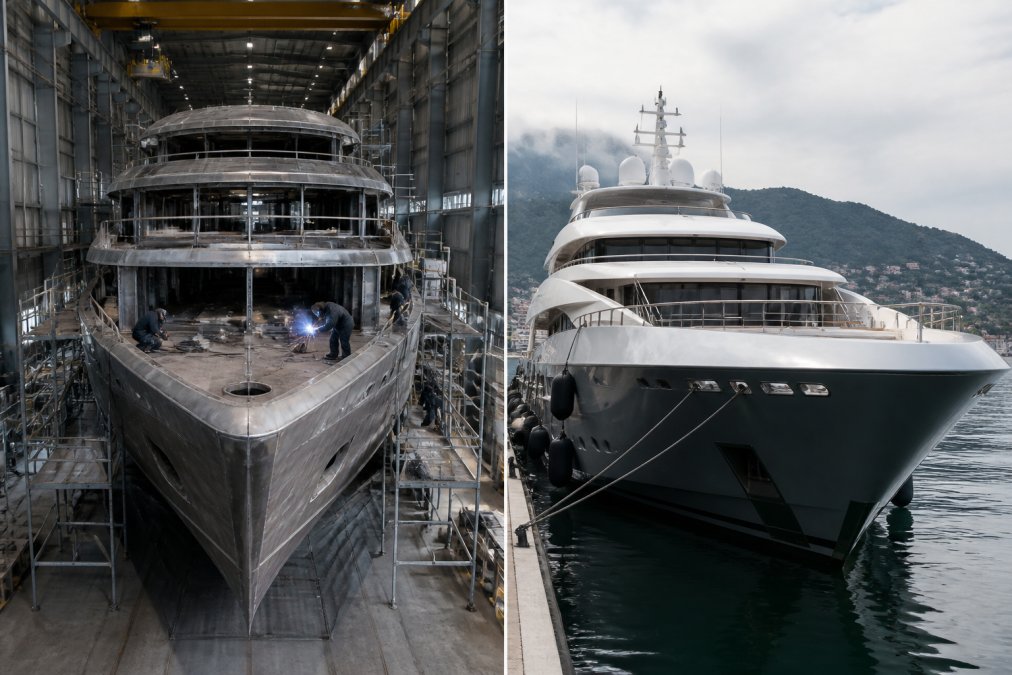
New-build yachts suit buyers who can tolerate 4-5 year timelines in exchange for complete customization. Brokerage purchases suit buyers who prioritize speed, known costs, and immediate use.
Yacht Survey and Inspection Checklist for Pre-Owned Vessels
Purchasing a pre-owned superyacht without a comprehensive independent survey is financial recklessness. A proper yacht survey examines the vessel’s structural integrity, mechanical systems, electrical infrastructure, safety equipment, and regulatory compliance.
A qualified marine surveyor, certified by organizations such as the Society of Accredited Marine Surveyors, conducts a systematic inspection including above-water hull examination, underwater hull inspection (requiring haul-out), engine and propulsion system evaluation, electrical and plumbing systems testing, and safety equipment verification.
Critical inspection points include:
Hull integrity: Cracks, corrosion, osmotic blistering, and structural stress indicate serious problems. Underwater ultrasonic thickness testing reveals hidden corrosion.
Engine and propulsion: Engine hours, maintenance records, and performance testing reveal whether the vessel has been properly maintained.
Electrical systems: Outdated wiring and inadequate capacity for modern electronics create fire and safety risks.
Plumbing and freshwater systems: Seawater intrusion, corroded pipes, and contaminated water systems are common in older vessels.
Safety equipment: Life rafts, fire suppression systems, and emergency beacons must meet current international maritime standards.
Regulatory compliance: Verify that the vessel holds valid certifications from its classification society (DNV GL, Lloyd’s Register, ABS, etc.).
Never skip the haul-out inspection. A vessel can appear immaculate above water while suffering serious corrosion or structural damage below the waterline.
Crew Recruitment and Management in the Middle East
A superyacht without a skilled, professional crew is a floating liability. Crew quality directly determines guest safety, vessel maintenance, and your enjoyment of the yacht.
International maritime labor standards (ILO Maritime Labour Convention) establish minimum crew qualifications, working hours, accommodation standards, and employment protections. Your crew must hold valid certifications: the captain and officers require specific maritime licenses; engineers require marine engineering certifications; deckhands and stewards require basic safety training.
The captain is your yacht’s most critical hire. The captain manages all crew, ensures regulatory compliance, maintains the vessel’s seaworthiness, and represents your interests to port authorities.
Crew recruitment in the UAE typically occurs through specialized maritime staffing agencies. These agencies maintain databases of qualified candidates, conduct background checks, and handle employment documentation. Alternatively, you can recruit through international maritime training institutions or networks.
Crew retention is challenging in the superyacht industry. Competitive salaries, professional development opportunities, and clear career progression reduce turnover. Many successful owners offer crew bonuses based on guest satisfaction scores and foster a culture of professionalism.
The cost of crew extends beyond salaries. You must provide accommodation (crew quarters must meet ILO standards), meals, uniforms, training, and medical insurance. ILO standards require that crew members receive minimum leave: typically one day off per week and extended leave for contract fulfillment.
Crew turnover is expensive. Recruiting and training new crew members costs significantly per person. Investing in crew satisfaction and professional development yields significant returns through reduced turnover and improved vessel operations.
Tax Implications, VAT Status, and Financial Planning
The tax treatment of superyacht ownership varies dramatically based on your residency status, the vessel’s flag state, your ownership structure, and your jurisdiction’s specific maritime tax regulations. This complexity demands professional tax and legal counsel before purchase.
UAE residents face different tax obligations than expatriates or non-residents. If you’re a UAE national or resident, you may be subject to corporate tax on charter income (if applicable), and your ownership structure influences personal liability and tax exposure. Non-UAE residents may benefit from more favorable tax treatment, particularly if the vessel is registered under a flag of convenience.
VAT (Value Added Tax) in the UAE is levied at 5% on the supply of goods and services, including yacht purchases and charter services. However, VAT treatment for superyacht purchases can be complex, particularly for non-residents or vessels intended for commercial charter. Consult with a UAE tax advisor familiar with maritime transactions to understand your specific VAT obligations.
Charter income, if you intend to offset ownership costs by chartering the yacht commercially, is subject to taxation in your jurisdiction of residence. Additionally, charter activities trigger specific maritime regulatory requirements and insurance implications.
Professional maritime tax planning can save substantially through optimal ownership structuring, VAT planning, and charter income optimization. Engage a tax advisor experienced in maritime transactions before finalizing your purchase.
| Consideration | Impact | Action Required |
|---|---|---|
| Ownership structure | Tax liability, asset protection, charter eligibility | Consult maritime legal counsel |
| Flag state | Regulatory compliance, tax treatment, crew standards | Confirm flag choice before purchase |
| Charter intentions | Income tax, commercial licensing, insurance | Clarify usage plan with tax advisor |
| Residency status | VAT obligations, personal tax liability | Document residency for VAT purposes |
| Corporate vs personal ownership | Liability protection, tax efficiency | Structure entity before purchase |
Buying a superyacht is a sophisticated financial and legal undertaking that demands professional guidance at every stage. The most successful purchases result from clarity about your actual usage needs, realistic budgeting for operating expenses, and proper structuring of ownership and crew management. Palm Lifestyle specializes in guiding discerning clients through every phase of yacht acquisition, from defining requirements and conducting technical inspections to structuring ownership and managing the transition to active use. Our team combines deep maritime expertise with understanding of GCC regulatory requirements and Middle Eastern business practices. Get in touch with us to discuss your superyacht acquisition and ensure you’re making an informed decision backed by professional guidance.
Frequently Asked Questions
What are the primary legal requirements for registering a superyacht in the UAE?
UAE vessel registration requires submission of technical specifications, proof of ownership, maritime insurance, and compliance with UAE maritime authority standards. The flag state registration process involves classification society approval and adherence to international maritime law conventions. You must also provide evidence of VAT status and crew documentation. A maritime legal counsel familiar with UAE regulations can guide you through the complete registration process and ensure all documentation meets local requirements.
What is the 10% rule for annual superyacht maintenance costs?
The 10% rule suggests that annual maintenance and operating expenses typically equal approximately 10% of the vessel's purchase price. For a superyacht, this covers crew salaries, fuel, insurance, marina berthing fees, technical surveys, refit schedules, and routine maintenance. Actual superyacht maintenance costs in the UAE may vary based on vessel size, age, displacement hull type, and usage patterns. Budget higher percentages for older vessels or those requiring specialized refit work.
What are the key differences between buying a new-build versus a brokerage superyacht?
New-build yachts offer customization, latest naval architecture, and extended warranties but involve longer delivery timelines and capital expenditure upfront. Brokerage vessels are immediately available with proven track records and lower initial costs, but may require unexpected maintenance and refit. New builds allow you to specify LOA, gross tonnage, and systems to match your needs exactly. Brokerage purchases require thorough technical surveys and sea trials. Each option suits different timelines and budgets.
How can I generate revenue from my superyacht to offset ownership costs?
Charter management is a proven strategy to offset operating expenses. By placing your superyacht on the charter market during periods you don't use it, you can generate significant revenue. Professional yacht management companies handle booking, crew coordination, maintenance scheduling, and compliance. Charter income can offset 30-50% of annual OPEX depending on vessel desirability, location, and seasonal demand. This requires selecting a reputable charter management partner and ensuring your vessel meets charter-market standards for safety and amenities.
External Sources
[EXTERNAL_LINK: International Labour Organization Maritime Labour Convention standards | ilo.org]
[EXTERNAL_LINK: UAE General Authority of Islamic Affairs vessel registration requirements | gaiae.ae]
[EXTERNAL_LINK: Lloyd’s Register superyacht classification and survey standards | lr.org]